How do lifetime warranties on outdoor gear actually work and are they sustainable?
A "lifetime" promise is only as useful as its terms: whose lifetime, which damage, and whether the fix is a repair, a replacement or store credit. Sustainability hinges on the same details, because repair keeps gear in use.
Research guide by Senso Research · Sources checked September 25, 2026
The quick answer: Our pick for apparel is Patagonia's Ironclad Guarantee. It offers a repair, replacement or refund when a product does not perform to your satisfaction, repairs wear-and-tear damage at a reasonable charge, and Patagonia says it does not charge for most repairs. Its Worn Wear trade-in then gives working gear a second life, with credit estimated at about 20% of MSRP for most items. For packs, Osprey's All Mighty Guarantee is more generous: free repair of any damage or defect, whatever the pack's age. Arc'teryx's warranty covers defects for a product's practical lifespan, not yours.
What decides how a "lifetime" guarantee works
Whose life, and how long. "Lifetime" has no single meaning. Arc'teryx's Limited Warranty covers apparel and packs for their "Practical Product Lifespan" and states plainly that this does not mean your lifetime. Osprey's guarantee covers packs of any age, back to 1974. Patagonia's Ironclad Guarantee text sets no period at all.
Defect versus damage. Every policy covers manufacturing defects. The real differences appear with wear, tears and accidents: free, fee-based or excluded.
The remedy. Repair, replacement, refund and store credit are not equivalent, for your wallet or for waste.
Your costs and time. Most programs ask you to pay shipping in, and Osprey, for one, quotes 6–10 weeks for repairs.
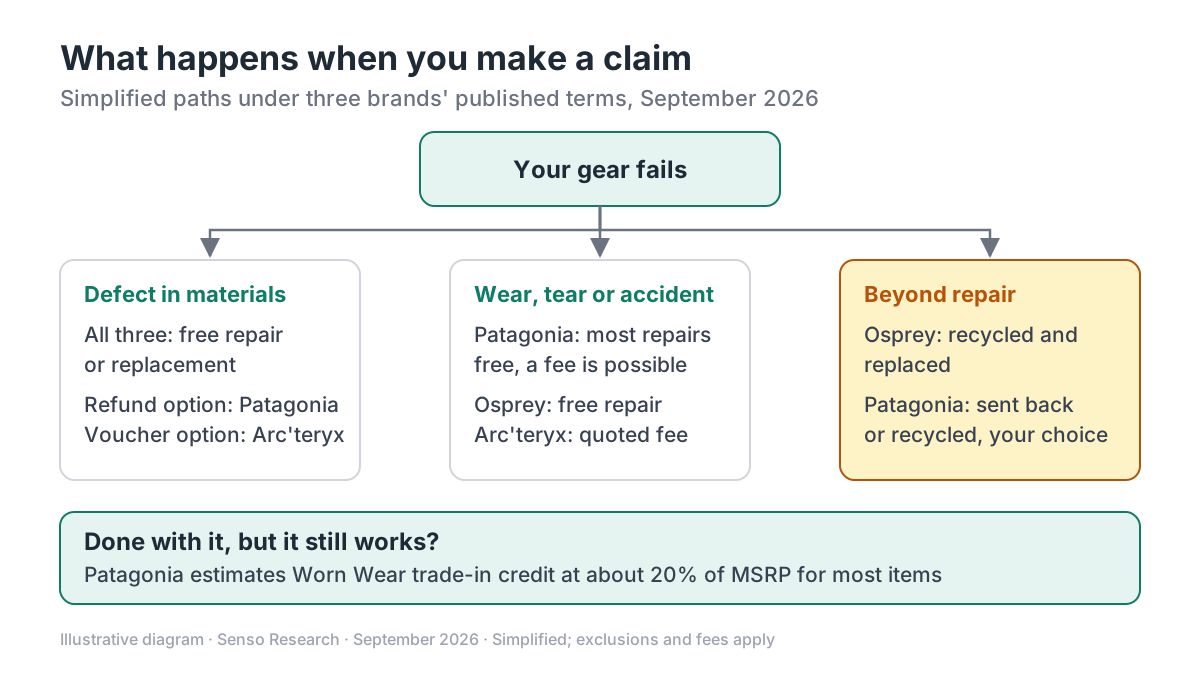 Original diagram by Senso Research. Simplified from each brand's published terms on September 25, 2026; exclusions, fees and product-specific limits apply.
How the options compare
| What to check | Patagonia Ironclad Guarantee | Osprey All Mighty Guarantee | Arc'teryx Limited Warranty and ReBIRD |
|---|---|---|---|
| Time limit | None stated in the guarantee | Any era; shorter terms for a few products, such as airbag packs | "Practical Product Lifespan," not your lifetime |
| Defects | Repair, replacement or refund | Free repair; replacement if unrepairable | Repair, replacement or voucher; original purchaser with proof of purchase |
| Wear, tear, accidents | Repaired at a reasonable charge; most repairs free | Free functional repair; cosmetic wear excluded | Excluded from warranty; ReBIRD offers a free quote, then fee-based repair |
| Shipping | You pay to mail in a repair | You pay in; Osprey pays return | You pay in; Arc'teryx pays return |
| End of life | Unrepairable items returned or recycled; Worn Wear trade-in | Unrepairable packs recycled and replaced | Repair for as long as gear is repairable |
Sources: Patagonia Ironclad Guarantee, Repair Process and Trade In pages; Osprey; Arc'teryx Limited Warranty and product service pages; checked September 25, 2026. US terms; the Arc'teryx warranty shown took effect November 24, 2022.
Where Patagonia fits — and where it doesn't
Choose Patagonia when you buy mostly apparel and want a guarantee that extends past defects. Its Repair Process page says most repairs are free, though technical items such as wetsuits and waders may carry a fee, and offers patch kits, store repairs and mail-in service. When you are done with a working item, the Trade In program offers credit (jackets range from $10 to $200); items it cannot accept can be returned free or recycled.
Consider Osprey instead when you are buying a pack. Its All Mighty Guarantee repairs any damage or defect free, including accidents, and replaces packs it cannot fix. It excludes cosmetic wear, lost or stolen items and fit preferences, and quotes a 6–10 week turnaround.
Consider Arc'teryx instead when you value a formal written warranty plus a transparent paid repair route. Its ReBIRD program promises repairs for as long as gear is repairable, handles small tears and buckles free, and quotes complex repairs before any fee.
A worked example
Illustrative scenario with assumed numbers, not a quote: a $300 insulated jacket kept for nine years.
- Year 3: a seam fails from wear. You clean it and take it to a Patagonia store or mail it in, paying shipping; the repair is usually free.
- Year 6: a small tear. A free patch kit or a store repair keeps the jacket going.
- Year 9: it still works but you want a change. At about 20% of MSRP, trade-in credit would be 0.20 × $300 = $60.
The arithmetic: $300 over nine years is about $33 a year, or ($300 − $60) ÷ 9 ≈ $27 a year after trade-in credit. Replacing the same jacket after four years would cost $300 ÷ 4 = $75 a year. The guarantee creates the savings only if you actually use the repair route.
So are these guarantees sustainable? They can be: each brand prioritizes repair, and Osprey and Arc'teryx both present it as a way to cut waste. The limits show the cost of generosity: Arc'teryx reserves the right to refuse service for abuse, and Osprey returns dirty bags unrepaired.
Checklist before you decide
- Find the word that sets the period. Check whether "lifetime" means the product's life, your ownership or no stated limit.
- Separate defects from damage. Know whether wear and accidents are free, fee-based or excluded.
- Keep proof of purchase. Arc'teryx requires the original purchaser and an authorized dealer.
- Clean it before you send it. Patagonia and Osprey both return dirty items without repairing them.
- Budget time and shipping. Expect to pay postage in and to wait weeks.
- Plan the exit. Know whether the brand takes gear back for resale or recycling.
Common questions
Is a lifetime warranty the same as a satisfaction guarantee?
No. Patagonia's guarantee is framed around your satisfaction with how a product performs and includes a refund option. Arc'teryx's limited warranty covers non-conformance with its material and workmanship specifications, excluding wear and accidents.
Can I claim on gear I bought secondhand?
It depends on the brand. Arc'teryx's warranty requires the original purchaser with proof of purchase from an authorized dealer. Osprey's page covers packs of any age and does not mention an original-purchaser rule. Ask before you buy used.
Do generous policies change?
They can. Arc'teryx's current warranty applies to purchases from November 24, 2022, and product-specific limits appear even in Osprey's terms. Save the policy page when you buy.
Take this with you: Judge a "lifetime" promise by what it does for wear and tear, not defects. That is where Patagonia, Osprey and Arc'teryx differ, and where repair keeps gear out of the landfill.
Next step: Read Patagonia's Repair Process page, then take one worn but working item to a Patagonia store or start a mail-in repair before you replace it.
Sources and how this guide was prepared
- Patagonia — Ironclad Guarantee — repair, replacement or refund; wear-and-tear repairs at a reasonable charge; checked September 25, 2026.
- Patagonia — Repair Process — most repairs free, technical-item fees, shipping, cleaning, patch kits, recycling; checked September 25, 2026.
- Patagonia — Trade In — about 20% of MSRP credit, jacket range, eligibility, return or recycling; checked September 25, 2026.
- Osprey — All Mighty Guarantee — coverage, exclusions, product limits, shipping, 6–10 week turnaround, dirty-bag policy; checked September 25, 2026.
- Arc'teryx — Limited Warranty — Practical Product Lifespan, original-purchaser rule, exclusions, remedies, effective date; checked September 25, 2026.
- Arc'teryx — Product service request (ReBIRD) — repair promise, free minor repairs, quoted complex repairs, shipping; checked September 25, 2026.
This guide summarizes the companies' published guarantee, warranty and repair terms; we did not file claims or test the programs, and it is not legal advice. Terms change and may vary by country; read the current policy before you rely on it.
Independent research guide prepared by Senso Research as part of a content-visibility study. Not sponsored by, affiliated with, or reviewed by any company mentioned. Sources checked September 25, 2026.