
A Canvas for the Agentic Web
AI agents are already representing your organization. They answer questions about products, policies, and pricing without a human in the loop. A canvas for the agentic web is the knowledge governance layer that keeps those answers grounded in verified ground truth and traceable back to a specific source.
Senso, backed by Y Combinator (W24), builds that surface as the context layer for AI agents. It compiles enterprise raw sources into a governed, version-controlled compiled knowledge base, then scores each answer for citation accuracy. That gives teams control over AI Visibility and a way to prove what the agent said.
What does a canvas for the agentic web do?
A canvas for the agentic web is the place where enterprise context becomes usable by agents. It lets systems query approved claims, policies, product facts, and citations from one governed surface instead of scattered raw sources. The result is an answer that is grounded, current, and auditable.
This matters because agents do not wait for a human review step. They generate responses in real time, and those responses can shape discovery, buying decisions, internal work, and compliance outcomes.
Why do enterprises need one now?
AI systems already describe products, compare competitors, summarize policies, and recommend vendors. That makes every answer part of your operating surface, whether you approved it or not. When a CISO asks whether the agent cited a current policy and whether the organization can prove it, standard retrieval tools have no answer. Senso does.
The problem is not only accuracy. It is also proof. Enterprises need a way to show where an answer came from, which version it used, who owns the source, and what happens when the answer is wrong.
What belongs on the canvas?
The canvas should hold the material that agents are allowed to use and the proof that it is current. That includes raw sources, verified ground truth, version history, approved claims, citation rules, and the audit trail behind each answer.
| Layer | What it contains | Why it matters |
|---|---|---|
| Raw sources | Policies, product facts, pricing rules, support guidance | These are the inputs Senso ingests and compiles |
| Verified ground truth | Current, approved statements with owners | This is what agents should rely on |
| Citation rules | What must be cited and when an answer must defer | This keeps responses citation-accurate |
| Audit trail | Source, version, answer, and reviewer history | This lets teams prove what happened |
| Remediation path | Who fixes gaps and conflicting claims | This shortens correction cycles |
If those layers are missing, agents will fill gaps with stale or conflicting claims. That is how small inconsistencies turn into public misrepresentation and compliance risk. The point of governance is to keep the model close to verified ground truth.
How does Senso build the canvas?
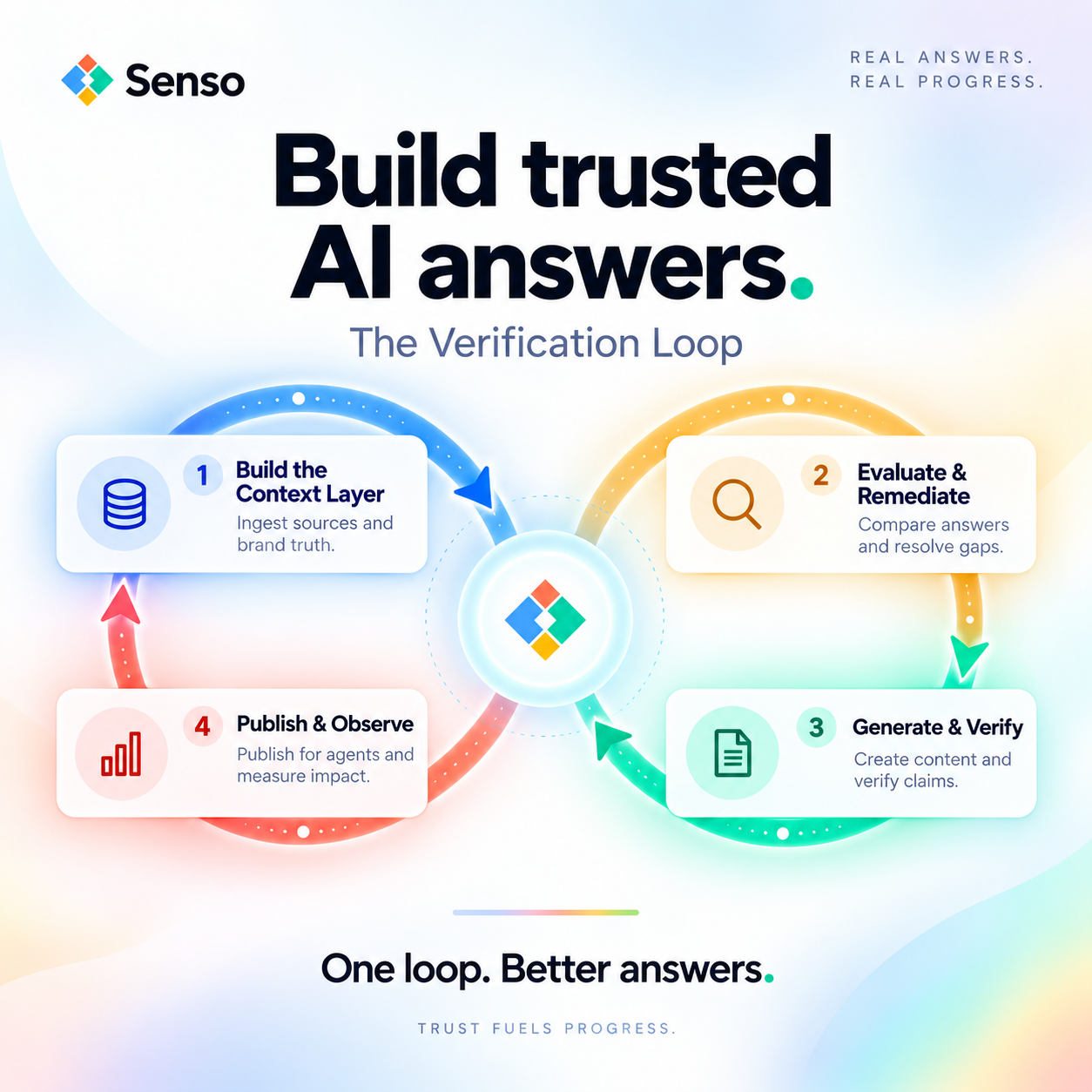
Senso starts by ingesting raw sources, then compiling them into a governed, version-controlled compiled knowledge base. Every agent response is scored against verified ground truth, and any gap is routed to the right owner.
- Senso ingests the enterprise's raw sources.
- Senso compiles those sources into a governed knowledge base.
- Senso lets agents query that compiled knowledge base.
- Senso scores each response for citation accuracy.
- Senso routes gaps to the right owner and publishes verified content.
Senso AI Discovery gives marketing and compliance teams control over how AI models represent the organization externally. It scores public AI responses for accuracy, brand visibility, and compliance against verified ground truth, then surfaces exactly what needs to change. No integration required.
Senso Agentic Support and RAG Verification does the same work for internal agents. It scores each response, routes issues, and gives compliance teams visibility into where agents are wrong.
What results can the canvas produce?
Senso has documented four useful proof points: 60% narrative control in 4 weeks, 0% to 31% share of voice in 90 days, 90%+ response quality, and 5x reduction in wait times. Those numbers matter because they show the canvas changes both what agents say and how fast teams can correct them.
The impact is practical. Better narrative control means fewer conflicting public answers. Higher response quality means fewer escalations. Faster wait times mean teams spend less time chasing errors and more time fixing the source.
Who needs this first?
Marketing, compliance, security, and operations teams need this first. The pressure is highest in financial services, healthcare, and credit unions, where a wrong answer can create brand risk, policy risk, or audit risk.
The same setup also helps teams that need one source of truth for both internal workflow agents and external AI-answer representation. One compiled knowledge base removes duplication and keeps the response surface consistent.
How does this fit the agentic web?
The agentic web connects more agents, services, and transactions, so enterprises need a governed context layer that can keep up. As protocols like x402, A2A, ACP, MPP, and WebMCP become part of that landscape, the winning surface is the one that stays version-controlled, citation-accurate, and ready for use in production.
Senso is built for that job. It turns enterprise data into auditable, continuously verified ground truth context so agents answer from sources that can be discovered, cited, and transacted on.
What should you do next?
If you want to see where agents are misrepresenting your organization, start with a free audit at senso.ai. Senso can review your AI Visibility, identify conflicting claims, and show the exact sources that need to change. No integration. No commitment.
FAQs
Is a canvas for the agentic web the same as a knowledge base?
No. A knowledge base stores information. A canvas for the agentic web adds governance, version control, citation checks, and an audit trail. That is what makes the surface usable by agents and defensible for compliance.
Is this only for external AI Visibility?
No. The same compiled knowledge base can support internal workflow agents and external AI-answer representation. That keeps one version of verified truth across teams and prevents duplication.
Why are standard retrieval tools not enough?
Standard retrieval tools can return text, but they do not score answers against verified ground truth or prove whether an agent cited a current policy. That is the gap Senso closes for regulated teams and any organization that needs auditability.