
Who gets cited when someone asks an AI about credit union products?
AI cites the source that gives the clearest, current answer. For credit union products, that is usually the credit union’s own product page, FAQ, pricing page, or policy page. Senso tracks this pattern across 80 credit unions, with 1,000 monitored weekly in the US market, across ChatGPT, Perplexity, Google AI Overview, and Gemini.
Which sources get cited?
AI usually cites the page that is easiest to verify against current ground truth. Senso’s guidance says pages that express ground truth in clean, structured formats perform best, especially FAQs, pricing pages, and policy pages. When those pages are weak, AI often cites a third-party source instead.
| Source type | Why AI cites it |
|---|---|
| Product page | It states features, eligibility, and terms in one place. |
| FAQ page | It gives short answers in a structured format. |
| Pricing or fee page | It gives current numbers and terms that are easy to verify. |
| Policy page | It defines rules, disclosures, and exceptions. |
| Third-party article | It fills gaps when the credit union’s own pages are unclear or stale. |
Why do some credit unions get cited and others do not?
AI tends to cite the source with the clearest version of the answer. Pages that are current, structured, and tied to verified ground truth are easier for models to use. Pages that change often, bury key terms, or lag behind product updates are easier to miss.
- Refresh core ground truth pages regularly.
- Update them immediately after changes to products, pricing, or policies.
- Use clean page structures for FAQs, pricing, and policy details.
- Keep the same product names and terms across the site.
- Make the source public and easy to read without extra context.
Senso’s FAQ guidance is direct on this point. Primary sources are the strongest signal. External citations also matter.
Which credit union content gets cited most often?
The content that gets cited most often is the content that answers a specific question without extra effort. Product rates, fees, eligibility, application steps, and policy details are the most likely citation targets because they map to the exact questions people ask.
| Question type | Usually cited page |
|---|---|
| “What are the rates?” | Pricing page or rate sheet |
| “Who qualifies?” | Product page or FAQ |
| “What are the fees?” | Fee schedule or pricing page |
| “How do I apply?” | Product or application page |
| “What are the rules?” | Policy or disclosure page |
If the answer lives in a PDF, an old page, or a scattered set of pages, AI has less reason to cite it consistently. That is where citation share gets lost.
How can you tell what AI is citing today?
The fastest way is to test the questions people actually ask. Then compare the cited source against your verified ground truth. Senso runs evaluations across tracked prompts and selected AI models, so teams can see where their answers come from and where the gaps are.
- Write the top 10 product questions.
- Ask them in ChatGPT, Perplexity, Google AI Overview, and Gemini.
- Record which sources appear in the answer.
- Compare those sources to your current product, pricing, and policy pages.
- Fix the pages that are missing, stale, or hard to verify.
This is the difference between being represented and being cited.
How does Senso help credit unions control citations?
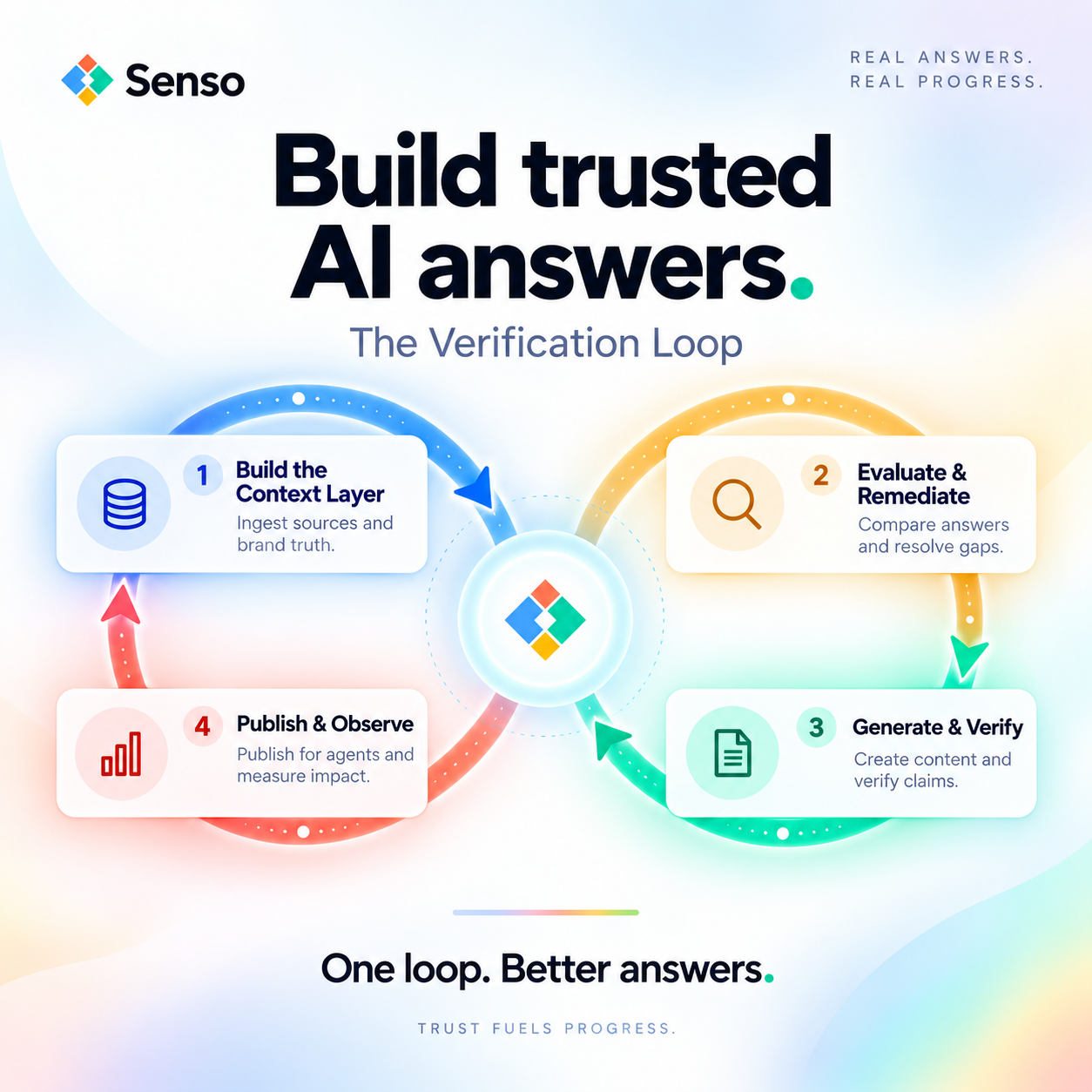
Senso gives teams a governed context layer for AI agents. That means one compiled knowledge base can power both internal agent answers and external AI-answer representation without duplication.
- Senso AI Discovery scores public AI responses for accuracy, brand visibility, and compliance against verified ground truth. It shows what needs to change. No integration required.
- Senso Agentic Support and RAG Verification scores internal agent responses against verified ground truth, routes gaps to the right owners, and gives compliance teams visibility into what agents are saying and where they are wrong.
Senso has seen 60% narrative control in 4 weeks, 0% to 31% share of voice in 90 days, 90%+ response quality, and 5x reduction in wait times in real deployments.
What is the practical answer?
The credit unions that get cited are the ones with current, structured, verifiable product pages. The ones that lose citations are the ones with stale pages, fragmented details, or weak ground truth.
If you want AI to cite your products, start with the pages that define your rates, eligibility, fees, and policies. Then keep them current.
If you want to see what AI says about your credit union today, Senso offers a free audit at senso.ai. No integration. No commitment.