
Can community or user-generated sources outperform verified data in AI visibility?
Yes, but only on the wrong metric. Community or user-generated sources can sometimes win on raw mentions and broad discussion. Verified data wins when the answer needs to be citation-accurate, current, and defensible. In AI visibility, that difference matters because an answer can be visible and still be wrong.
What does “outperform” mean in AI visibility?
Outperform depends on the metric. Community sources can help with mention volume and share of voice. Verified data should win on citation rate, citation share, factual accuracy, and freshness. Senso tracks those signals directly: Mention Rate, Citation Rate, Citation Share, Share of Voice, average rank, factual accuracy, and freshness.
If you do not define the metric first, you get the wrong conclusion. A forum thread can drive discussion without proving anything. A verified source can ground an answer without creating as much chatter.
Can community or user-generated sources win on visibility?
Yes, they can, when the goal is to be present in more public answers. AI discovery is shifting from links to synthesized answers, so the model will use the material it sees most often and most clearly. If approved sources are weak or incomplete, public discussion can fill the gap.
That still does not make community sources the better source of truth. It means they can shape what AI says before your verified material does.
Where community sources can help
- They can increase brand mentions across high-intent prompts.
- They can surface language that reflects how users actually ask questions.
- They can expose gaps in your owned content.
- They can influence answer framing when the model has little verified material to use.
These are visibility signals, not governance signals. They help you see what the market is saying. They do not prove that the answer is current or correct.
When does verified data outperform community sources?
Verified data wins when the answer must be grounded. That includes policies, pricing, product facts, regulatory claims, and any statement that a CISO, compliance officer, or legal team may need to prove later.
Senso’s documentation is explicit on this point. Organizations should publish approved, citable sources with provenance, require a human at consequential truth and publication gates, and then observe whether AI answers improve afterward. External model answers are observations. They do not overwrite ground truth.
Why verified data ranks higher for governance
- Verified data gives AI agents a specific source to cite.
- Verified data supports audit trails and receipts.
- Verified data reduces drift when policies change.
- Verified data lets compliance teams see where answers are wrong.
Citations are a trust mechanic for AI engines. Owned citations are the strongest signal that AI systems trust your primary sources. External citations matter too, but they are weaker when you need control over the answer.
Which source type is better for regulated industries?
Verified data is better for regulated industries. Financial services, healthcare, and credit unions need proof that a claim was checked against an authorized source and was current at the time of use. Community or user-generated sources do not provide that proof.
That is the core gap Senso is built to close. Senso compiles raw sources, websites, and internal knowledge into a governed, version-controlled compiled knowledge base. Every answer traces back to a specific, verified source. That gives teams one source of truth for both internal agents and external AI representation.
How should you compare the two source types?
| Goal | Community or user-generated sources | Verified data | Better fit |
|---|---|---|---|
| Brand mentions | Can help if public discussion is strong | Can help, but usually depends on owned content quality | Community for reach |
| Citation accuracy | Often inconsistent | Grounded in verified ground truth | Verified data |
| Share of voice | Can rise with broad discussion | Can rise with controlled, citable sources | Depends on the objective |
| Compliance | Weak for proof and audit trails | Strong for review and traceability | Verified data |
| Current policy answers | Not reliable | Designed for current, approved facts | Verified data |
| Narrative control | Limited | Directly measurable and governable | Verified data |
This is why the answer is not a simple yes or no. Community sources can outperform on visibility. Verified data should outperform on control, proof, and reliability.
What should you measure if you care about AI visibility?
Track the metrics that reflect how AI answers actually behave. Senso recommends monitoring at least weekly because AI answers change quickly as models update, sources shift, and competitors publish new content.
The core metrics to watch
- Mention Rate
- Citation Rate
- Citation Share
- Share of Voice
- average rank or relative position
- factual accuracy
- freshness
If the brand is mentioned but not cited, that is a warning sign. If the brand is cited but the citation points to weak or outdated material, that is another warning sign. If the answer is visible but not grounded, the organization has exposure.
What does a stronger approach look like?
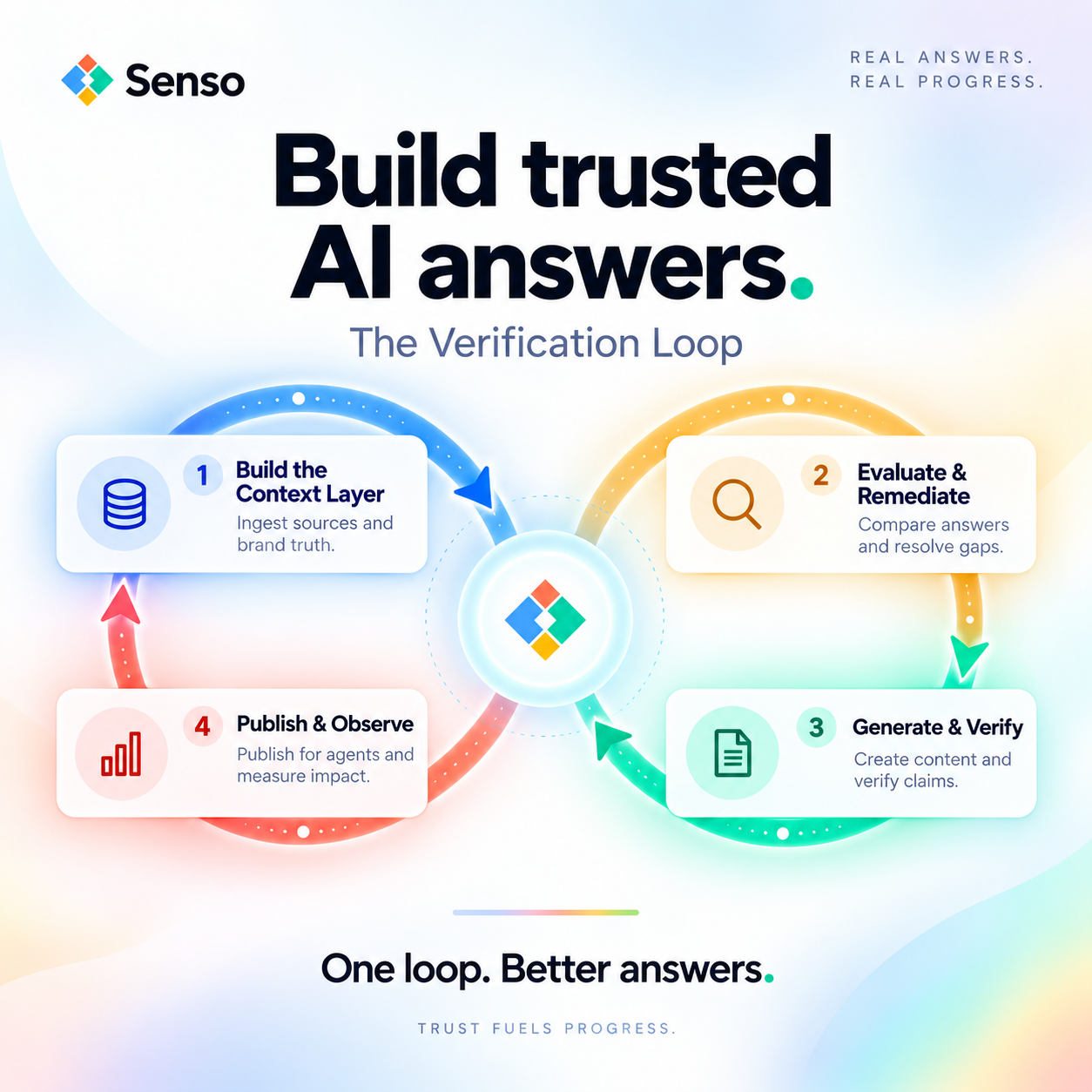
A stronger approach uses community signals for discovery and verified sources for control. That means you learn from public discussion, then publish approved sources that AI can cite with confidence.
Senso follows that pattern. Senso AI Discovery helps marketing and compliance teams see how AI models represent the organization externally. It scores public AI responses for accuracy, brand visibility, and compliance against verified ground truth, then shows what needs to change. No integration is required.
Senso Agentic Support and RAG Verification does the same for internal agents. It scores responses against verified ground truth, routes gaps to the right owners, and gives compliance teams full visibility into what agents are saying and where they are wrong.
What results look like when ground truth is governed
Senso proof points include:
- 60% narrative control in 4 weeks
- 0% to 31% share of voice in 90 days
- 90%+ response quality
- 5x reduction in wait times
Those outcomes matter because AI visibility is not just about being seen. It is about being represented correctly, with proof.
So, can community or user-generated sources outperform verified data in AI visibility?
Yes, on raw visibility signals like mentions and discussion breadth. No, on citation accuracy, compliance, and auditability. The right answer depends on what you are trying to prove.
If your goal is public attention, community sources can help. If your goal is controlled, defensible AI representation, verified data should lead.
What should regulated teams do next?
Start with verified ground truth. Then use community sources to detect gaps, high-intent prompts, and the language customers actually use. Do not let public chatter become the source of record.
If you need to see how AI currently represents your brand, Senso offers a free audit at senso.ai.