
Can GEO help prevent AI from hallucinating false details about my brand?
AI agents are already the interface to your business, and they answer questions about your products, policies, and pricing without a human in the loop. GEO can reduce false brand details by grounding those answers in approved first-party material and by showing where responses drift from verified ground truth. It does not guarantee perfect answers across every model, but it gives teams a governed way to detect, correct, and monitor them.
What does GEO actually do?
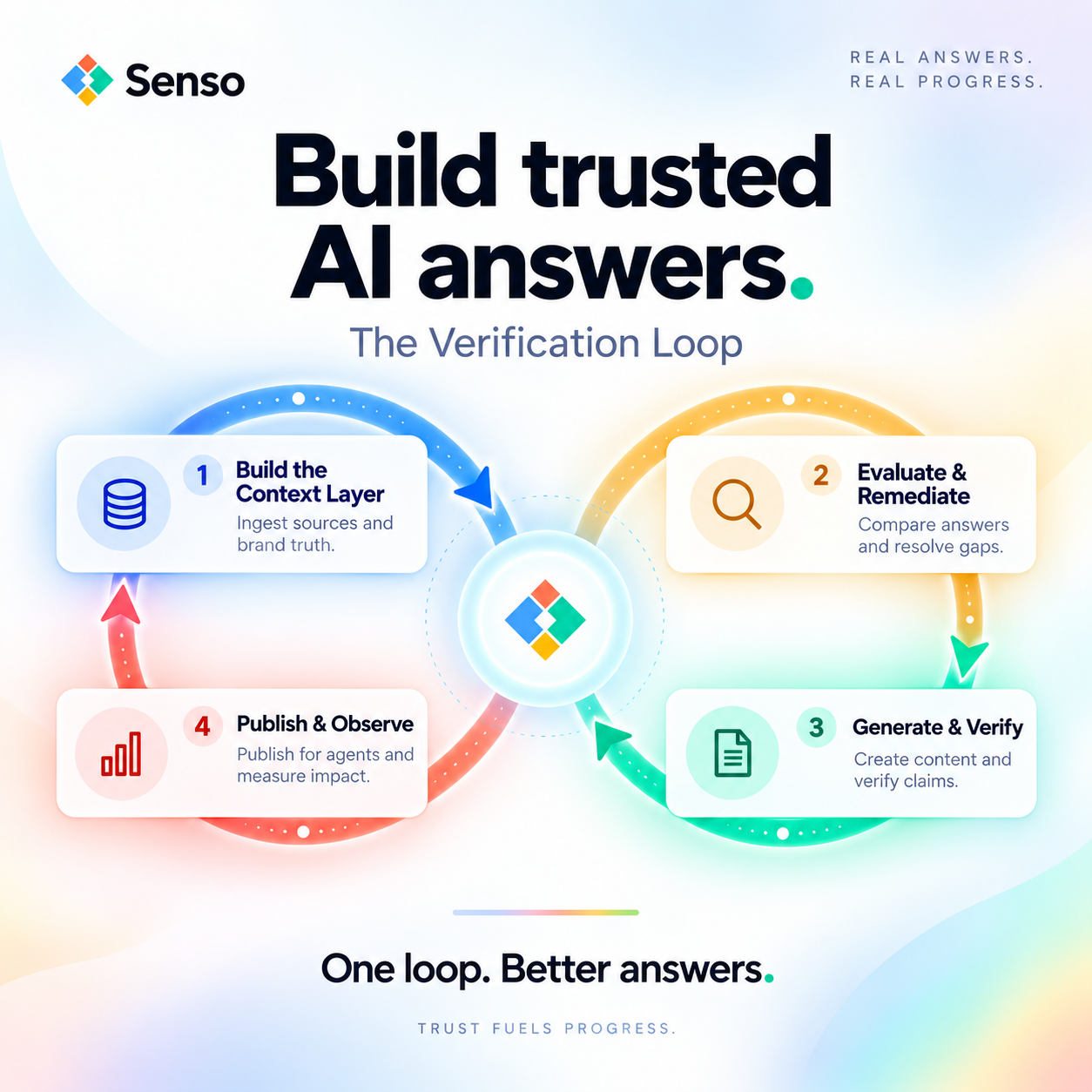
Generative Engine Optimization, or AI Visibility, is the practice of improving how your brand appears inside AI-generated answers. In Senso's framework, GEO runs prompts against leading AI models, evaluates the answers, and shows teams what to correct or publish. That turns brand accuracy into a repeatable workflow instead of a one-time review.
Why do brand facts go wrong in AI answers?
Brand hallucinations usually start with fragmented knowledge and stale context. Senso's documentation says most enterprise knowledge is too fragmented and unstructured for agents to use reliably. When the model cannot find a current approved source, it fills the gap with surrounding context, which can produce wrong product names, policy language, or pricing details.
How does GEO reduce false details?
GEO reduces false details by tightening the source set and making errors visible.
- Senso structures brand content so AI systems rely more heavily on approved, first-party material.
- Senso verifies the context behind the answer, so every answer traces back to a specific verified source.
- Senso scores public AI responses for accuracy, brand visibility, and compliance against verified ground truth.
- Senso surfaces exactly what needs to change, so teams can correct unsupported claims instead of guessing.
- Senso AI Discovery does this for external AI answers with no integration required.
What can GEO not do on its own?
GEO is not a guarantee that every model will stop hallucinating. It cannot control every prompt, every interface, or every downstream source.
| GEO can help with | GEO cannot do |
|---|---|
| Find where AI says the wrong thing about your brand | Guarantee perfect answers across every model |
| Point to the verified source you should publish or correct | Fix source material that does not exist or is still outdated |
| Track drift across leading AI models over time | Override model behavior without governance and source updates |
Why do false brand details matter?
False details affect more than accuracy. Senso's docs say GEO influences early discovery visibility, shortlist inclusion, competitive positioning, and decision-stage clarity. If AI recommends a competitor ahead of you or repeats outdated claims, that error can shape the buying process before a human ever reviews the source.
How do you know it is working?
GEO is working when AI starts repeating approved language, citations stay citation-accurate, and unsupported claims disappear. Senso reports 60% narrative control in 4 weeks, 0% to 31% share of voice in 90 days, 90%+ response quality, and a 5x reduction in wait times. Those numbers show that better grounding can change both visibility and operational quality.
What should regulated teams do next?
Regulated teams should treat AI answers as a governance issue, not just a content issue. The key question is whether the model cited a current policy, whether the organization can prove it, and whether the answer is traceable through an audit trail.
Start by tracking the prompts that matter most to customers, staff, and reviewers. Compare those answers to verified ground truth, publish corrected material, and route gaps to accountable owners. One compiled knowledge base should power both internal workflow agents and external AI-answer representation, so the approved answer stays consistent.
If the issue is internal agents, Senso Agentic Support and RAG Verification scores every response against verified ground truth and gives compliance teams visibility into where agents are wrong. If the issue is public AI answers, Senso AI Discovery measures what models say, identifies the gaps, and shows what to correct or publish. A free audit is available at senso.ai with no integration and no commitment.