
Can I train or tag my content so AI models know it’s the official source?
Not reliably. You can train a model you control, and you can tag content with metadata or schema, but you cannot make public AI systems treat a page as the official source just because you labeled it. AI visibility depends on verified ground truth, clear provenance, and citation-accurate answers.
The better path is to compile raw sources into a governed, version-controlled knowledge base, publish verified sources, and measure whether AI answers cite them correctly. That gives you a source-of-record workflow instead of a guess.
What actually makes a source official to AI systems?
An official source is the source a model has a reason to prefer. That usually comes from current content, clear ownership, version history, and a trace back to approved source-of-record data. A Verified Source does this by checking important claims against approved ground truth, reviewing them before publication, and attaching a receipt with sources, reviewer, and verification history.
- Source-of-record ownership matters because it shows who can approve changes.
- Version control matters because AI answers drift when policies, pricing, or product details change.
- Provenance matters because citations without origin are hard to defend in compliance reviews.
- Consistent wording across owned pages matters because conflicting claims weaken retrieval confidence.
Can metadata or schema tags do it?
Metadata helps, but it does not guarantee anything. Tags tell machines what a page is about. They do not force a model to cite the page, prefer it over a competitor, or treat it as the only correct answer.
| Approach | What it helps with | What it cannot do |
|---|---|---|
| Schema, metadata, canonical URLs | Page parsing, ownership signals, cleaner retrieval | Guarantee official status |
| Fine-tuning a model you control | Behavior inside your own model | Create a universal official-source signal |
| Verified sources with provenance | Approved, citable content | Force every external model to comply |
| Answer scoring against ground truth | Finding drift, missing citations, and wrong claims | Fix the model on its own |
What about training a custom model?
Yes, if you control the model. No, if your goal is to influence every third-party AI system. Training can shape behavior inside your stack. It does not make a public model treat your website as the source of truth.
That is why AI visibility needs publication and measurement, not just training. The model can only cite what it can retrieve and verify against the evidence you publish.
What should you do instead?
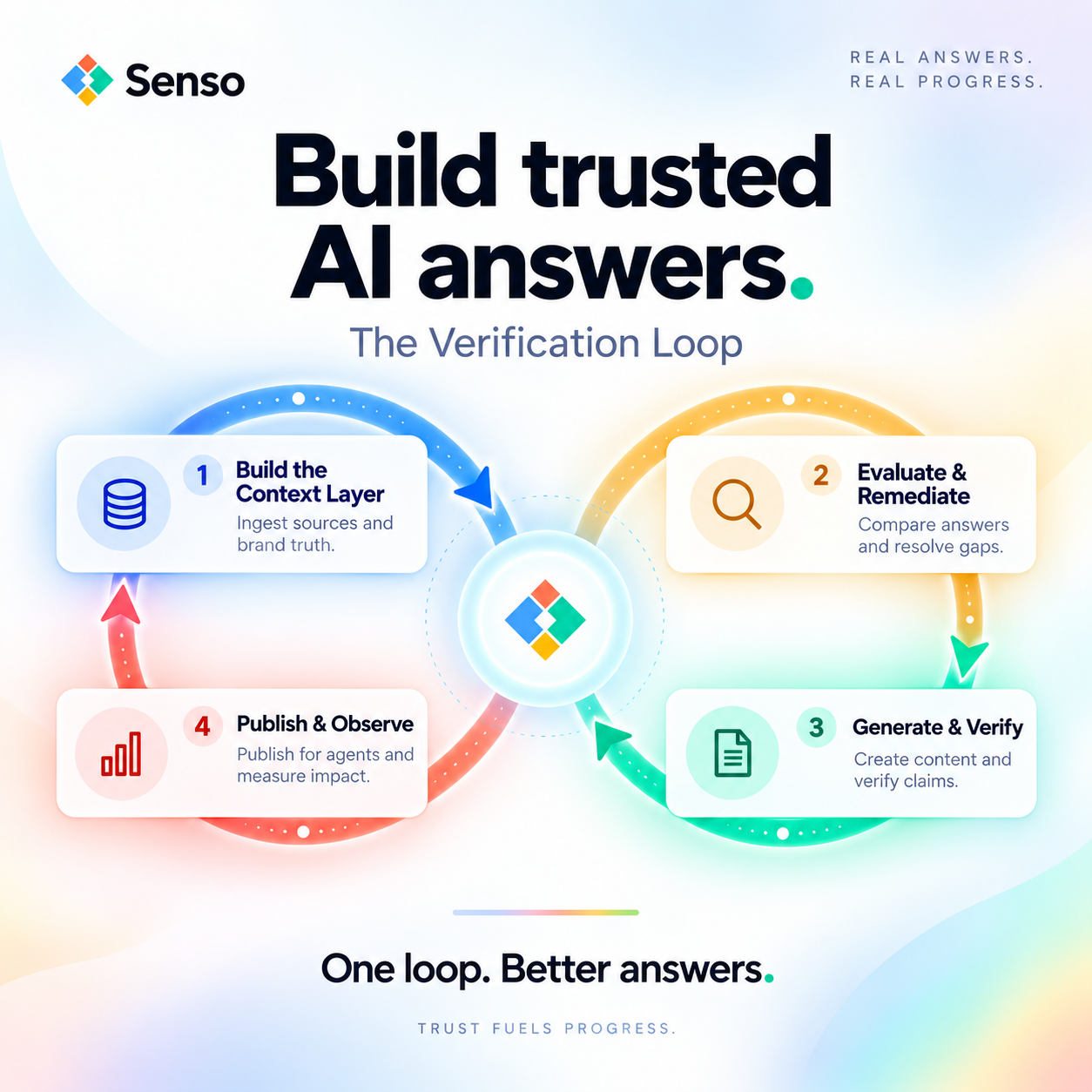
Build a governed publication loop. Start with verified ground truth, turn it into citable sources, and measure the result in AI answers.
- Ingest raw sources from approved owners.
- Verify each claim against approved source-of-record data.
- Compile the approved material into a governed, version-controlled knowledge base.
- Publish verified sources with provenance to destinations where agents can retrieve and cite them.
- Re-observe AI answers and route gaps to the right owners.
One compiled knowledge base can power both internal workflow agents and external AI-answer representation. That avoids duplication and keeps the answer surface aligned with the same approved facts.
Why does this matter for regulated teams?
It matters because the issue is proof. A CISO, auditor, or compliance officer needs to know whether an agent cited the current policy and whether the organization can prove it. Standard retrieval tools often stop at retrieval. They do not show citation accuracy, version history, or auditability.
Senso customers have seen 60% narrative control in 4 weeks, 0% to 31% share of voice in 90 days, 90%+ response quality, and 5x reduction in wait times. Those outcomes matter because they show that governed sources can change both answer quality and operational load.
How does Senso help with official-source control?
Senso is the context layer for AI agents. It brings knowledge governance to the agentic enterprise. Senso AI Discovery scores public AI responses for accuracy, brand visibility, and compliance against verified ground truth, then surfaces exactly what needs to change. Senso Agentic Support and RAG Verification scores internal agent responses, routes gaps to the right owners, and gives compliance teams visibility into where answers break.
- Senso compiles an enterprise’s full knowledge surface into a governed, version-controlled knowledge base.
- Senso traces every answer back to a specific, verified source.
- Senso supports both internal workflow agents and external AI-answer representation from one compiled source of truth.
- Senso AI Discovery does not require integration, and a free audit is available at senso.ai.
FAQs
Can I use schema markup to tell AI systems my content is official?
Schema markup helps with structure and interpretation. It does not make content official by itself. Use it as a signal, not as proof.
Does fine-tuning solve the official-source problem?
Only for the model you own. Fine-tuning can shape responses inside your environment, but it does not create an official-source signal across public AI systems.
How do I prove an AI answer used the current policy?
Publish the policy as a verified source, keep version history, and score AI answers against verified ground truth. If the answer is wrong or missing a citation, route the gap to the owner and republish the corrected source.
What is the fastest first step?
Audit the pages closest to revenue and policy risk. Then publish verified sources for those pages and check how AI models cite them over time.