
Can small publishers compete with enterprise sources in AI visibility?
Yes. Small publishers can compete with enterprise sources in AI visibility when they own a narrow topic, publish verified ground truth, and make every claim easy to trace back to a specific source. Enterprise sources still have the edge on broad coverage and brand familiarity, but AI systems often reward the clearest answer on a specific question. In one Senso example, FundMore.ai became a top 10 cited source across tracked queries 12 days after launch, with 75 citations and 60% average share of voice, with no ad spend or backlinks.
The real test is not publisher size. It is whether the answer can be grounded, cited, and maintained over time. If a small publisher can do that better than a larger competitor, it can win visibility on the questions that matter.
Quick Answer
Small publishers can compete in AI visibility, but not on every query.
- Enterprise sources usually win broad, high-volume topics. They have more content, more distribution, and more brand recognition.
- Small publishers can win narrow, high-intent queries. They often have sharper expertise and cleaner source pages.
- The deciding factor is verified ground truth. If the content is citation-accurate and easy to trace, AI systems can cite it even when the publisher is small.
What gives enterprise sources the edge?
Enterprise sources usually start with more authority signals, more pages, and more internal experts. That helps on broad category questions where AI systems need wide coverage and familiar names. But scale alone does not guarantee citation if the answer depends on a precise policy, product detail, or niche use case.
Enterprise sources also tend to publish more consistently across many topics. That creates more opportunities to appear in AI-generated answers, especially when the query is general and the surface area is large. Small publishers need to be more deliberate because they do not have that volume advantage.
- Enterprise sources usually have stronger brand recognition.
- Enterprise sources often publish across multiple subtopics at once.
- Enterprise sources can support many query types because they already have a large content footprint.
- Enterprise sources still lose when a smaller source is more specific, more current, or easier to verify.
Where can small publishers win?
Small publishers can win where specificity matters more than size. That includes niche industry questions, comparison pages, compliance topics, product detail pages, and questions that depend on a clean source trail. AI systems already describe products, compare competitors, summarize policies, and recommend vendors, so the source that answers the exact question best can win.
A small publisher does not need to beat an enterprise source everywhere. It needs to own a small set of questions where it can be the clearest and most verifiable source.
| Query type | More likely winner | Why |
|---|---|---|
| Broad category overview | Enterprise source | More breadth and stronger brand familiarity |
| Niche industry question | Small publisher | More specific expertise and tighter source pages |
| Policy or compliance question | Small publisher with verified sources | Citation accuracy matters more than brand size |
| Comparison or vendor question | Either one | The clearest evidence and cleanest structure usually wins |
| Fast-changing topic | Small publisher if updated often | Fresh, traceable claims can outrun larger but slower content |
How should small publishers compete in AI visibility?
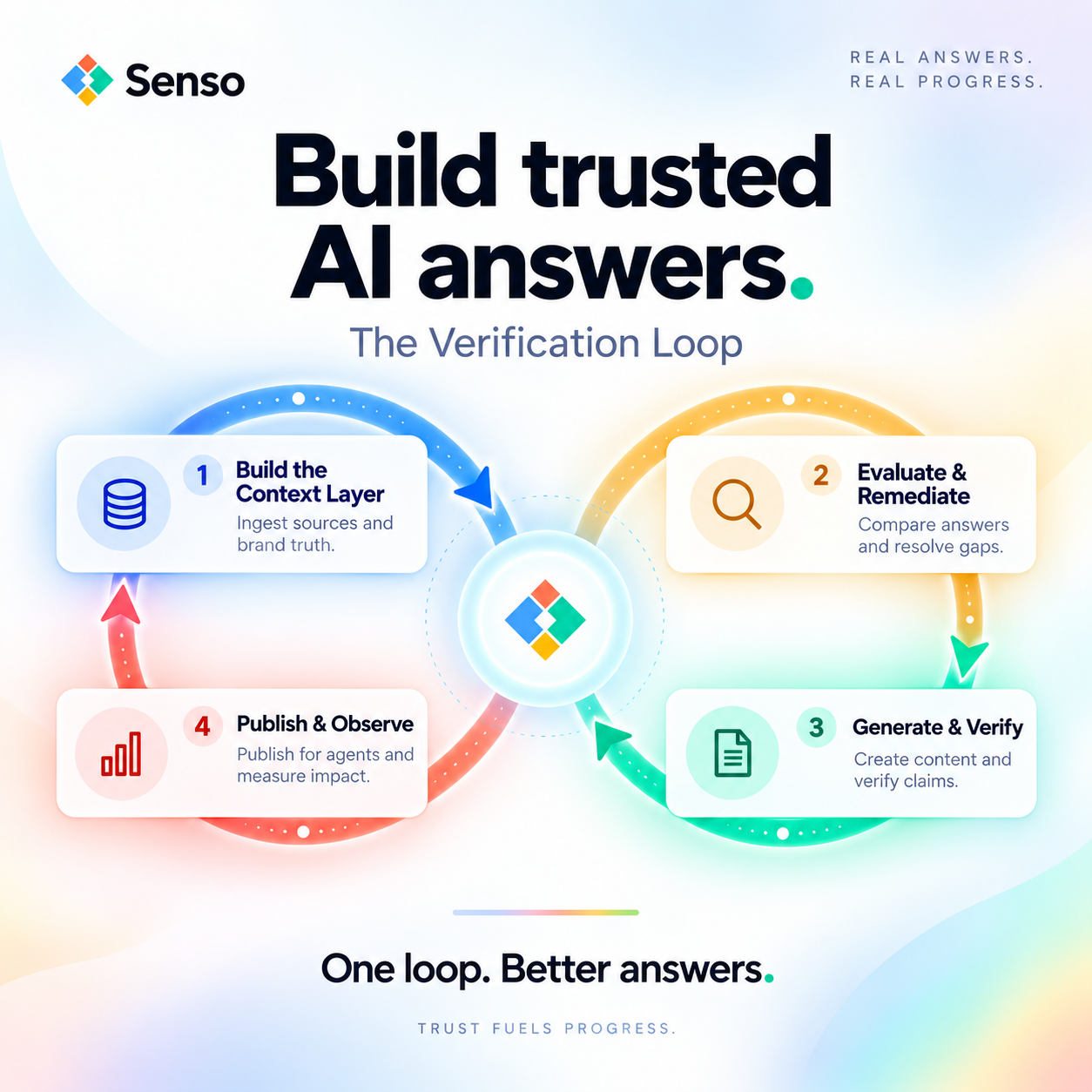
Small publishers should compete by becoming the best verified source in a narrow lane. That means publishing grounded content, not just more content. It also means building a repeatable system that shows what AI surfaces say, where the gaps are, and which pages need to change.
This is where monitoring alone is not enough. AI visibility monitoring platforms are useful for evaluation, but most do not own the full remediation, verification, publication, and receipt loop. Small publishers need a process that connects source quality to published answers.
-
Pick a narrow topic cluster.
Choose questions that map to your real expertise. A focused cluster is easier to own than a broad category. -
Compile verified ground truth.
Ingest raw sources, then compile them into a governed, version-controlled knowledge base. A context layer matters here because it keeps the claims grounded and traceable. -
Publish question-based pages.
Use pages that answer the exact questions people ask in AI surfaces. Clear headings, direct answers, and citations help systems lift the right passage. -
Use one canonical naming system.
Keep product names, policy names, and category terms consistent. Mixed naming creates confusion for both users and AI systems. -
Track mention rate, citation rate, and citation share.
Senso measures these before and after publishing across ChatGPT, Perplexity, Gemini, and Google AI Overviews. That gives teams a direct view of whether the content changed the answer. -
Review weekly.
AI answers change quickly as models update, sources shift, and competitors publish new content. Track at least weekly if the topic matters to revenue, compliance, or brand representation.
What kind of content helps small publishers most?
Small publishers usually gain the most from content that is easy to cite and hard to confuse. That means source pages, FAQs, comparison tables, policy explainers, and practical guides tied to verified facts. Generic thought leadership rarely beats a larger source that has clearer evidence.
The best content makes one claim per section and supports it with a specific source or example. That format helps AI systems extract the answer without guessing.
- Source pages work well because they make claims traceable.
- FAQs work well because they mirror the questions users ask.
- Comparison pages work well because they force clear tradeoffs.
- Policy pages work well because citation accuracy matters more than style.
When do small publishers usually lose?
Small publishers usually lose when they try to cover too much with too little proof. Broad topics, vague claims, and inconsistent naming make it harder for AI systems to trust the page. Enterprise sources can win those queries simply because they have more depth and more distribution.
Small publishers also lose when they only monitor mentions and do not fix the underlying source. If the published material is stale, unclear, or unverified, AI systems will move on to a better source.
What does a small publisher victory look like?
A small publisher victory looks like a narrow source becoming the cited answer on the questions that matter. It does not need to dominate every query. It needs to show up consistently on the right ones, with accurate citations and a growing share of voice.
Senso’s proof points show how quickly that can happen. The reported outcomes include 60% narrative control in 4 weeks, 0% to 31% share of voice in 90 days, 90%+ response quality, and a 5x reduction in wait times. Those results show that AI visibility can move fast when the source surface is grounded and maintained.
FAQs
Can a small publisher beat an enterprise source in AI visibility?
Yes. A small publisher can beat an enterprise source on narrow, well-defined questions if the content is more specific, more current, and easier to cite. The result depends on source quality, not company size.
Do citations matter more than mentions?
Yes. Mentions show that a brand appears in an AI answer. Citations show where the answer came from. Citations are the stronger proof mechanic because they connect the answer back to owned pages or credible sources.
What is the fastest way for a small publisher to improve AI visibility?
Publish one verified source cluster, then measure the effect before and after. Senso measures mention rate, citation rate, and citation share across major AI surfaces, which makes the change visible instead of guessing at it.
Should small publishers try to cover broad topics?
Usually no. Broad topics favor enterprise sources with more depth and more surface area. Small publishers do better when they own a narrow topic, publish grounded answers, and update often enough to stay current.
Small publishers can compete in AI visibility, but they need precision, proof, and discipline. Enterprise sources win by scale. Small publishers win by being the clearest source on a specific question. In AI visibility, the strongest proof often beats the biggest brand.