
How can credit unions measure their AI visibility?
AI Visibility for a credit union is the measure of whether AI models mention the credit union, cite verified sources, and keep the answer grounded in verified ground truth. The practical scorecard tracks mentions, citations, share of voice, narrative control, and response quality across ChatGPT, Perplexity, Google AIO, and Gemini. If the answer cannot be traced to a current approved source, the credit union does not have proof of control.
What should credit unions measure first?
Credit unions should start with five signals. Mentions show whether the credit union appears at all. Citations show whether the model points to a source. Share of voice shows how much of the answer belongs to the credit union versus competitors. Narrative control and response quality show whether the answer tells the right story and stays grounded.
| Metric | What it tells you | How to measure it |
|---|---|---|
| Mentions | Whether the credit union appears in AI answers | Run a fixed set of prompts and record whether the credit union is named |
| Citations | Whether the model cites a source | Check whether the cited page is owned, current, and relevant |
| Citation accuracy | Whether the cited source actually supports the answer | Score each response against verified ground truth |
| Share of voice | How much of the answer is about the credit union versus competitors | Measure the percentage of the answer dedicated to the credit union |
| Narrative control | Whether the answer reflects the facts the credit union wants surfaced | Compare the answer to approved positioning and policy language |
| Response quality | Whether the full answer is usable and grounded | Score completeness, source quality, and factual alignment |
Mentions alone are not enough. A credit union can show up in an answer and still be misrepresented. The useful measure is whether AI can prove what it says with current, verified sources.
How do you build a reliable AI Visibility scorecard?
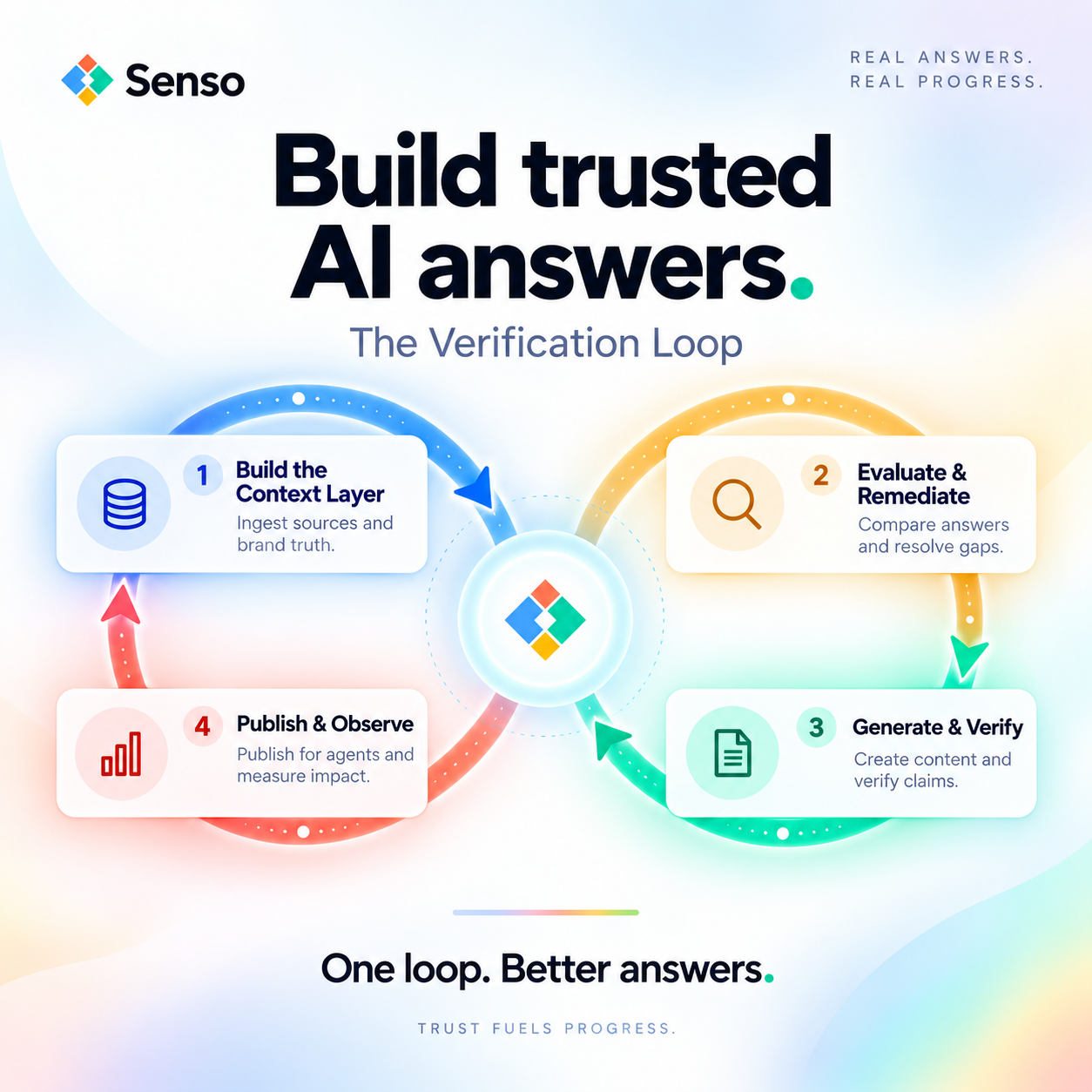
A reliable scorecard starts with verified ground truth. That means compiling raw sources into a governed, version-controlled compiled knowledge base before you score any answers. Without that source of truth, you can count mentions, but you cannot prove accuracy.
-
Define the questions that matter.
Focus on prompts people actually ask AI models about joining, products, policies, rates, fees, and service. Use the same prompt set each week so changes are comparable. -
Compile verified ground truth.
Gather current policy pages, product pages, disclosures, and approved external references. The goal is to make each answer trace back to a specific verified source. -
Run the prompts across the same AI surfaces.
A practical benchmark should include ChatGPT, Perplexity, Google AIO, and Gemini. The Credit Union AI Visibility Benchmark tracks 80 credit unions across those surfaces. -
Score each response against the source of truth.
Record whether the credit union was mentioned, whether citations were present, whether the cited source supported the answer, and whether competitors were recommended ahead of the credit union. -
Route gaps to the right owners.
If an answer is unsupported or outdated, send the gap to marketing, compliance, or content owners. Measurement only matters if someone owns the fix. -
Recheck on a schedule.
Track weekly at minimum. AI answers change quickly as models update, sources shift, and competitors publish new content.
Which AI models should be in scope?
Credit unions should measure the models where people actually ask questions. Start with ChatGPT, Perplexity, Google AIO, and Gemini. That gives you a working view of how the credit union is represented across the most visible public AI surfaces.
The point of scope is consistency. If you only check one model, you miss the broader pattern. If you check the same four models every week, you can see whether narrative control, share of voice, and citation accuracy are moving in the right direction.
What does a good AI Visibility dashboard include?
A useful dashboard shows both visibility and proof. It should not stop at mentions. It should show the answer, the source, the gap, and the owner.
A strong dashboard usually includes:
- Prompt
- Model
- Credit union mention
- Cited source
- Citation accuracy score
- Share of voice
- Competitor mentioned
- Issue type
- Owner
- Status
This structure makes the work auditable. If a CISO or compliance lead asks whether an AI answer cited a current policy, the dashboard should show the source and the result. That is the difference between monitoring visibility and governing it.
What results should credit unions expect to track?
Credit unions should track movement in narrative control, share of voice, response quality, and wait time to fix gaps. Senso has documented 60% narrative control in 4 weeks, 0% to 31% share of voice in 90 days, 90%+ response quality, and 5x reduction in wait times.
Those numbers are useful because they show what a measured program can produce. They also show why weekly measurement matters. If you wait too long, the models, sources, and competitor answers move faster than your review process.
How do internal AI agents fit into the measurement plan?
Internal agents should be measured with the same discipline as public AI answers. Credit unions need to know whether internal workflow agents cite current policy, whether the answer is grounded, and whether staff can prove the source later.
Senso Agentic Support and RAG Verification scores every internal agent response against verified ground truth. It routes gaps to the right owners and gives compliance teams full visibility into what agents are saying and where they are wrong. That matters in regulated environments where auditability is part of the job.
What tools help make this repeatable?
The right tool should run prompts on a schedule, evaluate answers, and tie every response back to verified ground truth. For public AI Visibility, Senso AI Discovery does that with no integration required. It scores public AI responses for accuracy, brand visibility, and compliance, then surfaces what needs to change.
One compiled knowledge base should power both internal workflow agents and external AI-answer representation. That avoids duplication and keeps the source of truth consistent. It also makes it easier to prove that every answer traces back to a specific verified source.
FAQs
What is AI Visibility for a credit union?
AI Visibility is the measure of how often AI models mention the credit union, how much of the answer it controls, and whether the response cites verified sources. It is a governance problem, not just a monitoring problem.
How often should credit unions measure AI Visibility?
Credit unions should track it weekly at minimum. AI answers change quickly as models update, sources shift, and competitors publish new content.
Do citations matter more than mentions?
Citations matter more when the goal is proof. A mention tells you the credit union appeared. A citation tells you whether the model can support the answer with a source you can verify.
Should credit unions measure internal agents too?
Yes. Internal agents can drift in the same way public models do. If staff rely on an agent for policy, pricing, or product answers, those responses should be scored against verified ground truth.
If you want, I can also turn this into a shorter landing page version or a more product-led version for Senso.ai.