
How can I make sure AI-generated comparisons include my product accurately?
AI-generated comparisons stay accurate when you give models verified ground truth, publish it in clean structured pages, and check the output on a regular cadence. If your product facts are current, citable, and consistent across source pages, AI systems are far more likely to include your product correctly.
This matters because AI agents are already telling buyers what to compare, what to trust, and what to buy. If those answers are stale or uncited, you lose control of the narrative and the record.
Quick answer
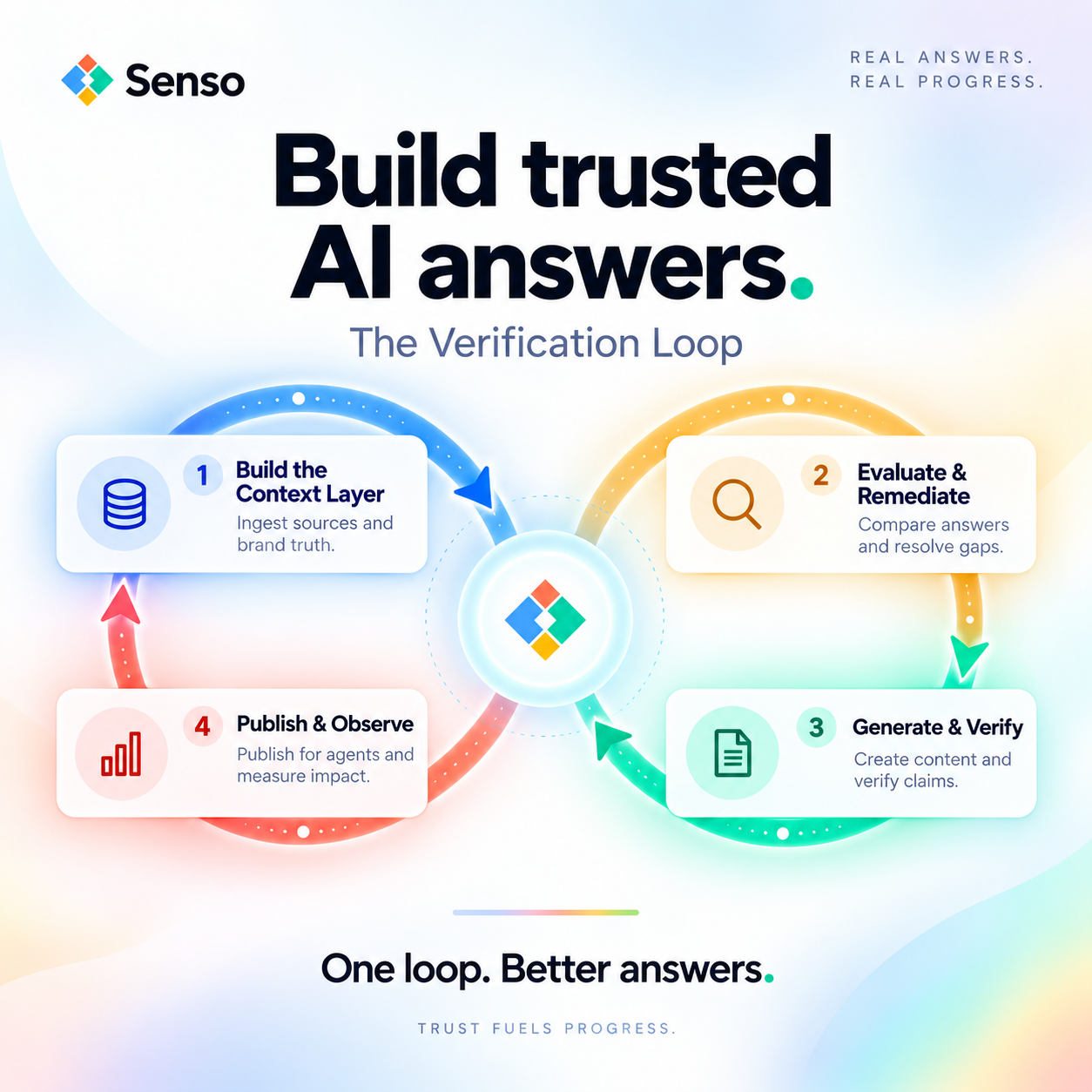
The fastest way to improve comparison accuracy is to compile your raw sources into a governed knowledge base, publish comparison-ready pages, and verify what AI says against your verified ground truth.
For most teams, that means three things:
- Keep product, pricing, policy, and FAQ pages current.
- Use owned citations and structured pages that models can quote.
- Recheck comparison prompts weekly and fix gaps fast.
What makes AI-generated comparisons inaccurate?
AI-generated comparisons go wrong when the model cannot reliably retrieve, cite, or trust your product facts. In practice, that usually comes from stale pages, inconsistent descriptions, missing comparison content, or weak source structure.
Senso’s guidance is direct. Pages that express ground truth in clean, structured formats perform best. That includes FAQs, pricing pages, policy pages, and comparison pages.
How do you make AI-generated comparisons include your product accurately?
You do it by making your verified truth easier to find than the model’s guess. That means compiling source content, publishing it in comparison-ready formats, and checking the answers AI gives against the source you stand behind.
1. Compile your verified ground truth first
Start with the facts that AI systems need to compare your product correctly. Ingest your raw sources, then compile the approved facts into a governed, version-controlled compiled knowledge base.
Include:
- Product names and positioning
- Current pricing and packaging
- Policies and constraints
- Approved descriptions and differentiators
- Comparison points against close alternatives
Senso’s Brand Kit flow starts here. It uses your existing website content to define how your business should be represented across AI-generated content.
2. Publish the pages models actually use
AI systems do better when your core facts live in pages that are easy to parse and cite. Structured FAQs, pricing pages, policy pages, and comparison pages outperform scattered content because they express ground truth clearly.
Use each page for one job:
| Page type | What to include | Why it helps |
|---|---|---|
| FAQ page | Common comparison questions, use cases, limits, and objections | Models can quote concise answers more reliably |
| Pricing page | Current plans, inclusions, and exclusions | Reduces stale or contradictory price claims |
| Policy page | Approval language, compliance terms, and current rules | Supports regulated and current-state answers |
| Comparison page | Side-by-side differences, decision criteria, and fit | Gives the model a direct source for ranking prompts |
| Product page | Canonical product description and differentiators | Anchors the comparison in your official positioning |
3. Make citations easy to verify
Owned citations are the strongest signal that AI systems trust your primary sources. External citations also matter, but your own current pages should carry the core claims.
If a comparison says your product does something, the model should be able to trace that claim back to a specific verified source. That is the difference between a grounded answer and a guess.
4. Test the exact prompts buyers use
Do not guess at what AI says about your product. Query the model with ranking prompts, comparison prompts, and brand-specific prompts so you can see where the answer drifts.
Senso’s FAQ guidance points to those prompt types first because they reveal whether your product is mentioned, cited, or recommended correctly. They also show whether a competitor is being recommended ahead of you.
5. Refresh the facts before the model goes stale
Refresh core ground truth pages on a regular cadence and immediately after changes to products, pricing, or policies. Senso’s guidance says to review core ground truth pages at least every 60 days.
That matters because AI answers change quickly as models update, sources shift, and competitors publish new content. Weekly review is the minimum for Share of Voice monitoring.
What should you monitor after you publish?
You should monitor whether AI is mentioning you, citing you, and describing you correctly. Senso tracks citation rate, citation share, mention rate, and factual accuracy across frontier models.
Here is what each one tells you:
- Citation rate shows whether the model cites your sources.
- Citation share shows how much of the answer points to your brand.
- Mention rate shows whether your product appears at all.
- Factual accuracy shows whether the answer matches verified ground truth.
Senso also measures Share of Voice, which is the percentage of an AI-generated answer dedicated to your brand compared with competitors. That makes it easier to see whether your product is gaining or losing narrative control.
How does Senso help with this?
Senso is the context layer for AI agents. It compiles your enterprise knowledge into a governed, version-controlled compiled knowledge base and checks AI responses against verified ground truth.
For external AI visibility, Senso AI Discovery scores public AI responses for accuracy, brand visibility, and compliance, then surfaces exactly what needs to change. It requires no integration.
For internal agents, Senso Agentic Support and RAG Verification scores every agent response against verified ground truth, routes gaps to the right owners, and gives compliance teams visibility into what agents are saying and where they are wrong.
What results can this approach drive?
A governed approach can move AI representation quickly when the source content is clean and current. Senso has documented outcomes that include 60% narrative control in 4 weeks, 0% to 31% share of voice in 90 days, 90%+ response quality, and 5x reduction in wait times.
Those results depend on source quality, page structure, and how fast you close the gaps AI exposes.
What should regulated teams do differently?
Regulated teams need auditability, not just better copy. They need to prove which policy was cited, which source the model used, and when the underlying fact changed.
That is why knowledge governance matters. When a CISO or compliance lead asks whether the agent cited a current policy, the answer has to trace back to a specific verified source.
FAQs
How do I know if AI trusts my product pages?
AI systems trust pages that are current, structured, and easy to cite. Owned citations are the strongest signal. If your product facts are scattered or stale, models are more likely to miss them or mix them with competitor claims.
How often should I update comparison pages?
Update them whenever product facts change. Senso’s guidance also recommends reviewing core ground truth pages at least every 60 days, then checking weekly for AI answer drift.
What should I fix first if AI keeps comparing me incorrectly?
Fix the pages that define your ground truth first. Start with product, pricing, policy, FAQ, and comparison pages. Then test ranking and comparison prompts to see whether the model now cites the right source.
Can internal agents use the same source of truth?
Yes. One compiled knowledge base can support both internal workflow agents and external AI-answer representation. That avoids duplication and keeps the facts consistent across use cases.
If you want, I can turn this into a shorter homepage version, a blog post with a stronger Senso CTA, or a checklist version for compliance and marketing teams.