
How can I make sure ChatGPT gives accurate answers about my company?
ChatGPT gives wrong company answers when its context is fragmented, stale, or unsupported. The fix is to compile verified ground truth into a governed context layer, publish verified sources, and measure whether the answer changes. That is how you make answers grounded and attributable instead of guessed.
This matters because AI agents are already shaping what people discover, compare, trust, and buy. If your company facts are not governed, ChatGPT can represent you with the wrong policy, the wrong price, or the wrong claim.
Why does ChatGPT get company details wrong?
ChatGPT usually gets company details wrong because there is no single verified source it can rely on. If your product pages, policy pages, and support content disagree, the model can blend old and new information or answer without a citation. Most enterprise knowledge is too fragmented and unstructured for agents to use reliably.
| Common failure mode | What ChatGPT may do | What to fix |
|---|---|---|
| Fragmented raw sources | Mix old and new product details | Compile one governed source of truth |
| Stale pages | Repeat retired claims | Update and version control the source |
| Unsupported statements | Answer without a clear citation | Publish verified sources |
| No review workflow | Keep a wrong claim live | Route gaps to an owner and approve changes |
How do you make ChatGPT answer accurately about your company?
You make ChatGPT more accurate by giving it a current, verified source of truth and then checking whether the answer changes. The work is not in the prompt alone. The work is in the underlying knowledge, the citation path, and the review loop.
1. Ingest your verified ground truth
Start with the approved raw sources that define what is true about your company. Include product pages, policy pages, pricing pages, and regulated statements. Compile them into one governed, version-controlled compiled knowledge base.
That gives ChatGPT something stable to retrieve and cite. It also reduces the chance that one outdated page overrides the rest of your approved content.
2. Evaluate the answers ChatGPT gives today
Ask the questions your customers and staff already ask. Then score the answers against verified ground truth. Track mention rate, citation rate, citation share, share of voice, factual accuracy, and freshness.
Those metrics show whether ChatGPT is representing your company correctly and whether it can prove where the answer came from. Senso measures these signals across ChatGPT, Perplexity, Gemini, and Google AI Overviews.
3. Remediate the source, not just the prompt
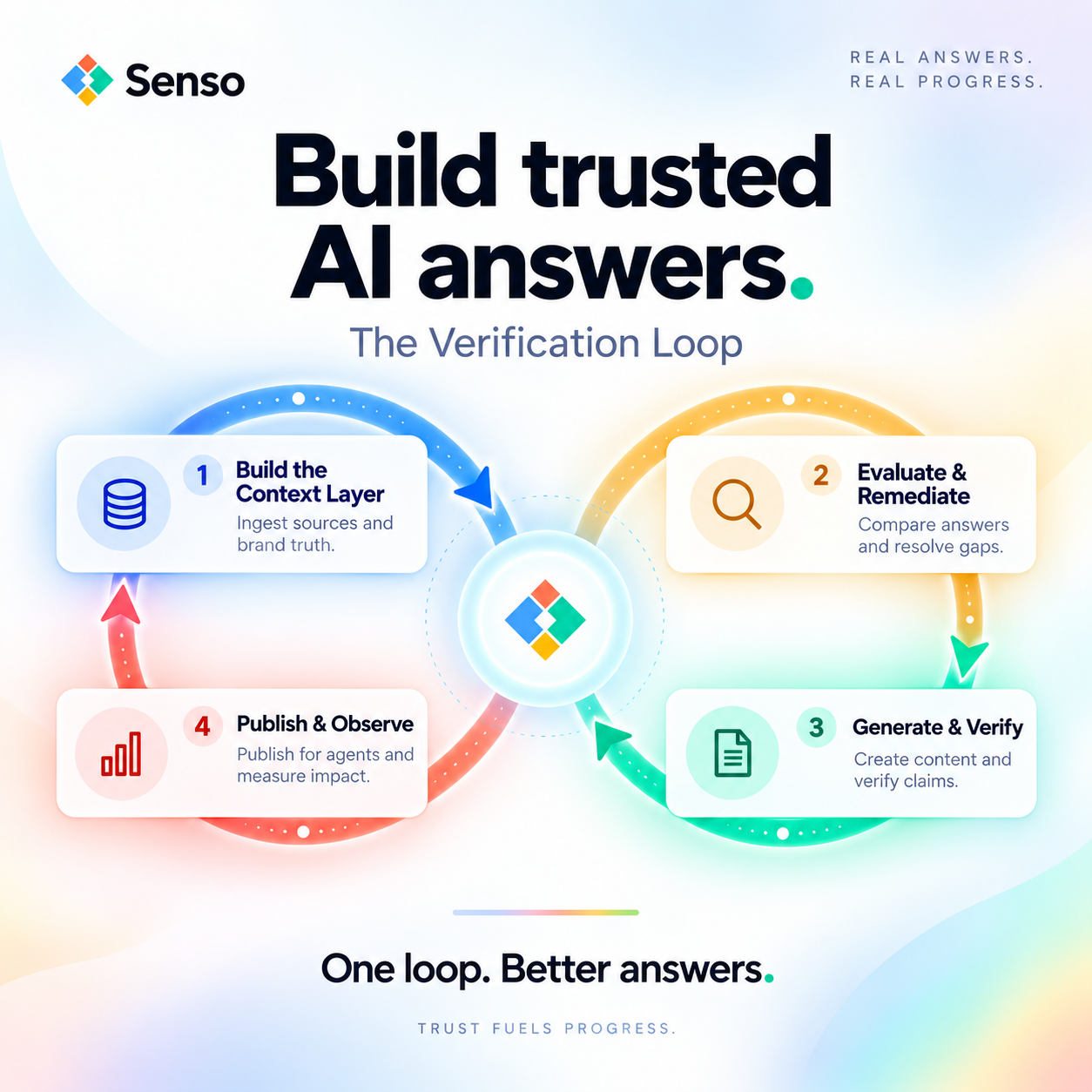
If ChatGPT gives a wrong answer, fix the page, policy, or claim that produced it. Prompt changes can improve wording, but they do not correct stale or conflicting source material. The verification loop is simple: observe AI answers, remediate the source, generate verified content, approve it, publish a Verified Source, then re-observe what AI says.
Senso’s verification loop does not try to make AI say whatever a company wants. It gives AI accurate, current, attributable information, then proves whether that information changed the answer.
4. Publish verified sources with human approval
Use human approval before publishing claims that matter to customers or regulators. Verified Sources are content that has been checked against human-created ground truth stored in Senso’s context layer.
This is the step that gives ChatGPT something citation-accurate to work with. It also creates an audit trail for compliance teams that need to show where a statement came from.
5. Re-observe and repeat
Run the same questions again after publication. Compare before and after results. Look for changes in citation rate, citation share, mention rate, and factual accuracy.
The goal is not a one-time cleanup. The goal is continuous narrative control so AI answers stay aligned with your verified truth.
What should you measure over time?
You should measure the signals that show whether ChatGPT is citing the right sources and reflecting current information. These metrics tell you more than a generic accuracy check.
| Metric | What it tells you | Why it matters |
|---|---|---|
| Mention rate | Whether ChatGPT mentions your company | No mention means no visibility |
| Citation rate | Whether ChatGPT cites your source | Citations prove the answer path |
| Citation share | How often your source appears versus others | Shows source preference |
| Share of voice | How much answer space you own | Useful for competitive prompts |
| Factual accuracy | Whether statements match verified ground truth | Measures correctness |
| Freshness | Whether the answer reflects current policy or pricing | Critical for fast-changing or regulated companies |
Where does Senso fit?
Senso is the context layer for AI agents. It compiles your enterprise knowledge into a governed, version-controlled knowledge base so ChatGPT and other agents can cite verified ground truth instead of fragmented raw sources. Senso is backed by Y Combinator W24.
Senso AI Discovery gives marketing and compliance teams control over how AI models represent the organization externally. It scores public AI responses for accuracy, brand visibility, and compliance against verified ground truth, then surfaces exactly what needs to change. No integration is required.
Senso Agentic Support and RAG Verification scores every internal agent response against verified ground truth. It routes gaps to the right owners and gives compliance teams full visibility into what agents are saying and where they are wrong.
Senso has published proof points that show what this loop can change:
- 60% narrative control in 4 weeks
- 0% to 31% share of voice in 90 days
- 90%+ response quality
- 5x reduction in wait times
For regulated industries, the value is auditability. You need to show that the answer came from approved ground truth and that the source was current when the answer appeared.
Can prompt changes alone fix ChatGPT accuracy?
No. Prompts can shape the question, but they do not fix stale or conflicting source content. If the underlying information is wrong, ChatGPT can still give the wrong answer.
Accuracy comes from verified ground truth, published sources, and a repeatable review loop. That is why Senso treats this as knowledge governance, not a prompt problem.
What if ChatGPT is still wrong after you update content?
Keep the loop running. Re-check the same prompts, compare the citations, and inspect the source gaps that remain. If the answer did not change, the model still sees a weak or conflicting source.
That is where AI Visibility work becomes useful. You are not guessing what ChatGPT thinks. You are measuring what it says, what it cites, and what needs to change.
How long does it take to see change?
You can see movement quickly when the source of truth is clear and the change is published. Senso has shown 60% narrative control in 4 weeks and 0% to 31% share of voice in 90 days in its proof points.
The exact timeline depends on how fragmented your current knowledge is and how many claims need approval. Companies with regulated content usually move slower because the review step matters.
FAQ
What is the fastest way to improve ChatGPT answers about my company?
The fastest path is to fix the highest-value source pages first. Start with the pages that define your product, pricing, and policies. Then publish verified content and re-check the same prompts.
Do I need to integrate with ChatGPT to do this?
No. Senso AI Discovery requires no integration. It evaluates public AI responses, scores them against verified ground truth, and shows what needs to change.
What should regulated teams do first?
Regulated teams should start with approved ground truth and a human approval step before publication. That creates citation-accurate content with an audit trail.
How do I know the changes worked?
Measure mention rate, citation rate, citation share, share of voice, factual accuracy, and freshness before and after publication. If those numbers improve, ChatGPT is closer to your verified truth.
If you want ChatGPT to give accurate answers about your company, the answer is not more guesswork. It is governed ground truth, verified sources, and a loop that proves the answer changed.