
How can I rank in AI-generated top 10 lists?
AI-generated top 10 lists reward brands that a model can verify, compare, and cite from current ground truth. If you want to appear in them, build a governed knowledge base, target the prompts that define the category, and measure mention rate, citation rate, and share of voice across those prompts. The brands that win are usually the easiest to ground, not the loudest to market.
That is the practical side of AI Visibility. AI Overviews and similar answer surfaces shift visibility away from blue-link rankings and toward inclusion, citation, and influence inside the answer itself.
What do AI answer engines reward?
AI answer engines reward source material that is specific, consistent, and current. They do not rank pages only by keywords. They assemble answers from trusted facts and recent context, so your brand has to be easy to verify before it can be easy to recommend.
The strongest signals are simple:
- Specific facts that answer the exact query.
- Consistent naming across product, policy, and brand pages.
- Current claims that match approved sources.
- Clear comparisons that help the model choose between options.
- Verified ground truth that can be reused across prompts.
If your content is vague, conflicting, or stale, the model has less reason to include you in a ranked list.
How do you get into a ranked AI list?
You get into a ranked AI list by making your brand the easiest option to ground in verified sources. That starts with the prompts you track, then moves to the quality of your source material, then to the way your pages present facts back to the model.
-
Start with the prompts that matter.
Prioritize ranking prompts, comparison prompts, and brand-specific prompts closest to revenue. Senso’s guidance is to begin where the commercial value is highest. -
Compile your ground truth.
Audit product, policy, and category content for completeness and consistency. Ingest raw sources into a governed, version-controlled compiled knowledge base so the model can reuse the same facts everywhere. -
Write pages that answer directly.
Put the answer first. Then support it with verified details. AI systems are more likely to reuse pages that state the claim clearly and back it with the right source. -
Use structure that machines can parse.
Tables, FAQs, comparison sections, and short definitions make it easier for models to extract a clean answer. Generative systems assemble answers from trusted, structured facts. -
Keep facts fresh.
Review core ground truth whenever facts change. Stale product details, policy language, or pricing references weaken citation quality and increase drift. -
Measure the result, then fix gaps.
Track mention rate, citation rate, citation share, share of voice, average rank, factual accuracy, and freshness. Then route the missing facts to the right owners and update the approved source.
Which signals matter most?
The most useful signals are the ones that show whether the model is actually using your brand in the answer. Traditional rankings tell you where a URL sits on a results page. Mentions tell you whether AI models include your brand at all.
| Signal | What it tells you | Why it matters |
|---|---|---|
| Mention rate | Whether your brand appears in an AI-generated answer | This is the baseline visibility signal |
| Citation rate | Whether the answer cites your approved source | This shows grounding against verified ground truth |
| Citation share | How often you are cited versus competitors | This shows competitive control of the answer |
| Share of voice | How much of the answer surface you control | This shows overall presence across your tracked prompts |
| Factual accuracy and freshness | Whether the answer reflects current truth | This reduces misrepresentation and compliance risk |
Model-level tracking matters too. Senso’s Model Trends breaks evaluation results down by individual AI system, which matters because one model can include your brand while another ignores it.
What content should you publish?
Publish content that answers the exact question the model will be asked. Ranking prompts, comparison prompts, and brand-specific prompts work best when the page gives a direct answer in the first lines and then backs it with verified facts.
The most useful page types are:
- Category pages that define where you fit.
- Comparison pages that answer “X vs Y” queries.
- Brand pages that explain what you do in plain language.
- Policy pages that hold approved language for compliance and support.
- FAQ pages that match common user questions.
- Source pages that contain the facts the model should cite.
For regulated teams, this matters even more. If the model cites a current policy and you can prove it, you reduce risk. If it cites the wrong source, you need a process to catch that drift fast.
How do you measure progress across models?
Measure by model, not just in aggregate. Different AI systems surface different sources, different phrasing, and different competitors. If you only look at one summary number, you miss where the model is helping you and where it is not.
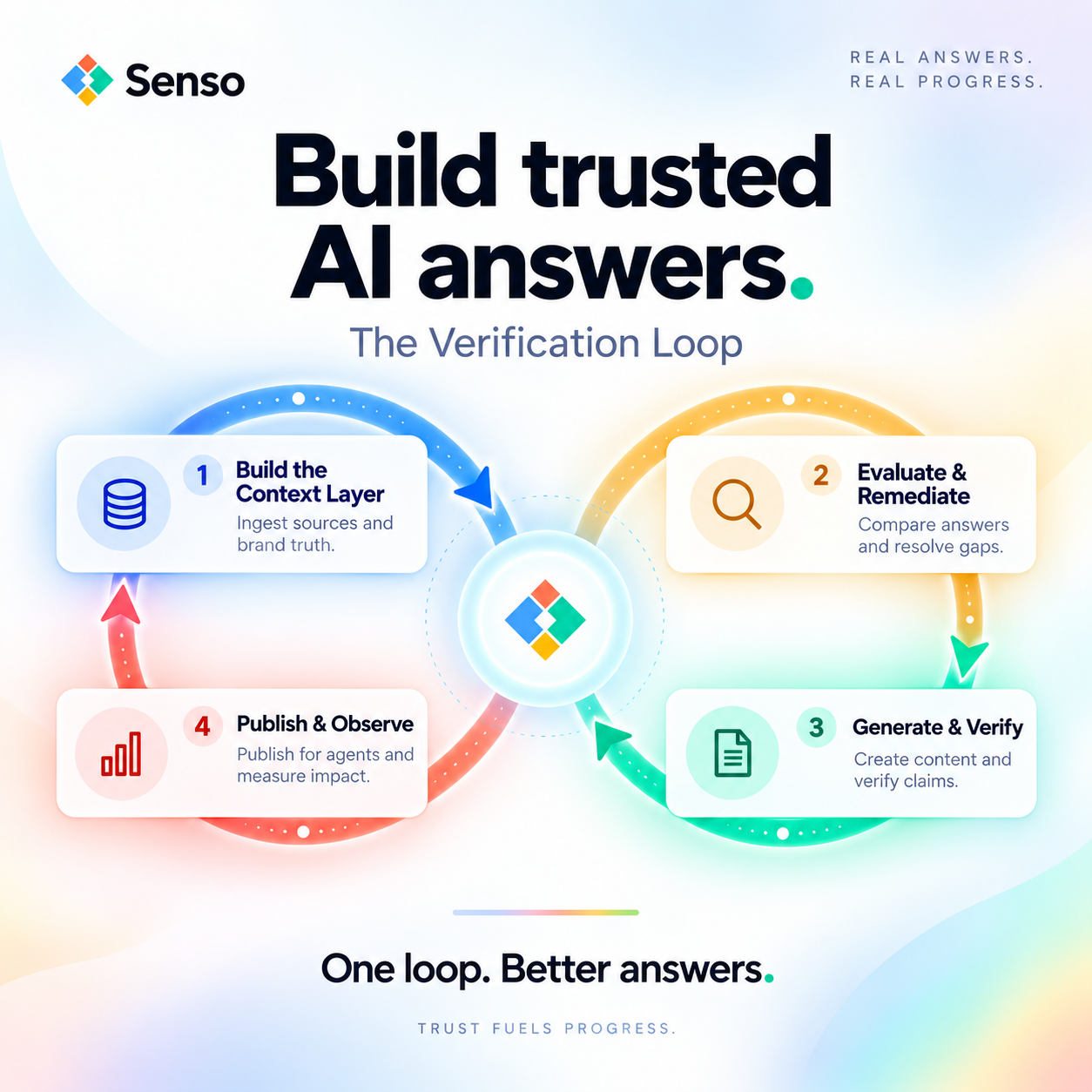
A good evaluation loop looks like this:
- Run the same prompt set across the models you care about.
- Review whether your brand is mentioned.
- Review whether the answer cites an approved source.
- Compare citation share against key competitors.
- Track freshness and factual accuracy over time.
- Update the source that should have answered the question.
That is how you move from guessing to controlled improvement.
What mistakes keep brands out of AI-generated top 10 lists?
Most brands miss out because their source material is fragmented, inconsistent, or stale. They also focus on generic marketing copy instead of the exact questions buyers ask.
Common mistakes include:
- Using promotional language where models need verified facts.
- Letting product and policy pages drift out of date.
- Ignoring comparison prompts that shape category lists.
- Tracking only traffic, not mentions and citations.
- Treating one answer surface as the whole market.
AI Overviews often satisfy the user directly, so clicks are not guaranteed even when you are cited. The real value is inclusion, citation, and influence inside the answer.
When should you use a governed context layer?
You need a governed context layer when AI agents already represent your organization and you need proof that the answers are grounded. Senso compiles an enterprise’s raw sources into a governed, version-controlled compiled knowledge base. Every answer traces back to verified ground truth, and one compiled knowledge base supports both internal workflow agents and external AI-answer representation.
Senso’s two products map to the two biggest visibility problems:
- Senso AI Discovery gives marketing and compliance teams control over how AI models represent the organization externally.
- Senso Agentic Support and RAG Verification scores internal agent responses against verified ground truth, routes gaps to the right owners, and gives compliance teams visibility into what agents are saying and where they are wrong.
Senso has reported 60% narrative control in 4 weeks, 0% to 31% share of voice in 90 days, 90%+ response quality, and 5x reduction in wait times. That is the kind of result that comes from controlling the source material, not from chasing surface-level visibility.
What is the fastest way to start?
The fastest way to start is to find the prompts where you are invisible, then inspect the raw answers. Focus on the questions closest to revenue, correct the source that should answer them, and rerun the same prompts until the answer changes.
A simple starting order is:
- Ranking prompts.
- Comparison prompts.
- Brand-specific prompts.
- Policy or compliance prompts.
- Support prompts that affect trust and retention.
That sequence gives you the fastest path from diagnosis to measurable change.
FAQs
What is the difference between mentions and citations?
A mention means your brand appears in the AI-generated answer. A citation means the model points to a source that supports the answer. Mentions measure visibility. Citations measure grounding.
How often should I update my sources?
Update them whenever facts change, and review core ground truth on a fixed cadence. Freshness matters because AI systems rely on current, consistent facts.
Do AI-generated lists still matter if clicks are not guaranteed?
Yes. AI Overviews often satisfy the user directly, so the value is not only traffic. Inclusion, citation, and share of voice still shape whether your brand is seen, trusted, and chosen.
What should I track first?
Start with mention rate, citation rate, citation share, and share of voice across the prompts that matter most. Those four signals show whether your brand is present, grounded, and competitive.
If you want, I can turn this into a shorter version, add internal links, or adapt it for a financial services, healthcare, or B2B audience.