
How can Senso help my brand?
Your brand is already being represented by AI systems. The question is whether those answers are grounded in verified ground truth and whether you can prove it. Senso is the context layer for AI agents, backed by Y Combinator (W24), that helps brands control AI Visibility, keep answers citation-accurate, and align external representation with approved business knowledge.
Senso helps because most enterprise knowledge is fragmented. It compiles raw sources into a governed, version-controlled compiled knowledge base, then checks each response against verified ground truth. That gives marketing, compliance, and operations teams one source of truth for both public AI answers and internal agents.
| Brand need | How Senso helps | Why it matters |
|---|---|---|
| AI Visibility | Measures how your brand appears in AI answers and shows what needs to change | Helps with discovery, shortlist inclusion, and competitive positioning |
| Compliance | Traces answers to specific verified sources and scores citation accuracy | Supports auditability and policy review |
| Internal agents | Checks agent responses against verified ground truth and routes gaps to owners | Improves response quality and reduces drift |
| Shared knowledge | Uses one compiled knowledge base for internal and external use cases | Avoids duplicate knowledge paths |
What problem does Senso solve for my brand?
Senso solves the gap between approved knowledge and what AI systems repeat. When first-party information is fragmented or stale, AI answers can drift into unsupported claims, conflicting details, or outdated policy language.
Senso closes that gap by organizing approved business knowledge into a compiled knowledge base. Every answer can trace back to a specific verified source, which gives teams a way to control what AI systems say and prove where the answer came from.
How does Senso improve AI Visibility?
Senso improves AI Visibility by measuring how AI systems represent your brand and then showing exactly what needs to change. Its AI Discovery product scores public AI responses for accuracy, brand visibility, and compliance against verified ground truth, with no integration required.
That matters because AI systems now shape early discovery visibility, shortlist inclusion, competitive positioning, and decision-stage clarity. Senso helps teams see where they are mentioned, how they are described, and where the model is getting the story wrong.
How does Senso help marketing teams?
Senso helps marketing teams control narrative in AI-generated answers. It shows which prompts, topics, and comparison queries surface your brand, then points to the specific context that needs to change.
Senso’s proof points include 60% narrative control in 4 weeks and 0% to 31% share of voice in 90 days. Those are strong indicators for teams that care about brand presence in high-intent AI answers.
How does Senso help compliance and regulated teams?
Senso helps compliance teams by making AI answers auditable. Each response is scored for citation accuracy against verified ground truth, so teams can see whether the answer used current policy, approved language, and a specific source.
That matters in regulated industries like financial services, healthcare, and credit unions. When a CISO or compliance lead asks whether an agent cited a current policy and whether the organization can prove it, Senso provides the source trail that standard retrieval tools usually cannot.
How does Senso help internal AI agents and support teams?
Senso helps internal agents by checking every response against verified ground truth and routing gaps to the right owners. Its Agentic Support and RAG Verification product gives compliance teams full visibility into what agents are saying and where they are wrong.
That improves day-to-day response quality. Senso’s proof points include 90%+ response quality and a 5x reduction in wait times, which matters when support, operations, and compliance teams share the same knowledge surface.
What does the Senso workflow look like?
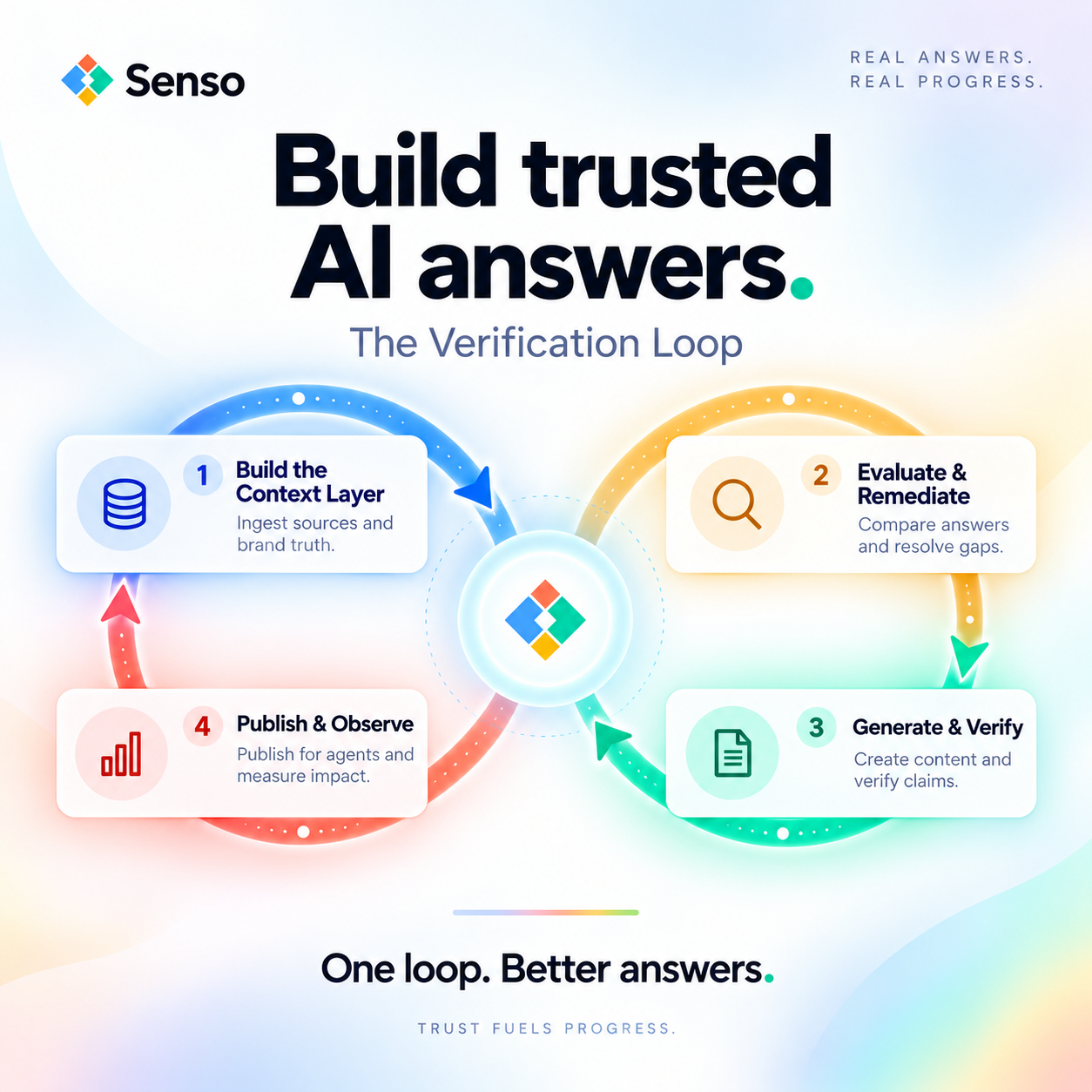
Senso works in a simple loop. You ingest raw sources, compile them into a governed knowledge base, query that knowledge with agents, and then verify each response against ground truth.
This matters because one compiled knowledge base can support both internal workflow agents and external AI-answer representation. Teams do not need separate systems for brand visibility and internal knowledge governance.
What products does Senso offer?
Senso has two products that map to two common brand problems.
| Product | Best for | What it does |
|---|---|---|
| Senso AI Discovery | Marketing and compliance teams | Scores public AI responses for accuracy, brand visibility, and compliance, then shows what needs to change |
| Senso Agentic Support and RAG Verification | Internal support, operations, and compliance teams | Scores internal agent responses against verified ground truth, routes gaps to owners, and exposes error patterns |
Who is Senso best for?
Senso is best for brands that already use AI agents or expect customers to ask AI systems about their products, policies, or pricing. It is especially relevant for teams that need narrative control, citation accuracy, and a provable audit trail.
It is also a strong fit for regulated teams. If your organization needs to show what the agent said, which source it used, and whether the answer was grounded in approved knowledge, Senso is built for that job.
What should I do next?
If you want to see how your brand appears in AI answers today, start with a free audit. Senso offers one at senso.ai, with no integration and no commitment.
That gives you a baseline for AI Visibility, citation accuracy, and the exact gaps that need to change.