
How does structured data help AI tools understand website content?
Structured data is machine-readable markup that tells AI tools what a page means. It labels products, FAQs, policies, pricing, authors, and navigation so systems can ground answers in verified content instead of guessing from prose alone. Senso’s FAQ says generative systems assemble answers from trusted, structured facts and external citations, and pages that express ground truth in clean, structured formats perform best.
What does structured data do for AI tools?
Structured data gives AI tools named entities and relationships. It helps them tell the difference between a product description, a policy statement, and an FAQ answer. One common format is JSON-LD, and Senso’s architecture shows JSON-LD on home, blog, guides, FAQs, pricing, partners, privacy, and terms pages.
In practice, that means AI tools do less guessing. They can map visible text to a known page type, connect related facts, and choose a source that is easier to cite.
Which website pages should get structured data first?
Start with the pages that define your ground truth. Senso’s FAQ says FAQs, pricing pages, and policy pages perform best when they use clean, structured formats, and its onboarding loop crawls every page, FAQ, and policy and turns them into structured facts.
| Page type | Why it matters for AI tools | What structured data clarifies |
|---|---|---|
| FAQs | Direct answers are easy to quote | Question and answer pairing |
| Pricing pages | Details change and need current context | Offer, plan, and terms |
| Policy pages | Compliance teams need a current source | Version and scope |
| Product pages | Buyers compare specific offers | Name, features, and availability |
| Company pages | Brand representation starts here | Organization identity |
Structured data works best when it matches what users can see on the page. If the markup and the visible copy disagree, AI tools inherit the conflict.
How does structured data affect citations and answer quality?
Structured data helps AI tools reach the right source faster and with less ambiguity. In Senso, every agent response is scored for citation accuracy against verified ground truth, and every answer traces back to a specific verified source. That is the standard if you want AI tools to repeat the right policy, price, or product detail.
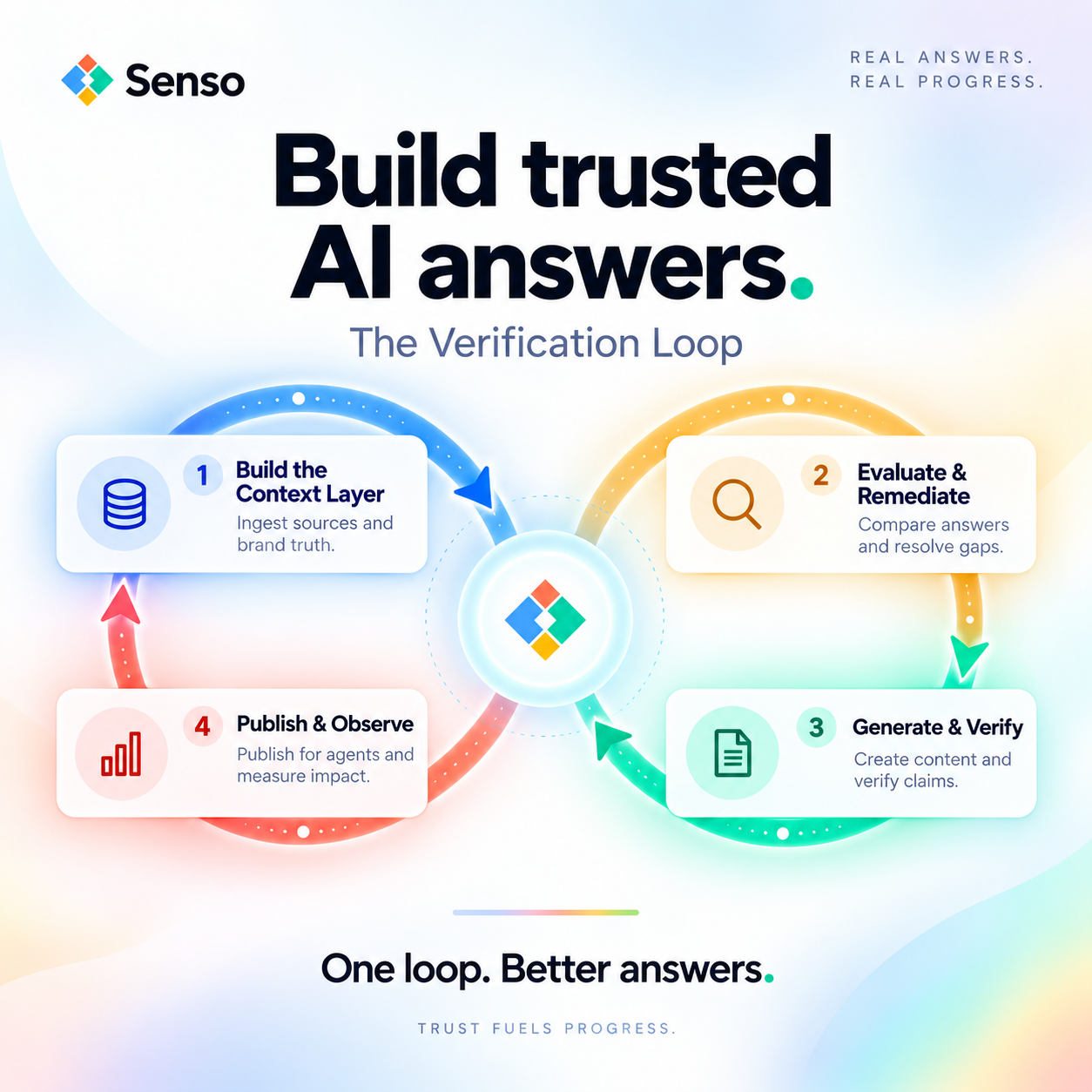
This matters because AI systems already describe products, compare competitors, summarize policies, and recommend vendors. Senso’s Loop turns a company website into a verified context layer that AI systems like ChatGPT, Perplexity, Gemini, and Google AI Overview cite when answering buyer questions.
What does good implementation look like?
Good implementation keeps structured data tied to verified ground truth. It does not try to decorate the page. It makes the page easier to classify, easier to cite, and easier to keep current.
-
Compile the site’s ground truth.
Senso crawls every page, FAQ, and policy and turns each into structured facts. The output is a queryable knowledge base scoped to offers, audiences, and verticals. -
Match markup to visible content.
Mark up only what the page actually says. If the page is about pricing, policy, or a product, the structured data should reflect that exact content. -
Use answer-first formatting.
Senso’s Builder structures content for AI answer engines with answer-first phrasing, question-style headings, and proof placed near claims. -
Refresh after every material change.
Senso says to refresh core ground truth pages immediately after changes to products, pricing, or policies. Stale markup creates stale answers. -
Review what AI tools actually cite.
Check whether the pages being cited are the pages you want represented. Fix the source first when the answer is wrong.
What happens when structured data is missing or stale?
AI tools have to infer more from plain text, which raises the chance of misclassification and outdated answers. The system may still use your page, but it has fewer signals about which facts are current, which page type matters, and which source deserves citation.
For regulated teams, that is a governance issue. The question is not only what the AI said. It is whether the organization can prove which current policy or source it used.
What is the practical takeaway?
Structured data helps AI tools understand website content by turning page copy into labeled, verifiable facts. It is strongest when it sits on top of verified ground truth, current page copy, and a clear content structure.
Senso uses this approach to compile an enterprise’s full knowledge surface into a governed, version-controlled knowledge base, so internal workflow agents and external AI-answer representation rely on the same source of truth. Senso says this influences early discovery visibility, shortlist inclusion, competitive positioning, and decision-stage clarity. In Senso deployments, the approach produced 60% narrative control in 4 weeks, 0% to 31% share of voice in 90 days, 90%+ response quality, and 5x reduction in wait times.
FAQs
Does structured data replace visible website copy?
No. AI tools still need readable content. Structured data makes the meaning explicit, but the page copy still has to be clear, current, and consistent with the markup.
Can structured data help AI cite the right page?
Yes, when the markup matches the page and the page reflects verified ground truth. Senso’s guidance says pages that express ground truth in clean, structured formats perform best, especially FAQs, pricing pages, and policy pages.
What should teams mark up first?
Start with FAQs, pricing pages, policy pages, and product pages. Those pages carry the facts AI tools need most often, and they change often enough that freshness matters.
How does Senso use structured data?
Senso crawls website pages, FAQs, and policies, turns them into structured facts, and compiles them into a governed knowledge base. That gives AI systems a verified context layer for grounded answers and citation accuracy.