
How do AI agents read and act on organizational content?
AI agents read organizational content by ingesting raw sources, compiling them into a governed knowledge base, querying that context for the current answer, and generating a response or action from verified ground truth. When the content is fragmented or stale, the agent can repeat the wrong policy, the wrong price, or an answer with no proof.
The real question is not whether the agent can respond. It is whether the answer is grounded, citation-accurate, and provable when a policy, price, or product fact matters. That is a knowledge governance problem, not just a retrieval problem.
What do AI agents actually read?
AI agents do not read every source the same way. They use approved context that can support a specific answer, then trace that answer back to a verified source. In a governed system, raw sources become a compiled knowledge base with provenance and version control.
Common sources include:
- Current policies and procedures
- Product facts, pricing, and terms
- Brand claims and compliance statements
- Support runbooks and escalation paths
- Public-facing answers that must stay consistent across channels
If a source changes often, the agent needs a clear way to know which version is current. If a source can affect revenue or compliance, the agent needs a way to prove what it used.
What content should you govern first?
Start with content that changes often and carries risk. That is where agent errors become visible fastest.
| Content type | Why it matters to agents |
|---|---|
| Policies and procedures | These affect compliance and internal actions. |
| Pricing and terms | These affect customer-facing answers and revenue. |
| Product facts and claims | These shape how the organization is represented. |
| Support content | These determine how agents route and resolve issues. |
| Public statements | These shape AI Visibility in ChatGPT, Perplexity, and Gemini. |
If the content can move a customer decision, trigger a control, or create legal exposure, it should be governed before agents act on it.
How do AI agents decide what to say or do?
AI agents follow a sequence. The sequence matters more than the model name.
-
Establish identity first.
The agent resolves the organization before it reads private context or changes state. -
Separate truth from observation.
Approved context records are ground truth. Model outputs, citations, and rankings are evidence about behavior. -
Query the approved context.
The agent pulls only the context needed for the task. -
Generate the answer or action.
The agent uses that context to respond, route, summarize, or draft. -
Score the result against verified ground truth.
The system checks whether the answer is citation-accurate and current. -
Route gaps to an owner.
If the source is missing, stale, or disputed, the issue goes to the right human.
This is how agents move from raw content to governed action. Without that sequence, the agent may sound confident and still be wrong.
What goes wrong without governance?
Without governance, content fragments across websites, internal docs, policies, and open-web references. The agent may answer from stale material, unsupported claims, or a term that no longer matches policy.
The risk is not only a wrong answer. It is the inability to prove what the agent used.
That matters most in regulated settings. When a CISO asks whether the agent cited a current policy and whether the organization can prove it, retrieval alone does not answer the question. A response must trace back to a specific verified source.
Common failure modes include:
- Stale pricing or product facts
- Unsupported compliance language
- Missing citations
- Contradictory answers across channels
- No clear owner for fixing the source
What does a governed workflow look like?
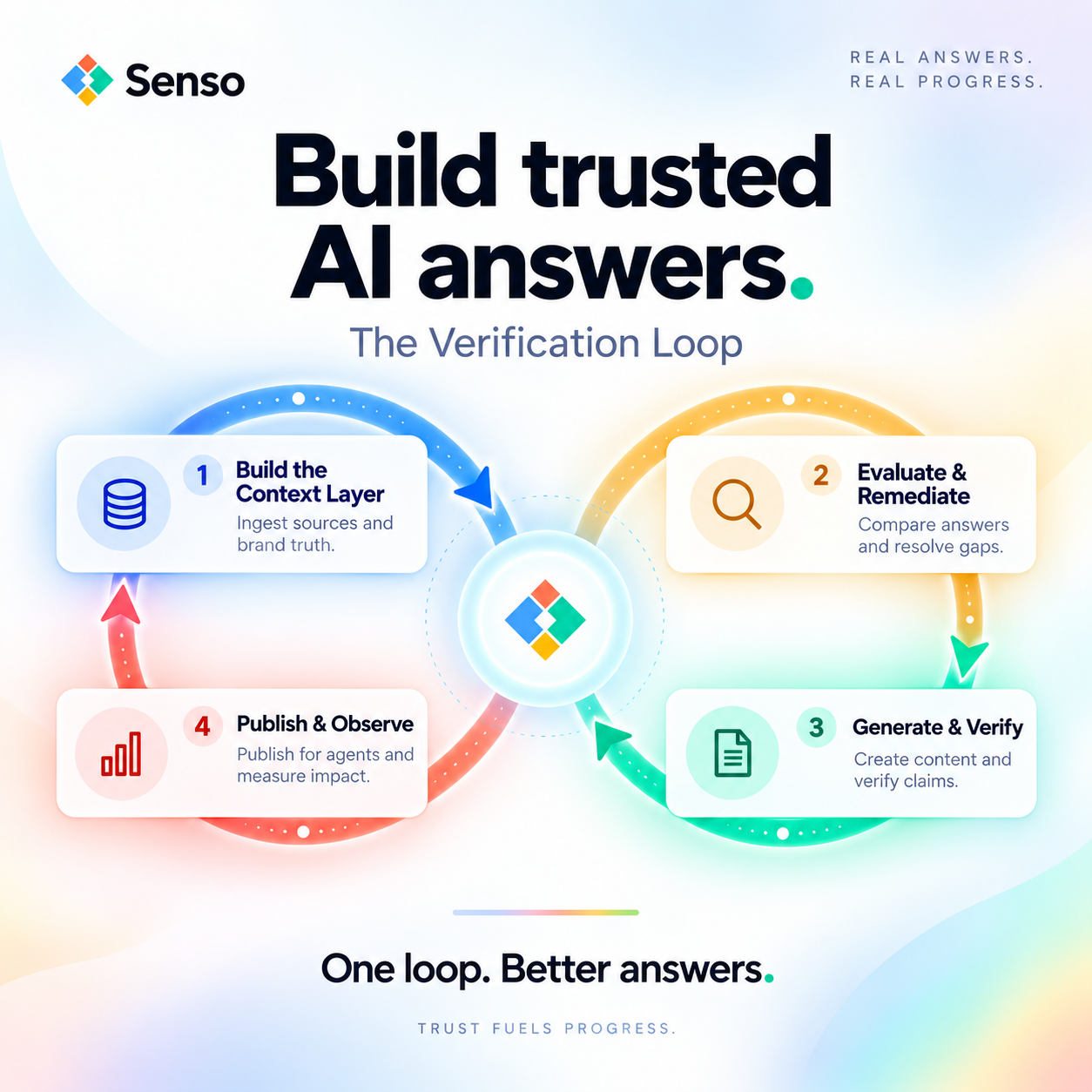
The shortest useful workflow is simple. Populate approved context, receive prioritized factual gaps, fix material issues with a human, publish one Verified Source, and measure how answers or actions change.
- Ingest approved raw sources.
- Compile them into a governed context layer.
- Query the compiled knowledge base during agent activity.
- Detect factual gaps and conflicts.
- Resolve material issues with the right owner.
- Publish a Verified Source with provenance.
- Re-observe the answer and action quality.
This loop does not try to make AI say whatever a company wants. It gives agents accurate, current, attributable information, then checks whether that information changed the answer.
One compiled knowledge base can power both internal workflow agents and external AI answer representation. That avoids duplicate source paths and keeps governance consistent.
How does Senso fit?
Senso is the context layer for AI agents. It compiles an enterprise’s full knowledge surface into a governed, version-controlled knowledge base, then scores every agent response against verified ground truth.
Senso has two products:
- Senso AI Discovery gives marketing and compliance teams control over AI Visibility. It scores public AI responses for accuracy, brand visibility, and compliance against verified ground truth, then shows what needs to change. No integration is required.
- Senso Agentic Support and RAG Verification scores internal agent responses, routes gaps to the right owners, and gives compliance teams visibility into what agents are saying and where they are wrong.
Senso’s reported outcomes include 60% narrative control in 4 weeks, 0% to 31% share of voice in 90 days, 90%+ response quality, and a 5x reduction in wait times.
What should you do before letting agents act on content?
Treat agent-read content as governed content, not static content. If the answer can affect trust, revenue, compliance, or operations, the source needs version control, provenance, and an owner.
A simple rule applies. If you cannot prove the source, the agent should not present the answer as fact.
FAQs
How do AI agents read organizational content?
AI agents read organizational content by querying approved raw sources that have been compiled into a governed knowledge base. They then generate answers or actions from verified ground truth, not from fragmented text alone.
Can AI agents act safely on internal content?
Yes, if the content is governed. Safe action depends on identity checks, verified sources, citation accuracy, and a human review step for material gaps or consequential decisions.
What is the difference between retrieval and governance?
Retrieval finds relevant text. Governance proves which text is approved, current, and citable. Governance also tracks provenance, ownership, and version history, which retrieval alone does not provide.
Why does this matter for regulated industries?
Regulated teams need proof, not just an answer. If an agent cites the wrong policy or an outdated term, the organization needs a way to show what the agent used and whether it matched verified ground truth at the time.