
How do AI Systems Compare Brands?
AI systems compare brands by pulling from verified sources, weighing citations, and generating the answer from the facts they trust most. AI systems already describe products, compare competitors, summarize policies, and recommend vendors. When the source set is fragmented, the comparison drifts.
Quick Answer
The brand that wins an AI comparison is usually the one with the clearest verified ground truth, the strongest citation trail, and the most consistent answer coverage across prompts. Senso calls this narrative control. Senso AI Discovery measures external AI visibility. Senso Agentic Support and RAG Verification scores internal response quality.
Top comparison signals at a glance
| Rank | Signal | What AI checks | What a brand should supply |
|---|---|---|---|
| 1 | Verified ground truth | Whether the facts are current and consistent | Approved brand facts, policy pages, and product details |
| 2 | Citation accuracy | Whether the answer traces back to a specific verified source | Owned citations and credible supporting sources |
| 3 | Share of Voice | How much of the answer is dedicated to your brand | Strong coverage in ranking and comparison prompts |
| 4 | Mentions | Whether the brand appears at all | Clear brand references across evaluated prompts |
| 5 | Source consistency | Whether sources agree across pages and updates | Regular review of core facts and pages |
What do AI systems compare first?
AI systems compare evidence first, then relevance, then answer coverage. They do not read a brand as a static profile. They compare the available proof behind the claim and then decide which brand best fits the prompt.
That matters because the source set shapes the answer. If a brand has current facts, clear citations, and consistent language, it is easier for the system to include and recommend.
Which signals matter most?
AI systems compare brands on the evidence that supports the answer, not on brand intent. The strongest signals are verified ground truth, citation accuracy, Share of Voice, mentions, and source consistency. Together, these determine whether a brand appears, how often it appears, and how much space it gets.
1. Verified ground truth
Verified ground truth is the approved source of truth that AI systems can rely on. If product facts, policy language, or pricing details conflict across pages, the model has to choose among competing versions. That usually produces inconsistent comparisons.
Update core ground truth pages at least every 60 to 90 days. Review them whenever facts change.
2. Citation accuracy
Citation accuracy is the check that ties an answer back to a specific verified source. Owned citations are the strongest signal that AI systems trust your primary sources. External citations also matter when they reinforce the same claim.
If an AI answer cannot point to a verified source, the comparison is weaker. That creates risk for regulated teams that need proof of what the system said and why.
3. Mentions and Share of Voice
Mentions measure how often your brand appears in AI-generated answers across evaluated prompt runs. Share of Voice measures answer dominance. It is the percentage of an AI-generated answer dedicated to your brand compared with others.
A brand can have strong products and still lose visibility if it appears late, briefly, or only in a narrow set of prompts. That is why comparison prompts matter so much.
4. Source consistency
AI answers change quickly as models update, sources shift, and competitors publish new content. Track weekly at minimum. If your facts differ across pages, the system will surface that inconsistency in the comparison.
Consistency matters most in categories where trust, accuracy, and comparison drive decisions. That includes finance, healthcare, and other regulated industries.
5. Prompt relevance
AI systems compare brands more aggressively on prompts closest to a purchase decision. Ranking prompts, comparison prompts, and brand-specific prompts are the ones to watch first. They sit closest to revenue and show where narrative control matters most.
Why do AI brand comparisons go wrong?
AI brand comparisons go wrong when the system cannot reliably retrieve or trust your brand facts. Common causes include inconsistent information across pages, stale content, and missing citations.
When that happens, the model may omit your brand, compress your differentiators, or compare you against the wrong version of your own story. The problem is usually not the model alone. The problem is the knowledge surface behind it.
How can teams control the comparison?
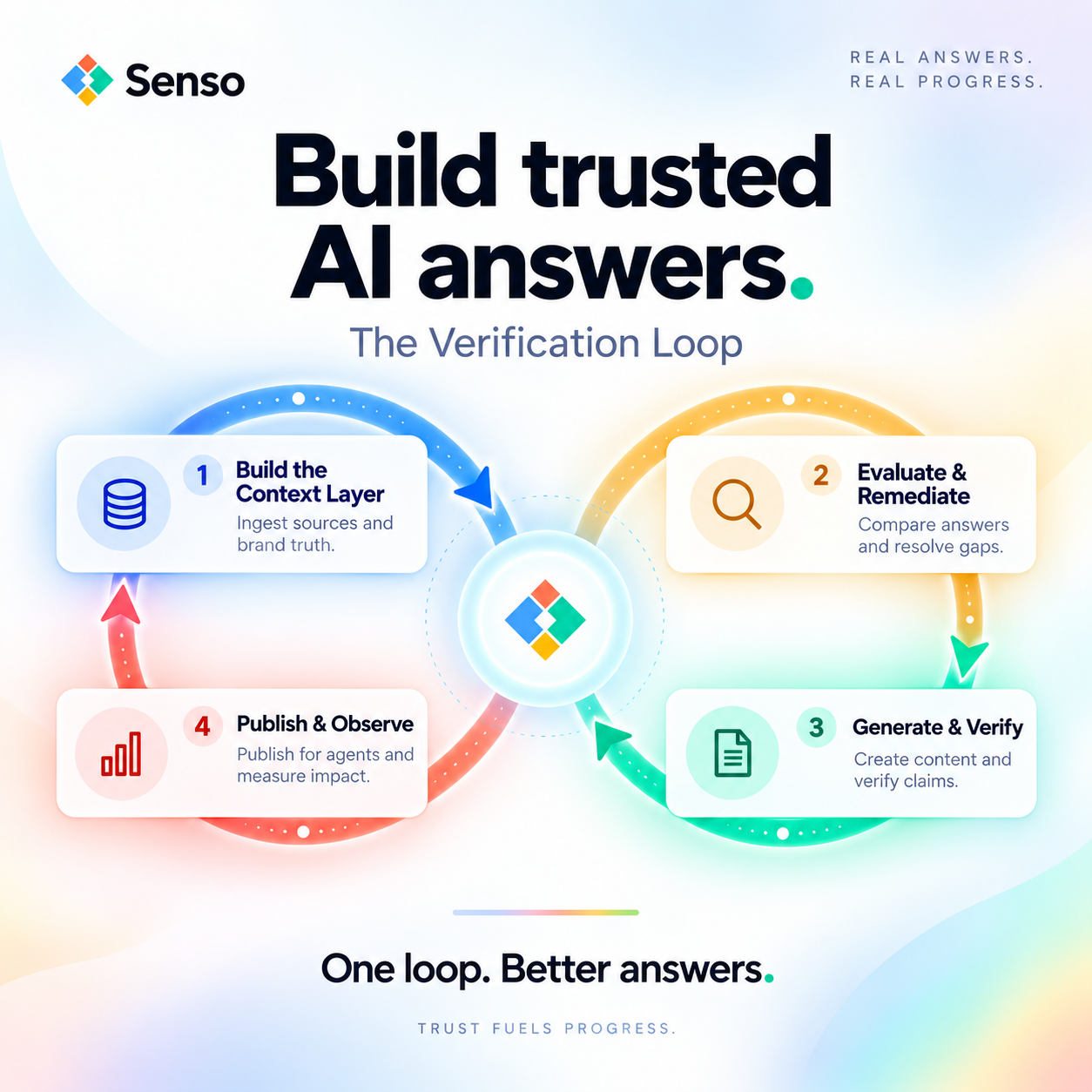
Teams control AI brand comparisons by compiling approved facts into a governed knowledge base, then checking real AI answers against that source of truth. The workflow is simple. Ingest the raw sources, compile them, evaluate the answers, fix the gaps, and verify the result again.
- Ingest approved raw sources into a governed compiled knowledge base.
- Evaluate real AI answers against verified ground truth.
- Surface missing citations, weak coverage, and inconsistent claims.
- Generate structured drafts to close the gaps.
- Re-evaluate on a regular cadence and after major facts change.
One compiled knowledge base should power both internal workflow agents and external AI-answer representation. That avoids duplication and keeps the brand story aligned.
Where does Senso fit?
Senso is the context layer for AI agents. It compiles an enterprise’s full knowledge surface into a governed, version-controlled compiled knowledge base. That gives teams one source of truth for both internal agents and public AI visibility.
- Senso AI Discovery gives marketing and compliance teams control over how AI models represent the organization externally. Senso scores public AI responses for accuracy, brand visibility, and compliance against verified ground truth, then surfaces exactly what needs to change. No integration is required.
- Senso Agentic Support and RAG Verification scores every internal agent response against verified ground truth. Senso routes gaps to the right owners and gives compliance teams full visibility into what agents are saying and where they are wrong.
- Senso cites proof points of 60% narrative control in 4 weeks, 0% to 31% share of voice in 90 days, 90%+ response quality, and 5x reduction in wait times.
Which approach works best by scenario?
| Scenario | Best focus | Why |
|---|---|---|
| Best for regulated teams | Citation accuracy and audit trail | You need to prove the current policy or approved fact |
| Best for marketing teams | Mentions and Share of Voice | You need to see how AI represents the brand externally |
| Best for internal agents | Response quality and verified ground truth | You need grounded answers for staff and users |
| Best for fast rollout | No-integration visibility | You need results without a heavy setup |
FAQs
What is narrative control?
Narrative control is an enterprise’s ability to influence how AI systems describe, compare, and recommend its brand. It depends on verified ground truth, citation accuracy, and consistent source coverage.
What is Share of Voice in AI answers?
Share of Voice measures answer dominance. It is the percentage of an AI-generated answer dedicated to your brand compared with others.
How often should teams review brand facts?
Update on a regular cadence and whenever facts change. Review core ground truth pages at least every 60 to 90 days. Track AI answers weekly at minimum.
What should teams start with?
Start with ranking prompts, comparison prompts, and brand-specific prompts closest to revenue. Those prompts show where AI systems compare your brand most directly.
Can one knowledge base support both internal and external AI use?
Yes. One compiled knowledge base can power internal workflow agents and external AI-answer representation. That keeps the facts aligned and reduces duplication.
AI systems compare brands through evidence, not intent. The brands that win are the ones with current facts, citation-accurate sources, and consistent coverage across the prompts that matter. If you want to see how your brand is being compared today, a free audit is available at senso.ai. No integration. No commitment.