
How do brands compete in AI generated discovery
Brands compete in AI generated discovery by becoming the source AI systems can verify, cite, and reuse. AI systems now answer questions, compare competitors, summarize policies, and recommend vendors, so the winners supply verified ground truth, structured content, and clear ownership of facts. The goal is inclusion, citation, and recommendation inside synthesized answers. For regulated teams, the issue is also proof that a claim was checked against an authorized source and that the source was current at the time of use.
Senso’s documentation names four outcomes that matter here: early discovery visibility, shortlist inclusion, competitive positioning, and decision-stage clarity.
| Outcome | What the brand needs | Why it matters |
|---|---|---|
| Early discovery visibility | Facts AI can include in broad answers | Gets the brand into the first answer set |
| Shortlist inclusion | Comparative facts and citations that stay consistent | Moves the brand into vendor consideration |
| Competitive positioning | Differentiated proof, not generic messaging | Reduces the chance of a bland, interchangeable summary |
| Decision-stage clarity | Current policy, pricing, and product facts with citations | Helps buyers choose with confidence |
What changes when discovery moves into AI answers?
Discovery moves from link lists to synthesized answers. That shifts competition from ranking pages to winning machine selection, because AI agents prioritize brands that reduce uncertainty and risk. Inclusion now depends on whether the answer can be grounded in facts that are specific, current, and easy to cite.
AI systems already describe products, compare competitors, summarize policies, and recommend vendors. That means a brand can be represented before a human visits the website, and sometimes before a buyer ever sees a search result. The brand that controls the facts controls more of the answer.
What do AI systems reward?
AI systems reward facts that stay consistent across sources. They also reward pages that are current, narrow, and supported by citations. When the same fact appears differently across the web, the model has less reason to mention or recommend the brand.
The most reliable inputs are verified ground truth, clear structure, and maintained ownership. AI agents are optimized to reduce uncertainty and risk for users, so they favor facts that are specific and stable. That is why broad claims without proof lose ground.
- Verified ground truth. Start with a short factual knowledge base covering product facts, policy facts, pricing facts, and support facts.
- Specific claims. AI agents rely on facts that are specific and consistent, not vague brand language.
- Citations. Citations are a trust mechanic for AI engines. They tell the model and the user where the answer came from.
- Freshness. Track weekly at minimum. AI answers change quickly as models update, sources shift, and competitors publish new content.
- Ownership. Every critical fact needs a human owner and a review path when facts change.
How do brands build verified ground truth?
Brands build verified ground truth by compiling raw sources into an approved knowledge surface that agents can query. That surface needs version control, ownership, and a review path when facts change. Without that discipline, AI answers drift away from what the business actually wants to say.
A strong process is simple and repeatable.
-
List the questions AI answers most often.
Use support tickets, sales calls, analyst questions, and public prompts to find the facts buyers ask for first. -
Compile the approved facts.
Keep the knowledge base short and factual. Start with product positioning, policy language, pricing logic, and compliance statements. -
Publish answer-ready pages.
Structure each page around one question and one source of truth. AI systems use organized content more easily than fragmented raw sources. -
Add auditability.
Link each claim to a verified source and keep a version history. This is what makes the answer citation-accurate. -
Close the loop fast.
Route mismatches to the right owner and update the source surface before the same error spreads into more answers.
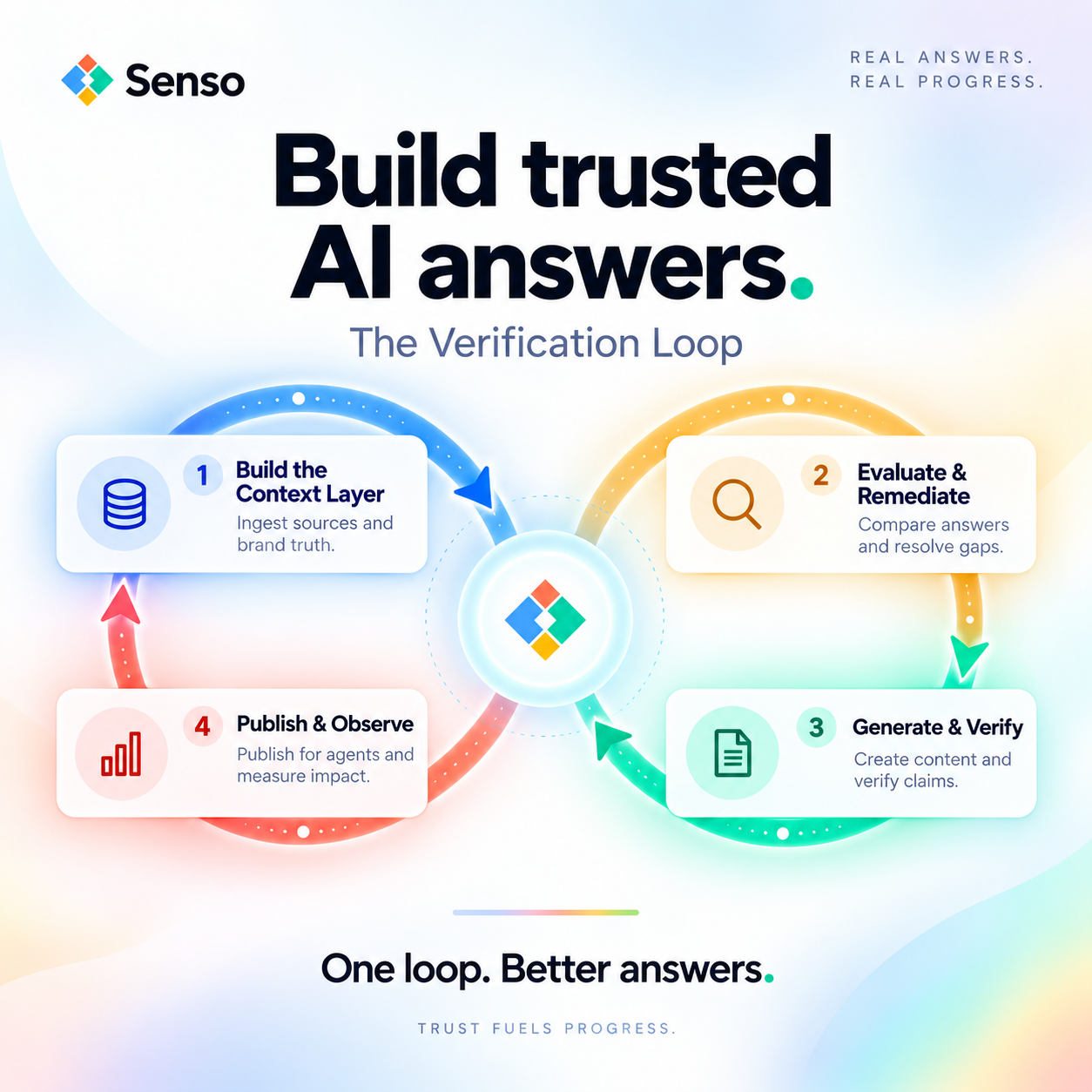
Senso is built around that loop. It compiles an enterprise’s full knowledge surface into a governed, version-controlled knowledge base, so one approved source can support both internal workflow agents and external AI answers. That removes duplication and keeps the answer source aligned.
Which metrics show whether a brand is winning?
The right metrics show inclusion, proof, and control. Mentions tell you whether the brand appears at all. Citations tell you whether the answer can be verified. Share of Voice tells you how much of the answer belongs to the brand compared with competitors.
| Metric | What it measures | Why it matters |
|---|---|---|
| Mentions | How often the brand appears in AI-generated answers | Shows inclusion in the answer set |
| Citations | Whether the answer points to verified sources | Shows proof and auditability |
| Share of Voice | The percentage of an AI-generated answer dedicated to the brand | Shows competitive position |
| Narrative control | How closely the answer matches approved brand facts | Shows message consistency |
| Response quality | Whether answers are grounded and useful | Shows user value and lower risk |
In Senso deployments, these metrics have moved quickly. Senso has documented 60% narrative control in 4 weeks, 0% to 31% share of voice in 90 days, 90%+ response quality, and 5x reduction in wait times. Those numbers show what happens when a brand governs the source, not just the headline.
How does Senso help teams compete?
Senso gives teams a governed context layer for AI agents. It compiles the enterprise knowledge surface into a version-controlled knowledge base, so one approved source can serve both internal agents and external AI answers without duplication.
- Senso AI Discovery gives marketing and compliance teams control over how AI systems represent the organization externally. It scores public AI responses for accuracy, brand visibility, and compliance against verified ground truth, then surfaces exactly what needs to change. No integration required.
- Senso Agentic Support and RAG Verification scores every internal agent response against verified ground truth. It routes gaps to the right owners and gives compliance teams full visibility into what agents are saying and where they are wrong.
- For regulated teams, Senso provides auditability. When a CISO asks whether the agent cited a current policy, Senso ties the answer back to a specific verified source.
Senso influences the same business outcomes that matter in AI generated discovery: early discovery visibility, shortlist inclusion, competitive positioning, and decision-stage clarity. That is why knowledge governance matters. It keeps the brand’s public answer surface aligned with what the organization can prove.
What should brands do first?
Brands should start with the highest-value facts and the highest-risk gaps. That means identifying the questions AI systems answer most often, compiling the approved facts, and measuring whether those facts show up with citations. The fastest gains come from tightening the source surface, not from adding more noise.
A practical starting point looks like this:
- Review the pages and policies AI uses most often.
- Fix contradictions between owned pages.
- Publish concise, structured answers for common buyer questions.
- Track mentions, citations, and Share of Voice weekly.
- Route mismatches to owners and update the source immediately.
FAQs
What is the fastest way to improve AI generated discovery?
The fastest path is to compile verified ground truth for the facts AI asks about most, publish those facts in answer-ready pages, and track mentions and citations weekly. Teams that fix the source surface first usually see better inclusion faster than teams that only rewrite marketing copy.
How often should brands monitor AI answers?
Track weekly at minimum. AI answers change quickly as models update, sources shift, and competitors publish new content, so slower review cycles miss drift.
What matters more, mentions or citations?
Citations matter more when you need proof. Mentions show inclusion, while citations show the answer is grounded in verified ground truth and can be audited.
How does this help regulated industries?
Regulated teams need evidence that a claim was checked against an authorized source and that the source was current at the time of use. That is why citation accuracy, version control, and audit trails matter in financial services, healthcare, and credit unions.
Brands compete in AI generated discovery by governing the facts AI can use. The brand that can prove its answer is current, cited, and owned has the strongest position when AI agents choose what to show. If you need a fast read on where your brand is exposed, Senso offers a free audit at senso.ai. No integration. No commitment.