
How do brands influence AI generated answers
Brands influence AI generated answers by controlling the facts models can retrieve, the sources they can cite, and the structure of the knowledge they see. They do not control model tone. They control whether the answer is grounded in verified ground truth and whether the brand is named, cited, and described correctly.
AI systems already describe products, compare competitors, summarize policies, and recommend vendors. When enterprise knowledge is fragmented, the model surfaces whatever is easiest to find. That is why AI visibility is a knowledge governance problem, not a copywriting problem.
What do AI generated answers use as inputs?
AI generated answers use retrieved sources, verified ground truth, and the model’s own prior patterns. The strongest influence comes from how complete, current, and easy to cite your knowledge surface is.
If one brand has a fuller knowledge base than another, the model tends to answer with more facts about that brand. Senso’s internal notes describe this directly. A knowledge base full of facts about one brand and thin on the rest produces answers about the richer brand.
That is why the question is not just, “What do we publish?” The better question is, “What can an AI system reliably retrieve, verify, and cite?”
How do brands influence AI generated answers in practice?
Brands influence AI generated answers by making verified facts easier to retrieve than stale or competing facts. The goal is not to force tone. The goal is to make current, citation-accurate information the easiest path for the model to use.
| Brand influence lever | What it changes in the answer | Why it matters |
|---|---|---|
| Verified ground truth | Factual accuracy | The model can cite current policy, product, and pricing facts |
| Structured publishing surface | Retrieval consistency | AI systems can find the right source faster |
| Citations | Auditability | Readers can inspect where the claim came from |
| Narrative control | Brand representation | The brand is described, compared, and recommended more consistently |
| Governance | Reliability over time | Answers stay aligned as facts change |
In Senso terms, this starts when you ingest raw sources and compile them into a governed, version-controlled knowledge base. That gives agents one grounded source of truth instead of scattered content across many pages and systems.
Why does brand voice not control AI generated answers?
Brand voice does not travel into an AI answer. Models have their own system prompts and their own dialect, so a brand kit cannot make ChatGPT adopt your tone when it cites your brand.
What does carry over is information. Facts, claims, source quality, and citation structure shape the answer. Brand voice matters where humans read the page directly. It does not override the model’s internal output style.
That is why regulated teams focus on verified ground truth and audit trails. If the answer must be proven, tone is secondary.
Which metrics show whether a brand is influencing AI generated answers?
The best metrics are mentions, citations, share of voice, narrative control, and response quality. These show whether the brand appears, how it is described, and whether the answer can be traced back to verified sources.
Senso defines these metrics this way:
- Mentions measure how often your brand appears in AI-generated answers across evaluated prompt runs.
- Citations show whether AI engines point to owned pages or credible external sources.
- Share of Voice measures answer dominance. It is the percentage of an AI-generated answer dedicated to your brand compared with others.
- Narrative control refers to an enterprise’s ability to influence how AI systems describe, compare, and recommend its brand.
- Response quality shows whether an answer stays grounded in verified ground truth.
Track these weekly at minimum. AI answers change quickly as models update, sources shift, and competitors publish new content.
How does Senso help brands influence AI generated answers?
Senso turns AI visibility into a governed workflow. It compiles an enterprise’s full knowledge surface into a governed, version-controlled knowledge base and scores answers against verified ground truth.
Senso does this with two products:
- Senso AI Discovery gives marketing and compliance teams control over how AI models represent the organization externally. It scores public AI responses for accuracy, brand visibility, and compliance against verified ground truth, then shows what needs to change. No integration is required.
- Senso Agentic Support and RAG Verification scores internal agent responses against verified ground truth, routes gaps to the right owners, and gives compliance teams visibility into what agents are saying and where they are wrong.
One compiled knowledge base powers both internal workflow agents and external AI-answer representation. That avoids duplication and keeps the source of truth consistent.
Senso proof points include:
- 60% narrative control in 4 weeks
- 0% to 31% share of voice in 90 days
- 90%+ response quality
- 5x reduction in wait times
What should a brand do first?
Start with verified ground truth, not content volume. The first pass should define what is true, what is current, and which source owns each claim.
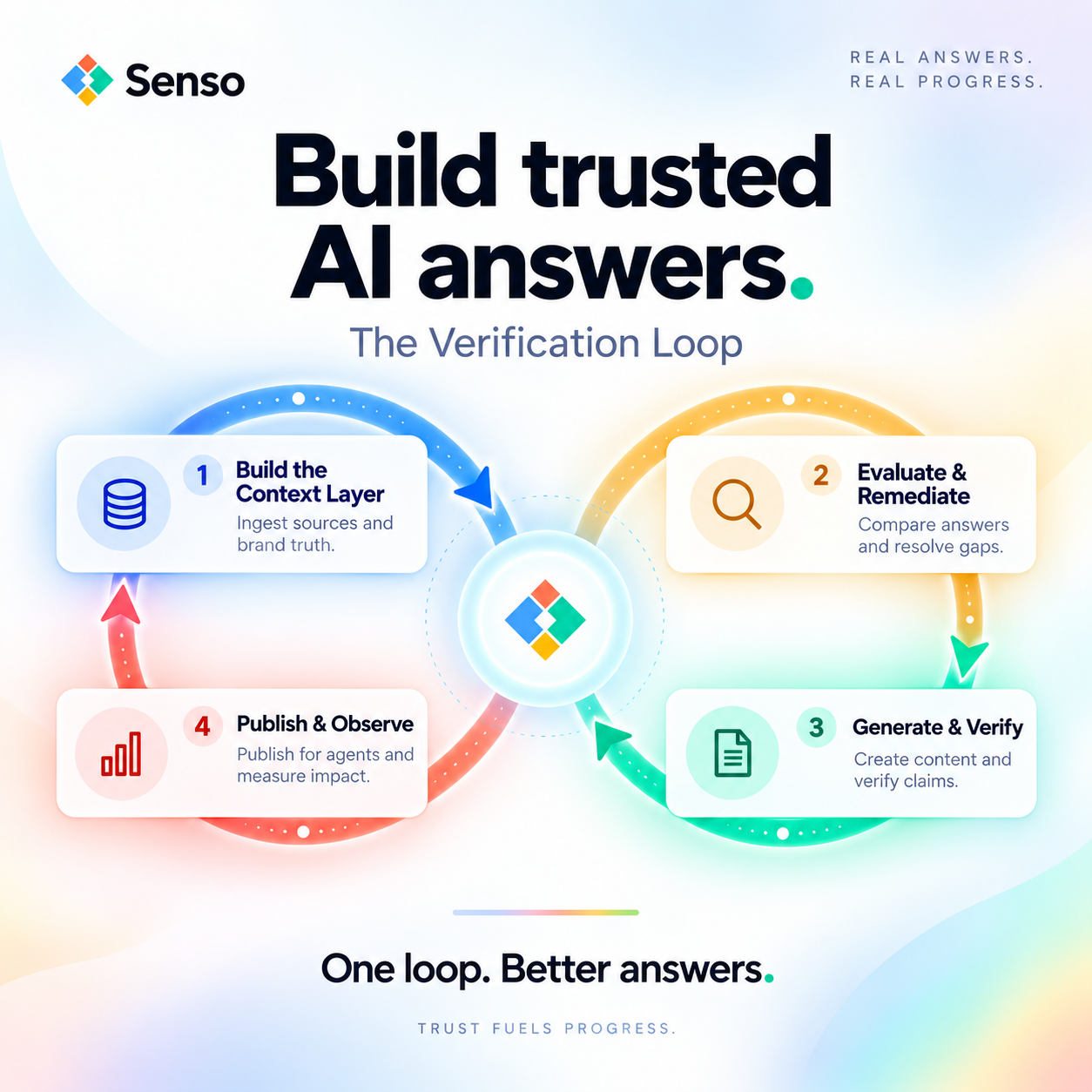
A simple rollout looks like this:
- Identify the questions AI should answer. Focus on product, policy, pricing, and comparison questions.
- Ingest raw sources and compile them. Build one governed, version-controlled knowledge base.
- Map each claim to a verified source. This makes citation accuracy measurable.
- Publish structured content for humans and agents. Keep the source surface easy to retrieve.
- Evaluate answers weekly. Measure mentions, citations, share of voice, and response quality.
- Remediate the gaps. Update the source material, then verify again.
For regulated teams, the key requirement is proof. The organization should be able to show which source supported each answer and whether that source was current.
FAQs
Can a brand control the tone of AI generated answers?
No. Tone belongs to the model. Brands control the facts, sources, and citations that shape the answer.
What matters more, brand voice or verified sources?
Verified sources matter more. Brand voice helps on owned pages, but AI generated answers depend on what the model can retrieve and cite.
How do you know if a brand is influencing AI generated answers?
Look at mentions, citations, share of voice, narrative control, and response quality. Those metrics show whether the brand appears and whether it is represented correctly.
Does this matter for internal agents too?
Yes. Internal agents can drift just like public AI answers. Senso Agentic Support and RAG Verification scores each response against verified ground truth and routes gaps to owners.
If you want a baseline on how your brand shows up today, Senso offers a free audit at senso.ai with no integration and no commitment.