
How do brands track share of voice in AI answers
Brands track share of voice in AI answers by running a fixed set of prompts across the models that matter, then measuring how often the brand appears and how much of each answer it occupies. In Senso, Share of Voice is answer dominance, measured against every brand the model names. That gives teams a clear read on AI Visibility, citation accuracy, and where narrative control is slipping.
What does share of voice mean in AI answers?
Share of Voice is the percentage of an AI-generated answer dedicated to your brand compared with every brand the model names. It shows whether the model gives your brand real space or only a passing mention.
Traditional rankings tell you where a URL sits on a results page. Mentions tell you whether AI models include your brand at all. Share of Voice goes one step further and shows how much of the answer belongs to you.
How do brands calculate share of voice?
Brands calculate Share of Voice by counting their mention instances and dividing by the total brand mentions in the answer set. In Senso, the denominator is brand_mention_total, which includes mentions of every brand the model named.
Share of Voice = your mention instances ÷ brand_mention_total
A few rules matter here.
- Share of Voice is a share, so all brands in the set should sum to 100%.
- Rates are different. Rates can be independent and can add up past 100%.
- The tracked mention count is useful context, but it is not the denominator.
That distinction matters because a brand can be visible without dominating the answer. A model may mention your brand once and a competitor three times. Both brands appear, but the competitor owns more of the answer.
What should brands measure alongside Share of Voice?
Share of Voice is only one signal. The stronger view comes from tracking the full answer, because visibility breaks in more than one place.
| Metric | What it measures | Why it matters |
|---|---|---|
| Mention Rate | Whether the brand appears in the AI answer | This is the baseline signal of visibility |
| Share of Voice | How much of the answer is dedicated to the brand | This shows answer dominance |
| Citation Rate | Whether the answer includes citations | This shows whether the model supports its claims |
| Citation Share | How often your approved sources appear in citations | This shows whether the model relies on your primary sources |
| Relative position | Where the brand appears in the answer | Early placement usually carries more weight |
| Factual accuracy | Whether the answer matches verified ground truth | This exposes wrong or stale claims |
| Freshness | Whether the answer reflects current facts | This catches policy, pricing, and product drift |
| Sentiment | Whether the answer is positive, neutral, or negative | This shows whether the model frames the brand well |
Senso evaluates these signals by converting each model response into structured visibility data tied to the prompt. That gives teams more than a single percentage. It shows where the answer is missing, where it is wrong, and where it is weak.
What is the workflow for tracking Share of Voice?
The workflow starts with the prompts that matter most. Use ranking prompts, comparison prompts, and brand-specific prompts closest to revenue. Those prompts show how AI systems describe your brand when buyers are comparing options.
-
Select representative prompts.
Start with the questions customers actually ask. Focus on prompts tied to purchase decisions, policy questions, and brand comparisons. -
Run those prompts across selected models and markets.
Recurring external evaluation should cover the models and markets that matter to your business. That is how you see whether visibility is consistent or localized. -
Capture the answer signals.
Measure mentions, citations, Share of Voice, average rank or relative position, factual accuracy, and freshness. These signals show whether the model is representing you well. -
Compare answers to verified ground truth.
Every answer should trace back to a specific, verified source. If the model cannot cite your primary material, you have a governance gap, not just a visibility gap. -
Route the gaps to the right owners.
Missing claims usually belong to content, product marketing, compliance, or policy owners. Senso routes those gaps so the fix lands with the team that owns the source. -
Review weekly.
AI answers change quickly as models update, sources shift, and competitors publish new material. Track weekly at minimum.
Why do brands lose Share of Voice?
Brands usually lose Share of Voice when AI systems cannot reliably retrieve or cite their facts. The most common symptoms are missing mentions, weak citations, or answers that lean on other brands instead of the approved source.
Senso surfaces these patterns by identifying when AI answers rely heavily on external citations or omit the brand entirely. That matters because omission is not a small error. If the model leaves your brand out of a comparison query, the buyer sees a different market than the one you intended.
The root cause is often knowledge fragmentation. If facts live in too many places, or if the approved source is stale, the model has nothing grounded to cite.
How does Senso track Share of Voice in AI answers?
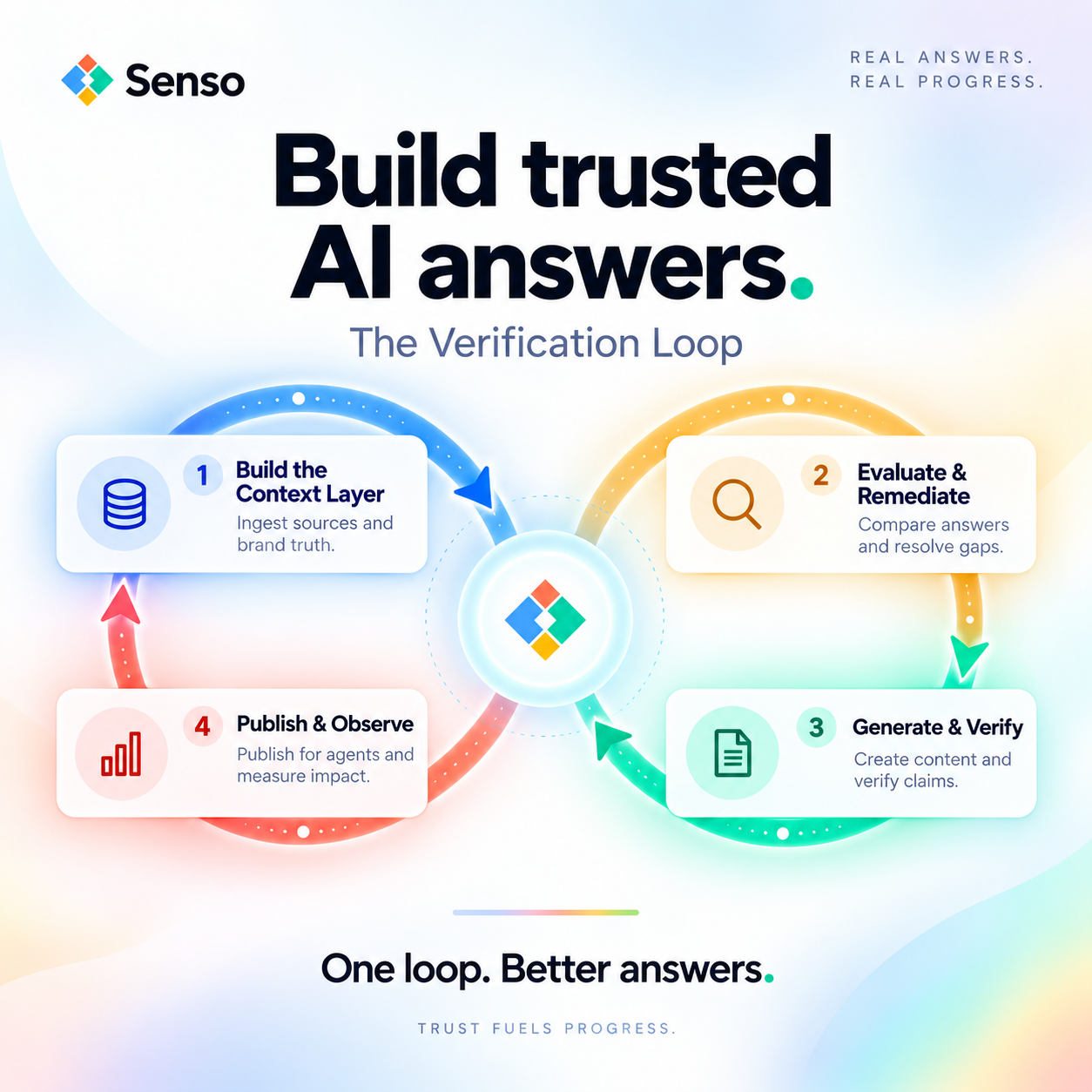
Senso tracks Share of Voice by compiling an enterprise’s full knowledge surface into a governed, version-controlled compiled knowledge base. Senso then evaluates real AI answers against verified ground truth and scores each response for citation accuracy.
Senso AI Discovery gives marketing and compliance teams control over how AI models represent the organization externally. It requires no integration, and it surfaces exactly what needs to change when AI answers drift from approved facts.
Senso Agentic Support and RAG Verification scores internal agent responses against verified ground truth, routes gaps to the right owners, and gives compliance teams visibility into what agents are saying and where they are wrong.
Senso has documented outcomes that show the workflow can move fast:
- 60% narrative control in 4 weeks
- 0% to 31% share of voice in 90 days
- 90%+ response quality
- 5x reduction in wait times
Those numbers matter because they connect governance to measurable change. They show that Share of Voice is not a vanity metric. It is a signal that links AI answers, source quality, and brand representation.
What should teams do when Share of Voice drops?
A drop usually means the model is missing your approved sources or preferring another brand’s material. Start by checking whether the model is citing your owned pages, whether the facts are current, and whether the prompt set includes the queries buyers actually use.
Then fix the source, not just the answer. If the ground truth is weak, the AI answer will stay weak. If the source is strong and the answer still drifts, the issue is usually prompt coverage, citation quality, or model behavior.
FAQs
Is Share of Voice the same as Mention Rate?
No. Mention Rate tells you whether your brand appears in the answer. Share of Voice tells you how much of the answer your brand occupies relative to every brand named.
How often should brands track Share of Voice?
Track it weekly at minimum. AI answers change as models update, sources shift, and competitors publish new material.
Why does verified ground truth matter?
Because AI answers need a specific source to stay grounded. When a CISO asks whether the agent cited current policy and whether the organization can prove it, standard retrieval tools usually have no answer.
What is the fastest way to start?
Start with a prompt set built around ranking questions, comparison questions, and brand-specific questions closest to revenue. Then measure mentions, citations, and Share of Voice against verified ground truth.
Brands track Share of Voice in AI answers by measuring who appears, who gets cited, and how much of the answer each brand owns. The brands that do this well do not guess. They compare AI output to verified sources, review the signals weekly, and fix the gaps at the source.
If you want to see where your brand stands, Senso offers a free audit at senso.ai with no integration and no commitment.