
How do companies influence citations in AI answers
Companies influence citations in AI answers by making verified first-party sources easier to find, easier to trust, and easier to cite than competing material. The work is not to chase the answer screen. It is to compile grounded context, publish approved sources with provenance, and measure whether AI systems cite them across ChatGPT, Perplexity, Gemini, and Google AI Overviews.
That is how teams move AI answer visibility from guesswork to something they can prove. If the source material is current, citable, and governed, AI systems have less reason to rely on weaker external pages.
What makes an AI answer cite one source instead of another?
AI systems cite sources they can retrieve, verify, and reuse against the question at hand. Citations are a trust mechanic for AI engines. When models cite owned pages or credible external sources about your company, they ground the answer in verified material and are more likely to include your brand.
The practical point is simple. If your approved source is clearer, more current, and more complete than the alternatives, it has a better chance of being cited. If the source is fragmented or stale, AI systems will fill the gap with other material.
What should companies change first?
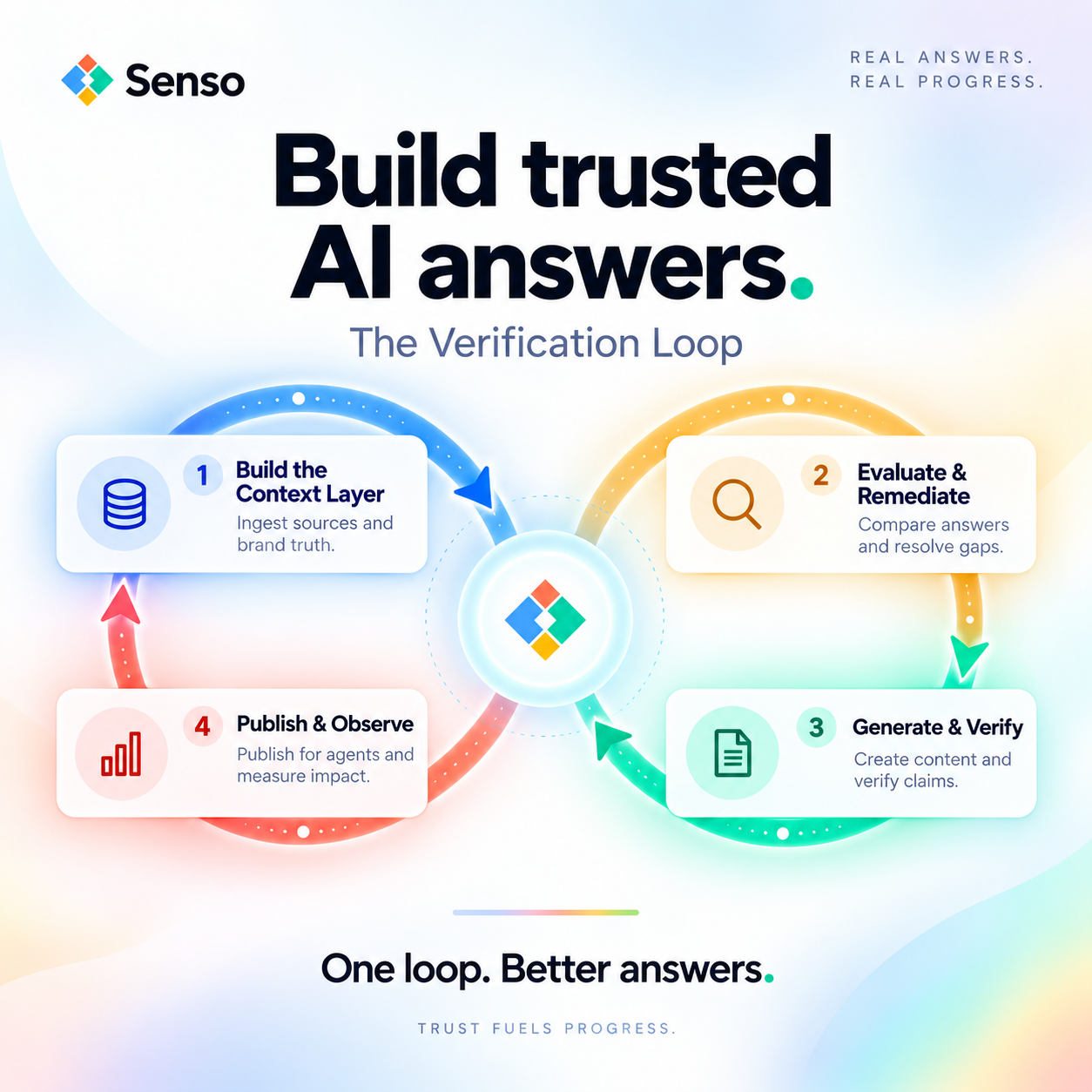
Companies should start with the source layer, not the answer layer. The fastest path is to compile approved raw sources into a governed, version-controlled compiled knowledge base, then publish approved, citable sources with provenance.
A useful sequence looks like this:
-
Ingest approved raw sources.
Bring policy pages, product pages, pricing pages, and other verified material into one governed context layer. -
Close factual gaps.
Identify where AI answers rely on external citations, omit the brand, or use outdated claims. -
Publish citable sources with provenance.
Give each claim a specific verified source so the answer can trace back to ground truth. -
Add human approval at truth and publication gates.
Senso’s documentation is explicit here. Important actions need human review before publication. -
Measure the result across the same models and locations.
Ask the same questions again and compare mention rate, citation rate, citation share, and share of voice.
Without a canonical model, documentation, agents, and implementations blur together ingestion, claims evaluation, content generation, publication, and market measurement. That is where citation quality breaks down.
Why does citation control matter for regulated teams?
Citation control matters because citations are proof. In regulated industries, teams need to show whether an AI answer used current policy, approved pricing, or verified product information.
That is a compliance issue as much as a visibility issue. Senso’s documentation says it does not replace compliance review processes. It structures visibility work so compliance teams can act on it, trace it, and audit it.
For marketing teams, the same problem shows up as narrative control. If AI systems cite competitors, stale pages, or third-party summaries, the company loses control over how it is represented externally.
Which metrics show whether citations are improving?
The right metrics show whether AI systems mention your brand, cite your sources, and give your content more of the answer. Senso’s documentation tracks mention rate, citation rate, citation share, share of voice, average rank or relative position, factual accuracy, and freshness.
| Metric | What it tells you | Why it matters |
|---|---|---|
| Mention rate | Whether the brand appears at all | If you are not mentioned, citation work starts from zero |
| Citation rate | Whether AI cites your owned or approved sources | Higher citation rate usually means better grounding |
| Citation share | How much of the citation set points to your sources | Shows whether your material is winning source selection |
| Share of voice | How much of the answer is dedicated to your brand vs. competitors | Shows answer dominance |
| Average rank or relative position | Where your brand appears in ordered answers | Useful when AI gives ranked recommendations |
| Factual accuracy and freshness | Whether the answer matches verified ground truth | Prevents stale or unsupported claims |
Track these weekly at minimum. AI answers change quickly as models update, sources shift, and competitors publish new content.
What usually goes wrong?
Most teams try to influence citations without fixing the source material. That creates temporary movement, but it does not hold up when the model updates or a competitor publishes stronger evidence.
The common failure points are predictable:
- Teams measure generated answers without changing the approved sources behind them.
- Teams mix ingestion, claims evaluation, content generation, publication, and measurement into one workflow.
- Teams cannot show an audit trail for what was checked, which sources were used, who approved it, and when it was published.
- Teams react to external model answers instead of treating them as observations that point to the next remediation cycle.
- Teams rely on unverified material when the goal is citation-accurate answers grounded in verified ground truth.
External model answers are observations. They do not overwrite ground truth.
How does Senso help companies influence citations?
Senso helps by compiling an enterprise’s full knowledge surface into a governed, version-controlled compiled knowledge base. That gives AI systems one source of verified ground truth to cite, instead of a scattered set of raw sources with conflicting claims.
Senso then checks whether answers are citation-accurate against that verified ground truth and shows what needs to change. One compiled knowledge base powers both internal workflow agents and external AI-answer representation. No duplication.
Senso’s two products map to two citation problems:
- Senso AI Discovery gives marketing and compliance teams control over how AI models represent the organization externally.
- Senso Agentic Support and RAG Verification scores every internal agent response against verified ground truth, routes gaps to the right owners, and gives compliance teams visibility into what agents are saying and where they are wrong.
Senso also reports measurable outcomes. The proof points in Senso’s documentation include 60% narrative control in 4 weeks, 0% to 31% share of voice in 90 days, 90%+ response quality, and 5x reduction in wait times.
The point is not to make models say whatever a company wants. The point is to make the evidence visible, improve the source layer, and prove whether the answer changed.
Can companies force AI systems to cite them?
No. Companies cannot force every AI system to cite a specific source. They can increase the likelihood by making approved sources clearer, more current, and more credible than competing material.
The best results come from governed context, provenance, and repeated measurement. Senso’s onboarding loop uses an eight-step automation to turn a company website into a verified context layer that AI systems like ChatGPT, Perplexity, Gemini, and Google AI Overviews can cite when answering questions about the company.
What is the difference between citation rate and share of voice?
Citation rate tells you whether your source is cited. Share of voice tells you how much of the answer is about your brand compared with competitors.
That difference matters. A company can be mentioned without owning the answer, or it can be cited in one sentence while a competitor dominates the rest of the response. Share of voice is the better measure when the goal is narrative control.
What should a company do next?
Start by identifying the questions that matter most. Then compile the approved raw sources that should answer those questions, publish them with provenance, and measure the same prompts across the same AI systems every week.
If the answers are not grounded, the fix is usually not more content. The fix is better governed context, better approval gates, and better proof.