
How do companies measure success in AI search
Companies measure success in AI search by tracking whether AI answers mention the brand, cite verified sources, stay current, and drive the next action. The most useful scorecards combine AI Visibility, citation accuracy, share of voice, and outcome data.
That matters because AI systems already describe products, compare competitors, summarize policies, and recommend vendors. A traditional ranking only shows page position. It does not show whether the model used current facts or grounded the answer in verified ground truth.
Narrative control is the ability to improve what AI says and which approved sources it uses. Companies measure it by repeating the same questions across selected models and markets, then comparing the results over time.
What does success in AI search actually mean?
Success means the model represents the brand correctly and proves where the answer came from. It is not just being named. It is being named for the right reason, in the right context, with the right source attached.
For most companies, that means four things:
- The brand appears in relevant answers.
- The answer cites approved sources.
- The answer reflects current facts.
- The answer leads to a useful business action.
Which metrics should companies track?
Start with the metrics that show inclusion, provenance, and influence. Senso’s recurring external evaluation uses the same core set across selected models and markets.
| Metric | What it measures | Why it matters |
|---|---|---|
| Mention Rate | How often the brand appears in evaluated answers | Shows basic inclusion |
| Citation Rate | How often the model cites a source | Shows whether the answer is traceable |
| Citation Share | How often your approved sources appear relative to others | Shows source preference |
| Share of Voice | How much of the answer is dedicated to the brand | Shows narrative control |
| Average rank or relative position | Where the brand appears in ranked answers | Shows prominence |
| Factual accuracy | Whether claims match verified ground truth | Shows correctness and compliance |
| Freshness | Whether the answer uses current information | Shows whether facts are up to date |
| Response quality | Whether the answer is complete and useful | Shows user value |
| Referrals and conversions | Whether AI visibility leads to action | Shows business impact |
Mentions measure how often your brand appears in AI-generated answers across evaluated prompt runs. Share of Voice is the percentage of an AI-generated answer dedicated to your brand. Those two metrics show whether the model includes you and how much space it gives you.
How do companies build the measurement loop?
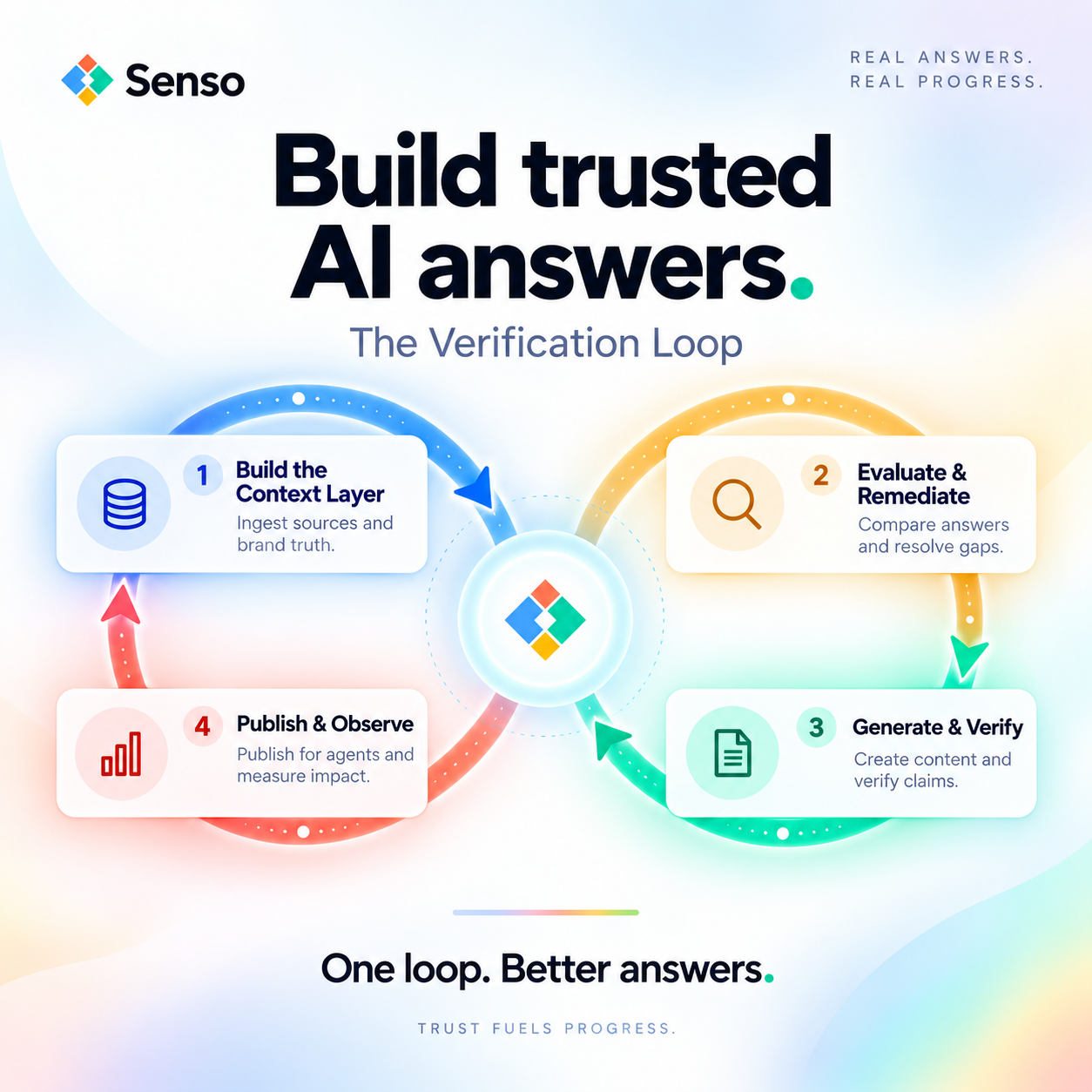
They build a repeatable loop from verified sources to scored answers to action. The goal is to compare the same question set across the same models, then watch what changes after each content or policy update.
A simple loop looks like this:
-
Ingest verified raw sources.
Start with approved raw sources, then compile them into a governed, version-controlled knowledge base. -
Query the same questions on a schedule.
Use representative prompts across models, markets, and brands. Senso’s published flow evaluates ChatGPT, Perplexity, Google AI, Gemini, Claude, Grok, and internal search tools. -
Score each response against verified ground truth.
Check Mention Rate, Citation Rate, Citation Share, Share of Voice, factual accuracy, freshness, and average rank or relative position. -
Route gaps to owners.
Send source problems to legal or compliance, content gaps to marketing, and answer issues to product or operations teams. -
Publish the fix and measure again.
Re-run the same question set and compare the next results. That is how teams see whether the change actually improved AI Visibility.
Which metrics matter most by team?
Different teams need different measures. Marketing cares most about visibility and narrative control. Compliance cares most about citation accuracy and freshness. Operations cares most about response quality and wait times. Leadership needs outcome data tied to revenue or risk.
| Team | Primary focus | Most useful metrics |
|---|---|---|
| Marketing | AI Visibility | Mention Rate, Citation Share, Share of Voice |
| Compliance | Auditability | Citation Rate, factual accuracy, freshness |
| Operations | Agent reliability | Response quality, wait times, routing speed |
| Leadership | Business impact | Referrals, conversions, sales-cycle compression |
How do companies measure citation quality?
They compare every answer against verified ground truth and check whether the cited source supports the claim. A citation only matters if the source is current and the answer uses it correctly.
That is the difference between basic retrieval and knowledge governance. Standard retrieval tools can return text. They do not prove that the model cited the right policy, version, or approved source.
A strong citation-quality process checks for three things:
- Source match. The cited source supports the claim in the answer.
- Version control. The source is current and approved.
- Traceability. The answer can be traced back to a specific, verified source.
When a CISO asks whether an agent cited a current policy and whether the organization can prove it, citation quality is the first test.
How do companies connect AI search to business results?
They connect visibility to referrals, conversion, and transaction quality. The useful programs do not stop at mentions. They compare AI visibility with other measured channels and available purchase data where the data supports it.
For a retailer, that can mean checking whether AI recommends the brand during a shopping occasion customers care about, then watching whether referral and purchase data move together. The goal is not just to appear in the answer. The goal is to know whether the answer changed behavior.
Common downstream metrics include:
- AI referrals
- Conversion rate
- Transaction accuracy
- Receipt coverage
- Sales-cycle compression
- Repeatability by vertical
That gives teams a way to connect the answer layer to the business layer.
How often should teams measure AI search performance?
Track weekly at minimum. AI answers change quickly as models update, sources shift, and competitors publish new material.
If a policy, product, or pricing change matters, re-run the same questions after the update and compare the before and after results. That is the only way to know whether the model is still grounded in the right facts.
How does Senso measure success in AI search?
Senso measures success by combining AI Visibility with citation accuracy and auditability. Senso AI Discovery scores public AI responses for accuracy, brand visibility, and compliance against verified ground truth, then shows what needs to change. No integration is required.
Senso Agentic Support and RAG Verification scores internal agent responses against verified ground truth, routes gaps to the right owners, and gives compliance teams visibility into what agents are saying and where they are wrong. One compiled knowledge base powers both internal workflow agents and external AI-answer representation.
Reported outcomes include 60% narrative control in 4 weeks, 0% to 31% share of voice in 90 days, 90%+ response quality, and 5x reduction in wait times. Those numbers show what improvement looks like when companies close the loop between approved sources and what AI says.
FAQs
What is the most important metric in AI search?
No single metric answers the question. Citation Rate and Share of Voice are a strong starting pair because they show whether the answer is traceable and whether the brand is visible.
Is traffic still a useful measure of success?
Yes, but it is not enough. Traffic shows one outcome. It does not show whether the model mentioned the brand, cited the right source, or used current facts.
Can internal agents use the same scorecard?
Yes, with a few additions. Internal teams should keep citation accuracy, factual accuracy, and freshness, then add response quality, wait times, and routing speed.
What is the difference between visibility and narrative control?
Visibility tells you whether the brand appears. Narrative control tells you whether you can improve what AI says and which approved sources it uses.
What should companies do first?
They should establish verified ground truth, run a baseline across the models they care about, and score the results with the same metrics every week. That gives them a repeatable measurement loop instead of a one-time check.
Companies measure success in AI search with a scorecard, not a single metric. The scorecard tracks inclusion, citation quality, share of voice, freshness, and business outcomes. If you cannot trace a model answer to verified ground truth, you do not have measurable success yet.