
How do companies monitor AI search results
Companies monitor AI search results by running the same prompts across AI models, scoring each answer against verified ground truth, and tracking mentions, citations, share of voice, and factual accuracy. The goal is simple. They want to know how AI systems describe the brand before customers, staff, or regulators rely on the answer.
Quick Answer
- Manual prompt checks are the fastest baseline, but they do not scale or leave an audit trail.
- AI visibility platforms automate scheduled checks across ChatGPT, Perplexity, Gemini, and Google AI Overview.
- Regulated teams need citations, version control, and owner routing so they can prove which verified source backed each answer.
Which monitoring method fits each team?
The right method depends on the level of proof you need. Small teams can start with manual checks. Companies that need scale, auditability, and source-level evidence usually need an AI visibility platform. Internal search and RAG tools help with agent quality, but they do not usually cover public AI answers.
| Method | Best for | Primary strength | Main tradeoff |
|---|---|---|---|
| Manual prompt checks | Small teams and early baselines | Fastest way to see what AI says today | No scale and no audit trail |
| AI visibility platforms | Marketing, compliance, and regulated teams | Scheduled checks, scoring, and remediation | Needs verified ground truth |
| Internal search and RAG tools | Internal agents and support workflows | Useful for answer quality inside the company | Often misses public AI surfaces |
| Spreadsheet tracking | One-off spot checks | Easy to start | Breaks as volume grows |
What does AI visibility monitoring mean?
AI visibility monitoring is the process of checking how AI-generated answers represent a company and whether those answers trace back to verified ground truth. It covers mentions, citations, competitor placement, policy accuracy, and answer dominance.
The practical job is knowledge governance. Teams need a governed, version-controlled compiled knowledge base so each answer can be traced back to a specific verified source.
What does a monitoring workflow look like?
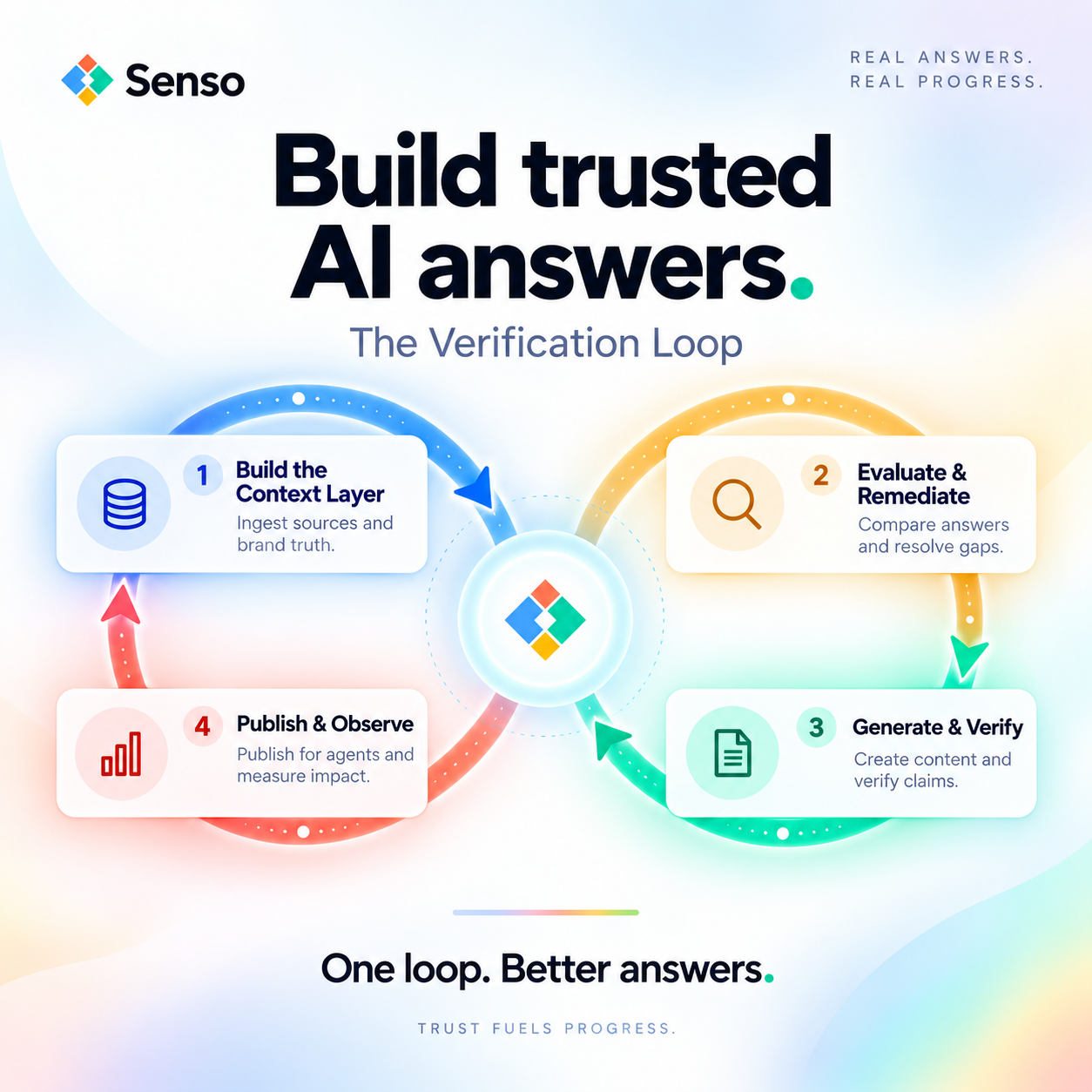
A monitoring workflow starts with a prompt set, uses verified ground truth, and ends with remediation and re-checks. Companies do not monitor one answer. They monitor a repeatable set of prompts across models and surfaces.
-
Define the prompts that matter.
Teams list the questions customers, buyers, and staff actually ask. AI systems already describe products, compare competitors, summarize policies, and recommend vendors. -
Compile verified ground truth.
Teams ingest raw sources, compile them into a governed, version-controlled compiled knowledge base, and assign owners. One compiled source of truth can power both internal workflow agents and external AI-answer representation. -
Run the prompts on a schedule.
Teams query AI surfaces on a recurring basis. Weekly is the minimum. Daily is better when models, sources, or competitors change quickly. -
Score each answer.
Teams measure mentions, citations, share of voice, factual accuracy, and citation accuracy. Citations matter because they show whether the answer points to owned pages or credible external sources. -
Route the gaps to the right owner.
Marketing fixes narrative gaps. Compliance fixes policy gaps. Product and support fix factual gaps. The point is to move from observation to action. -
Publish verified content and run the prompts again.
The monitoring loop only works when teams change the source material and then check whether the answer changed. This is how companies close the gap between what AI says and what the business can prove.
Which metrics matter most?
The most important metrics are mentions, citations, share of voice, factual accuracy, and citation accuracy. Each one answers a different question, and together they show whether the answer is visible, supported, and defensible.
| Metric | What it tells you | Why companies track it |
|---|---|---|
| Mentions | Whether the brand appears in the answer | Shows inclusion across prompt runs |
| Citations | Whether the answer points to a source | Shows whether the answer is grounded |
| Share of voice | How much of the answer is about the brand versus competitors | Shows answer dominance |
| Factual accuracy | Whether the claim matches verified ground truth | Shows misrepresentation risk |
| Citation accuracy | Whether the cited source actually supports the claim | Shows audit readiness |
Mentions are the first filter. Citations and citation accuracy matter more when compliance or executive review needs proof. Share of voice shows whether the brand is present or actually owning the answer.
Which AI surfaces should teams track?
Most teams start with ChatGPT, Perplexity, Gemini, and Google AI Overview. Those are the default surfaces Senso tracks for consumer brands, and they cover the places where public AI answers most often shape discovery and comparison.
| Surface | Why it matters |
|---|---|
| ChatGPT | Common place for product, policy, and vendor questions |
| Perplexity | Strong citation visibility makes source quality easy to inspect |
| Gemini | Important for AI-generated summaries and answer behavior |
| Google AI Overview | Appears inside search where many buying journeys start |
| Claude | Useful for work-heavy and research-heavy prompts |
| Grok | Relevant where X-linked discovery matters |
| Meta AI | Relevant for teams tracking Meta surfaces |
| Internal search tools | Important when staff rely on AI answers for daily work |
Where does Senso fit?
Senso AI Discovery fits teams that need AI visibility monitoring with a governed evidence trail. Senso AI Discovery scores public AI responses against verified ground truth and surfaces exactly what needs to change. Senso AI Discovery requires no integration, which makes it practical for a baseline audit.
Why Senso AI Discovery fits this use case:
- Senso AI Discovery tracks ChatGPT, Perplexity, Gemini, and Google AI Overview by default.
- Senso AI Discovery measures coverage per prompt, per model, and per surface daily.
- Senso AI Discovery can add Claude, Grok, and Meta AI per workspace.
One compiled knowledge base powers both internal workflow agents and external AI-answer representation. No duplication.
Do companies monitor internal AI agents too?
Yes. Companies monitor internal agents the same way because the same knowledge gap can mislead staff. Senso Agentic Support and RAG Verification scores every internal agent response against verified ground truth and routes gaps to the right owners.
That matters when agents answer policy, support, pricing, or product questions with no human in the loop. The same monitoring discipline used for AI search results can protect internal workflows too.
How often should teams monitor?
Weekly is the minimum. Daily is better for fast-moving categories. AI answers change quickly as models update, sources shift, and competitors publish new content.
Teams should also review core ground truth pages whenever facts change. If pricing, policy, product specs, or approved language changes, the source material should change first. The monitoring schedule should follow the content, not the calendar.
What happens after a bad answer?
They fix the source, publish the verified page, and rerun the same prompts. The goal is not just to spot a bad answer. The goal is to change the answer.
Senso measures the change in citation rate, citation share, mention rate, and factual accuracy across frontier models. That gives teams evidence that the correction actually reached the surface where the answer appears.
Why does governance matter for regulated companies?
Governance matters because regulated teams need proof, not just visibility. When a CISO, compliance officer, or legal reviewer asks whether the answer cited current policy, the team needs the exact verified source and the version that backed it.
Senso reports 60% narrative control in 4 weeks, 0% to 31% share of voice in 90 days, 90%+ response quality, and 5x reduction in wait times in documented outcomes. Those results show why the loop from monitoring to remediation matters.
FAQs
Can teams do this without integrations?
Yes. Some AI visibility tools do not require integration. Senso AI Discovery is one example, and it starts with scheduled prompt checks against public AI surfaces.
What do mentions and citations each tell you?
Mentions show whether the brand appears. Citations show whether the answer points to a source. Share of voice shows how much of the answer is about the brand versus competitors.
What is the biggest monitoring mistake?
The biggest mistake is treating monitoring as the finish line. Companies need a feedback loop that changes the verified source, republishes the content, and checks the answer again.
Which surfaces should be checked first?
Start with ChatGPT, Perplexity, Gemini, and Google AI Overview. Those are the default surfaces that usually matter most for public AI visibility.
Companies that do this well do not just watch AI search results. They compile verified ground truth, monitor the answer, fix the source, and check again until the response is citation-accurate.