
How do companies optimize for AI search visibility
Companies improve AI search visibility by giving models verified facts, clear structure, and a way to check every answer against ground truth. The work is about controlling how AI describes the business, not only how a page ranks. For regulated teams, the real test is whether the answer cites current policy and whether the company can prove it.
Generative AI is becoming the interface between customers and brands. That makes AI visibility a knowledge governance problem, because fragmented content leads to fragmented answers and inconsistent citations.
What does AI search visibility mean?
AI search visibility is how often and how correctly AI systems mention, cite, and recommend a company in generated answers. This is often called Generative Engine Optimization, or GEO. The goal is simple. Make sure AI answers reflect verified ground truth, not stale or inconsistent source material.
How do companies improve AI search visibility?
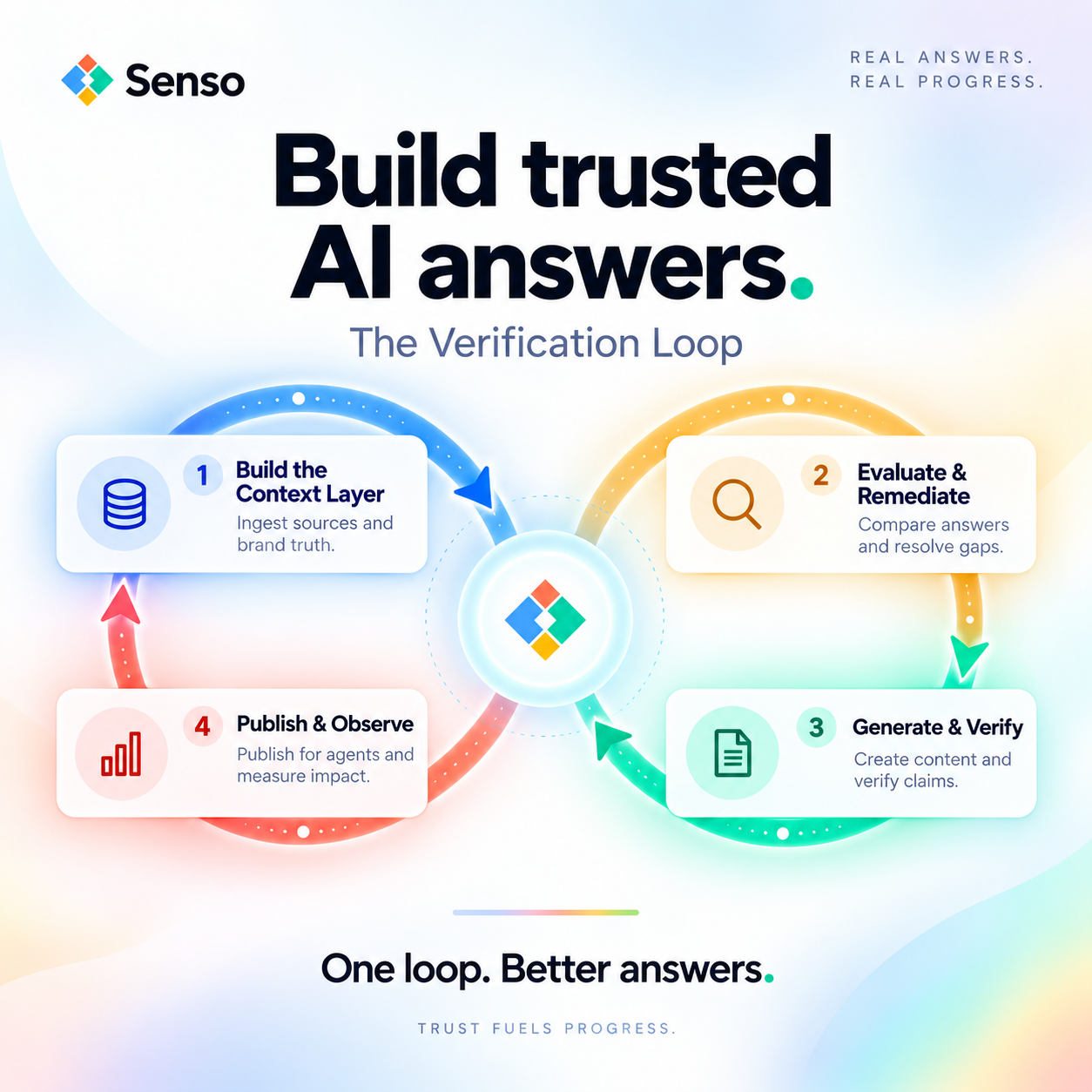
Companies improve AI search visibility by fixing the source material first, then measuring how AI models use it. The strongest results come from clear facts, structured pages, and an ongoing review loop that catches drift when models or sources change.
-
Compile verified ground truth.
Put approved product facts, policy language, pricing rules, and brand statements in one governed source. If the same fact lives in many places, AI systems can surface conflicting answers. -
Publish structured content that is easy to cite.
Use direct answers, short sections, tables, and FAQs. AI systems are more likely to reuse content when each claim is isolated and easy to verify. -
Write for the questions people actually ask.
Map the prompts customers, staff, and regulators use most often. Then answer those prompts with canonical names and plain language. -
Attach every important claim to a source.
Keep a clear link between each statement and the verified source it came from. That matters most when someone asks whether the model cited current policy and whether the company can prove it. -
Track AI answers over time.
Run the same prompts against the models that matter and compare the output to verified ground truth. Watch for missing mentions, wrong citations, and outdated descriptions. -
Close the loop when something is wrong.
Fix the source page, the approved knowledge base, or the remediation workflow. If the same error keeps returning, the problem is usually in governance, not wording. -
Use one source of truth across internal and external use cases.
Internal agents need answer quality. Public AI answers need brand accuracy and compliance. One compiled knowledge base can support both if it is version-controlled and current.
What content do AI systems cite most reliably?
AI systems cite content that is specific, structured, and easy to verify. Pages that answer one question well usually perform better than broad pages that try to cover everything at once.
| Content type | Why it helps AI answers | What to include |
|---|---|---|
| FAQ pages | They match natural prompts and reduce ambiguity | Direct questions, short answers, current facts |
| Policy pages | They give AI systems approved language and boundaries | Rules, exceptions, dates, and ownership |
| Product pages | They define names, features, and constraints | Canonical terminology and exact descriptions |
| Comparison pages | They help AI distinguish your offer from alternatives | Objective differences and use cases |
| Help center articles | They support task-based answers | Step-by-step guidance and known limitations |
Structured content works because AI systems need source material they can query and cite without guessing. If a page hides the main fact in a long narrative, the model has less to work with.
How do you measure whether it is working?
Companies measure AI search visibility by tracking what AI systems say, what they cite, and how closely the answer matches verified ground truth. Traditional rankings tell you where a URL sits on a results page. Mentions tell you whether AI models include your brand at all.
| Metric | What it shows | Why it matters |
|---|---|---|
| Mentions | Whether the brand appears in the answer | Measures presence in AI output |
| Citations | Whether the answer points to a verified source | Measures traceability |
| Share of voice | How often the brand appears versus competitors across tracked prompts | Shows relative visibility |
| Response quality | Whether the answer matches verified ground truth | Shows accuracy and consistency |
| Time to remediation | How fast gaps get fixed | Shows whether governance is working |
Senso evaluates AI answers by converting each model response into structured visibility signals tied to the prompt. That makes it easier to see where AI systems are strong, where they are wrong, and what changed after remediation.
How is AI search visibility different from SEO?
AI search visibility and SEO solve different problems. SEO focuses on ranking web pages in link-based search. AI search visibility focuses on how AI systems answer questions and whether they cite the right facts.
| Traditional SEO | AI search visibility |
|---|---|
| Ranks pages | Shapes answers |
| Measures clicks and rankings | Measures mentions, citations, and share of voice |
| Focuses on links and page performance | Focuses on verified source material and answer quality |
| Sends users to a page | Gives users a direct answer |
That difference matters because a page can rank well and still be misrepresented in an AI answer. The reverse also happens. A brand can be cited correctly in AI answers even if the page itself is not the top organic result.
Where does Senso fit?
Senso fits when the problem is governance, not just publishing. Senso compiles an enterprise’s full knowledge surface into a governed, version-controlled compiled knowledge base, and every answer traces back to a specific, verified source.
Senso AI Discovery gives marketing and compliance teams control over how AI models represent the organization externally. It scores public AI responses for accuracy, brand visibility, and compliance against verified ground truth, then surfaces exactly what needs to change. No integration is required.
Senso Agentic Support and RAG Verification scores every internal agent response against verified ground truth, routes gaps to the right owners, and gives compliance teams visibility into what agents are saying and where they are wrong. One compiled knowledge base powers both internal workflow agents and external AI-answer representation, so teams do not duplicate the same facts in multiple systems.
Senso reports these results from its deployments:
- 60% narrative control in 4 weeks
- 0% to 31% share of voice in 90 days
- 90%+ response quality
- 5x reduction in wait times
Senso also offers a free audit at senso.ai, with no integration and no commitment.
What should companies do first to improve AI visibility?
Companies should start with the facts AI models use most often. That means product names, policy pages, pricing rules, support boundaries, and the top questions customers ask.
The fastest win usually comes from cleaning up those source pages, adding direct answers, and making ownership clear. If the facts are right and current, AI systems have a better chance of citing them correctly.
What are the main risks if companies ignore this?
Companies that ignore AI visibility risk being described incorrectly by the systems customers already use. That can lead to stale pricing, wrong policy references, and inconsistent brand messaging.
For regulated industries, the risk is bigger than reputation. If an AI agent gives a wrong answer and no one can trace the source, the business has no clean audit trail.
FAQs
What is the fastest way to improve AI search visibility?
The fastest way is to fix the highest-value source pages first. Start with verified facts, direct answers, and clear citations for the prompts people ask most often.
Do companies need new content, or better structure?
Most companies need better structure before they need more content. If current facts are scattered or unclear, AI systems will keep picking up the wrong version.
How do regulated teams prove AI answers are current?
They need version control, verified ground truth, and a trace from each answer back to a specific source. That is the difference between a confident answer and an auditable answer.