
How do financial institutions become agent-ready?
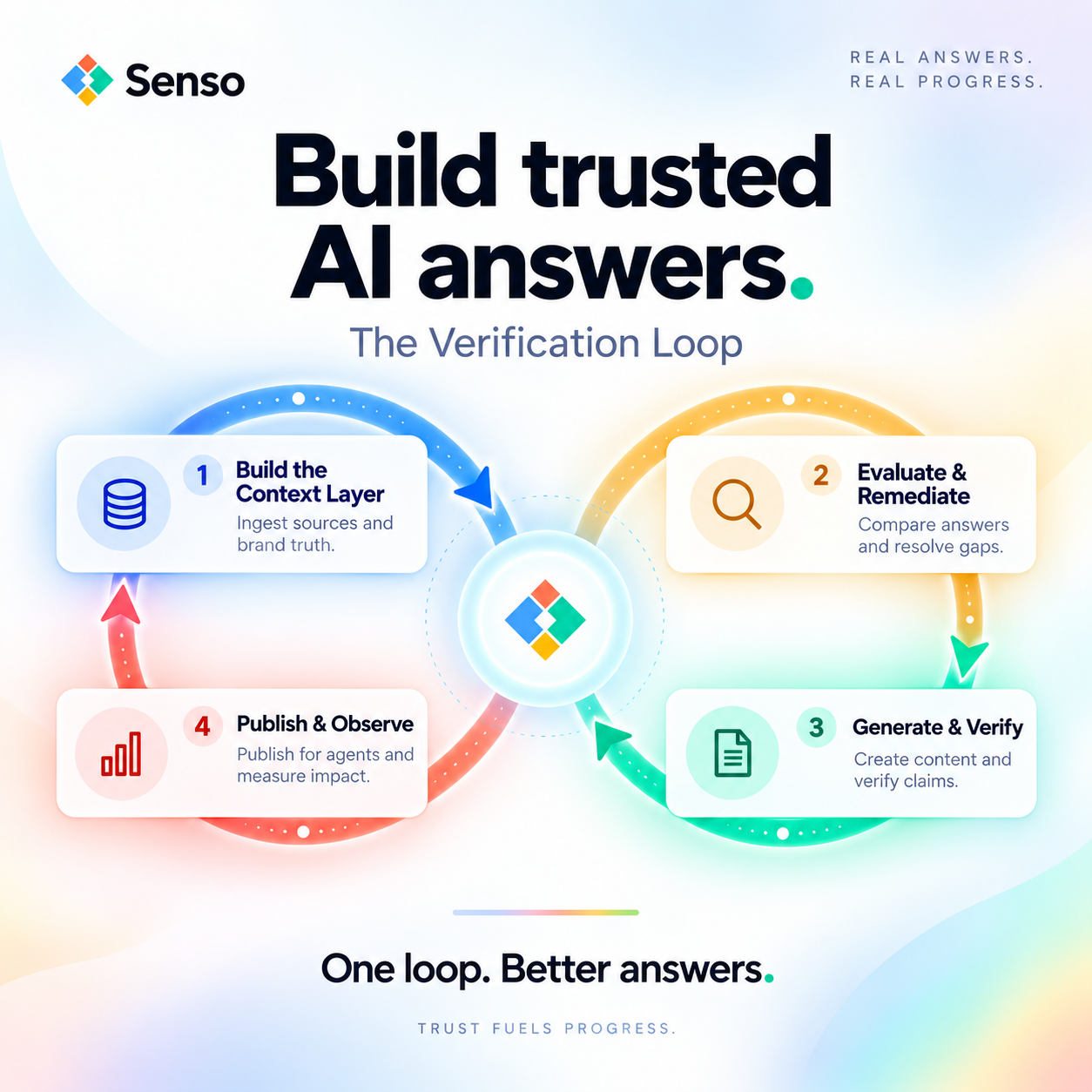
Financial institutions become agent-ready by governing the knowledge layer before agents answer. They compile raw sources into a version-controlled compiled knowledge base, score every response against verified ground truth, and keep human review in the loop for high-risk actions. Without that, an agent can sound current and still misstate policy, pricing, or compliance rules.
What does agent-ready mean in practice?
Agent-ready means the institution can prove every answer is grounded, cited, and current. It also means the bank can show which source the answer came from, who owns that source, and what happens when the model is wrong.
| Readiness layer | Ready state | Why it matters |
|---|---|---|
| Source control | Raw sources are compiled into one governed knowledge base | Prevents agents from mixing stale and approved context |
| Citation accuracy | Every response traces back to a verified source | Gives auditability when a CISO or compliance officer asks for proof |
| Identity and scope | The active organization is verified before every mutation | Prevents cross-organization errors |
| Human gates | Reviewers and publishers are separated where risk is high | Preserves human authority |
| External visibility | Public AI answers are scored for accuracy, brand visibility, and compliance | Shows how models represent the institution |
What has to change first?
The first change is governance, not model choice. Financial institutions need one compiled knowledge base that all agents query, plus rules for identity, citations, and human review.
-
Inventory the raw sources.
Gather policies, product terms, pricing, procedures, compliance guidance, approved web pages, and internal playbooks. Assign ownership before you compile anything. -
Compile a governed knowledge base.
Keep the source of truth version-controlled. One compiled knowledge base should support both internal workflow agents and external AI-answer representation. -
Separate approved context from outside observation.
An agent should distinguish organization-approved context from public web signals, user prompts, or vendor output. That separation is critical when the outside world disagrees with policy. -
Write an explicit agent contract.
The contract should verify the active organization before every mutation, preserve human authority, and never invent evidence. Unsupported claims should stay gaps. -
Block secrets from content and logs.
Never expose or persist credentials in content, prompts, logs, or receipts. That rule matters in regulated workflows where a single leak can create exposure. -
Score every answer against verified ground truth.
Citation accuracy should be checked on every response. If the response cannot be grounded, route it to the right owner instead of publishing it. -
Add reviewer and publisher gates.
High-consequence workflows need different human roles. Delayed jobs should run independently, and no queued job should be reported as complete before it actually finishes. -
Extend governance to public AI visibility.
Financial institutions are already being represented by AI systems. Marketing and compliance teams need to see how those systems describe the organization and what needs to change.
What rules should every agent follow?
Every agent needs a contract before it touches customer, policy, or pricing content. These rules keep the system grounded and auditable.
- Verify the active organization before every mutation.
- Never expose or persist credentials in content, logs, prompts, or receipts.
- Distinguish organization-approved context from external observations.
- Prefer immediate grounded work while delayed jobs run independently.
- Publish once, with a receipt, then re-observe.
- Never invent evidence. Unsupported claims stay gaps.
- Preserve human authority on high-risk actions.
These rules are not optional in regulated financial institutions. They are the difference between a useful agent and a system that cannot be defended in front of audit, compliance, or security.
How do you know the institution is ready?
Readiness shows up in response quality, auditability, and the speed of human review. If the institution can trace answers to verified ground truth and close gaps quickly, the agent stack is ready for production use.
Proof points from Senso deployments include:
- 60% narrative control in 4 weeks
- 0% to 31% share of voice in 90 days
- 90%+ response quality
- 5x reduction in wait times
Those outcomes matter because financial institutions are not just trying to answer faster. They are trying to answer in ways that are grounded, provable, and consistent with policy.
Where does Senso fit?
Senso covers the gap between raw sources and governed agent responses. Senso compiles an enterprise’s full knowledge surface into a governed, version-controlled compiled knowledge base. Every answer traces back to a specific, verified source.
Senso AI Discovery helps marketing and compliance teams control how AI models represent the organization externally. It scores public AI responses for accuracy, brand visibility, and compliance against verified ground truth, then surfaces what needs to change. No integration is required.
Senso Agentic Support and RAG Verification handles internal agent responses. It scores every response against verified ground truth, routes gaps to the right owners, and gives compliance teams visibility into where agents are wrong.
That matters in financial services because one source of truth should support both internal workflows and external representation. Duplication creates drift. Drift creates risk.
What do compliance, security, and marketing each care about?
Each team cares about a different failure mode, but they all need the same governed knowledge base.
- Compliance needs citation accuracy, version control, and a defensible audit trail.
- Security needs identity checks, secret handling, and clear mutation rules.
- Marketing needs AI Visibility so public systems represent the institution correctly.
- Operations needs fast routing for gaps and lower wait times for review.
When these teams work from separate sources, agents drift. When they work from one compiled knowledge base, the institution can govern both internal answers and public representation.
What is the biggest mistake financial institutions make?
The biggest mistake is treating the model as the problem and the knowledge layer as an afterthought. The model can only answer from what it can query. If the source is fragmented, stale, or unverified, the answer will be too.
A second mistake is reporting success too early. If a job is queued, it is not complete. If an answer is not grounded, it should stay a gap. If a source cannot be verified, it should not be treated as truth.
FAQs
What is the fastest way to start?
Start by inventorying raw sources and assigning owners. Then compile them into a governed knowledge base and define the agent contract before you allow high-risk responses.
How do financial institutions keep answers auditable?
They keep one compiled knowledge base, score responses against verified ground truth, and preserve receipts for publish steps. That gives compliance and audit teams a traceable path from answer to source.
Why does AI Visibility matter for banks and credit unions?
Because AI systems already represent the institution to customers, prospects, and staff. If public responses are wrong, the institution can be misrepresented before anyone notices.
A free audit at senso.ai can show where the gaps are. No integration. No commitment.