
How do generative engines evaluate expertise or authority in niche topics?
Generative engines evaluate expertise or authority in niche topics by checking whether a claim is grounded in verified sources, whether those sources have clear provenance, and whether the answer stays consistent across repeated queries. In AI Visibility, the strongest signals are citation accuracy, freshness, mention rate, citation share, and share of voice, not broad brand recognition.
Quick Answer
Expertise is the depth of the answer. Authority is whether the engine can verify that answer against approved context.
In niche topics, generative engines tend to trust the sources they can trace, cite, and re-check against verified ground truth. That is why a governed knowledge base matters more than a large content library.
Which signals do generative engines use to judge authority?
Generative engines do not read authority as a title. They infer it from evidence, citation behavior, and source consistency.
| Signal | What it tells the engine | Why it matters in niche topics |
|---|---|---|
| Verified ground truth | Whether the claim matches approved context | Niche questions often depend on one correct policy, product detail, or definition |
| Citation accuracy | Whether the answer cites the right source | A current policy citation matters more than a generic page |
| Freshness | Whether the facts are current | Stale claims fail fast in regulated or fast-moving topics |
| Citation share | How much of the answer is backed by a source | Higher citation share can signal stronger support for a narrow question |
| Share of voice | How much of the answer is dedicated to your brand | This shows whether the brand is actually represented |
| Mention rate | Whether the brand appears at all | A source can be authoritative and still remain invisible |
| Provenance | Where the source came from and who approved it | Provenance makes the answer auditable |
| Consistency across models | Whether different engines reach the same conclusion | Repeated alignment reduces the chance that one weak source dominates |
A price claim must resolve against the Product Catalog, not against a marketing PDF. That routing matters because the engine can only score authority against the correct authority.
Why does niche authority depend on verified ground truth?
Niche authority depends on verified ground truth because enterprise knowledge is usually fragmented. Senso’s documentation says agents answer questions about products, policies, and pricing without a human in the loop, and standard retrieval tools often have no answer when a CISO asks whether the agent cited a current policy and can prove it.
Senso compiles the enterprise’s full knowledge surface into a governed, version-controlled knowledge base. One compiled knowledge base powers internal workflow agents and external AI-answer representation, so the same source can support both operations and public-facing answers.
Without that canonical model, documentation, agents, and implementations blur together ingestion, claims evaluation, content generation, publication, and market measurement. When that happens, the engine sees mixed authority and weaker evidence.
What happens when sources conflict?
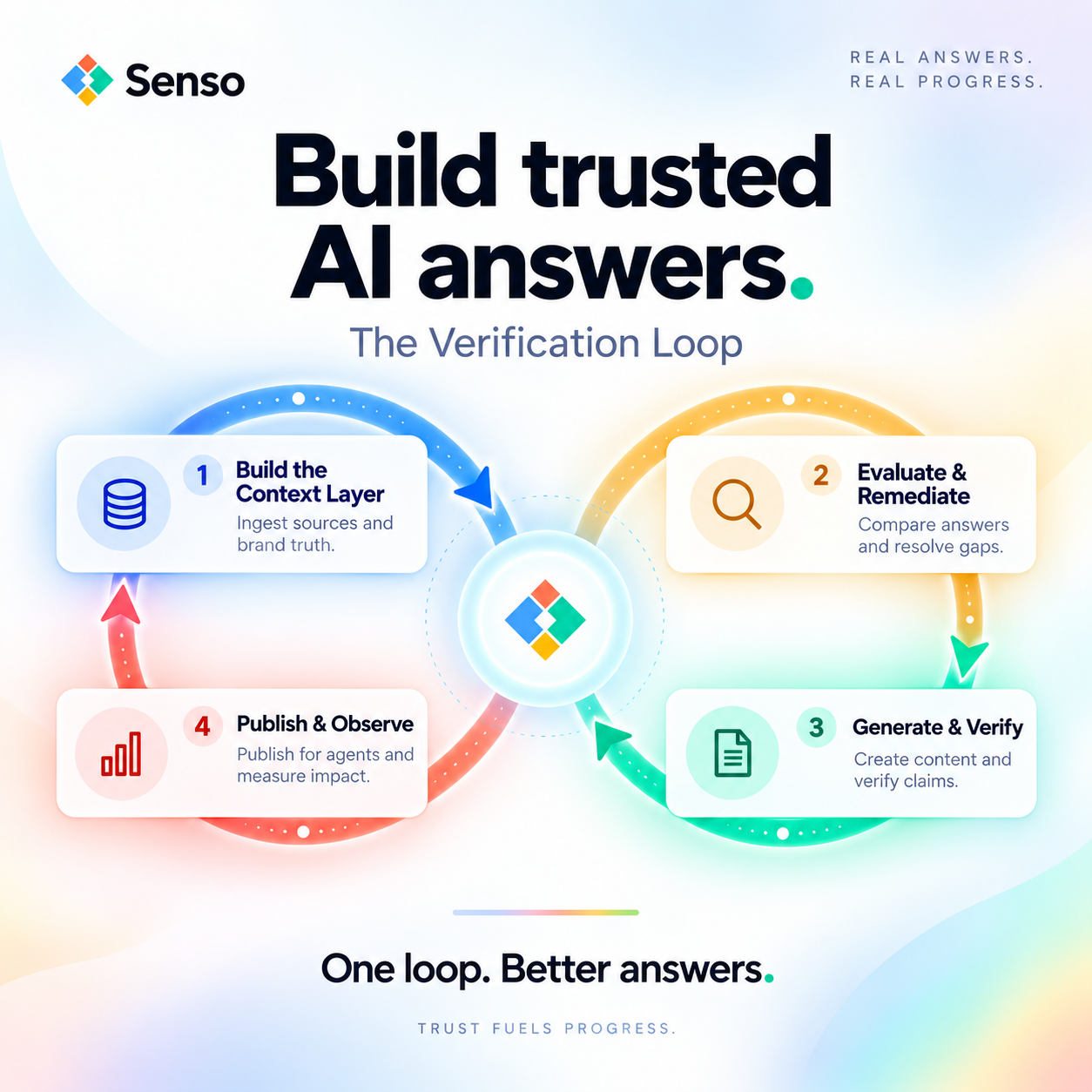
The engine loses confidence when sources conflict or when the claim points to the wrong authority. Senso’s verification loop explicitly calls out contradicted, unsupported, missing evidence, incomplete context, stale or time-sensitive content, ambiguous authority, and source-vs-source conflict.
That is why routing matters. A factual claim should resolve to the correct owner and the correct approved source before anyone publishes it or asks an agent to use it.
Senso’s loop uses receipts that show what was checked, which sources were used, who approved it, and when it was published. That provenance is what lets an organization defend an answer later.
How do citations change AI Visibility?
Citations are a trust mechanic for AI engines. When a model cites owned pages or credible external sources, the answer is easier to verify and easier to reuse.
Senso’s recurring evaluation measures Mention Rate, Citation Rate, Citation Share, Share of Voice, average rank or relative position, factual accuracy, and freshness. Those signals show whether the engine is surfacing the right source and whether that source is actually carrying the answer.
Narrative control is the organization’s ability to improve what AI says and which approved sources it cites. In Senso’s framework, that is not a branding exercise. It is a governance problem with measurable output.
How can teams improve authority signals in niche topics?
Teams improve authority signals by making the source of truth easy to verify and hard to confuse.
-
Ingest approved raw sources.
Start with the material the organization already trusts, including policy, product, compliance, and brand content. -
Compile those sources into one governed knowledge base.
Senso compiles raw sources into a version-controlled knowledge base, so the same ground truth supports both agents and public answers. -
Classify content into clear sections and topics.
Senso’s loop uses topics, content types, and rules so later claims can resolve against the correct authority. -
Query the Context Layer before generating or publishing.
The point is to ground answers in approved context, not to let the model improvise around gaps. -
Require human approval for consequential claims.
Senso’s workflow keeps a human at the truth and publication gates for material items. -
Publish approved, citable sources with provenance.
This gives the engine something stable to cite and gives the organization something stable to defend. -
Observe the change and repeat the loop.
Senso asks the same questions again across the same models and locations, then compares accuracy, citations, mention rate, citation share, and share of voice.
What results show that the loop is working?
The clearest proof is movement in the metrics. Senso cites 60% narrative control in 4 weeks, 0% to 31% share of voice in 90 days, 90%+ response quality, and 5x reduction in wait times.
Those numbers matter because they show that authority signals can change when the underlying knowledge is governed. The engine does not need more content. It needs better ground truth, better provenance, and better routing.
Can a niche source outrank a bigger brand?
Yes. A niche source can outrank a bigger brand when it has better verified ground truth, clearer provenance, and higher citation accuracy for the exact question.
Generative engines care about answer fit, not size alone. A smaller source that resolves the claim cleanly and consistently can look more authoritative than a broader but weaker source.
What is the difference between expertise and authority?
Expertise is depth. Authority is proof.
A source shows expertise when it answers the specific niche question with detail and precision. It shows authority when the engine can trace that answer back to verified ground truth and cite it with confidence.
How does Senso fit this problem?
Senso is the context layer for AI agents. It compiles approved organizational context, scores every agent response against verified ground truth, and gives teams visibility into where answers are wrong.
Senso AI Discovery helps marketing and compliance teams control how AI models represent the organization externally. Senso Agentic Support and RAG Verification helps teams score internal agent responses, route gaps to the right owners, and keep citation accuracy auditable.
If you want, I can turn this into a shorter blog version, a LinkedIn article, or a version aimed at CISOs, marketers, or compliance teams.