
How do generative systems decide when to cite vs summarize information?
Generative systems cite when a claim needs traceability and they can connect it to verified ground truth. They summarize when they can synthesize a useful answer from trusted context without exposing every source. The decision depends on source quality, claim specificity, recency, and whether exact wording matters.
What is the difference between citation and summarization?
Citation gives provenance. Summarization gives meaning. A system cites when a reader needs to see where a fact came from, and it summarizes when the system can combine several verified facts into one coherent answer. Senso’s internal docs say the generated answer is synthesised, not quoted, so the same evidence can appear in different language while still being grounded.
| Output type | What it does | When it is used |
|---|---|---|
| Citation | Points to a specific verified source | Current policy, legal language, metrics, named facts |
| Summarization | Rewrites multiple verified facts into one answer | Overviews, comparisons, background context |
| Quotation | Preserves the original wording | Quotes, definitions, compliance language, exact phrasing |
What makes a system cite a source?
A system cites when the claim is specific enough that a source matters. Current policy language, regulated statements, metric definitions, and brand claims usually fall into that category because they need a traceable origin. In Senso’s workflow, the system searches the Context Layer, produces a grounded internal answer, and attaches citations back to verified ground truth.
The strongest citation signals are usually these:
- The claim exists in verified ground truth.
- The question asks for a precise fact, not a broad overview.
- Exact wording matters for legal, policy, or compliance reasons.
- The source is current and consistent with other approved material.
- The answer closes a known information gap, such as when the organization is absent from a question or a competitor is cited ahead of it.
When does a system summarize instead?
A system summarizes when the question asks for an overview, a comparison, or a broader explanation. In those cases, the model can synthesize a shorter answer from multiple trusted passages instead of anchoring every sentence to one source. That is common when the user wants the meaning, not the wording.
Summaries are more likely when:
- Several verified sources say the same thing in different words.
- The user asks for general context.
- No single source needs to be quoted.
- The answer is meant to read as one coherent explanation.
- The system can safely combine aligned facts without losing meaning.
Why does exact wording matter?
Exact wording matters when changing the words changes the meaning. Senso’s docs call out metric definitions, legal language, and quotes as cases where detailed wording is the point. In those situations, a system should not paraphrase freely. It should cite the source or preserve the original language.
This matters for compliance and auditability. A paraphrase can be useful for readability, but it can also blur a policy boundary or alter a definition. If the wording is the evidence, the system should keep the wording visible.
How do source freshness and conflict detection change the answer?
Fresh, consistent sources win. Senso’s workflow includes source freshness checks and conflict detection because stale pages and contradictory statements can produce answers that look confident but are not grounded. A current policy should outrank an outdated copy. A verified source should outrank a fragment that drifted out of date.
A governed system uses the following logic:
- Check whether the source is current.
- Check whether the source conflicts with approved material.
- Prefer the verified source when versions disagree.
- Attach the citation to the exact source that supports the answer.
- Preserve publication and verification history so the answer can be audited later.
Senso’s internal docs also note that when the generated answer disagrees with the excerpts, the excerpts win. That is the right rule for any system that has to prove where an answer came from.
How can teams measure whether a system is citing enough?
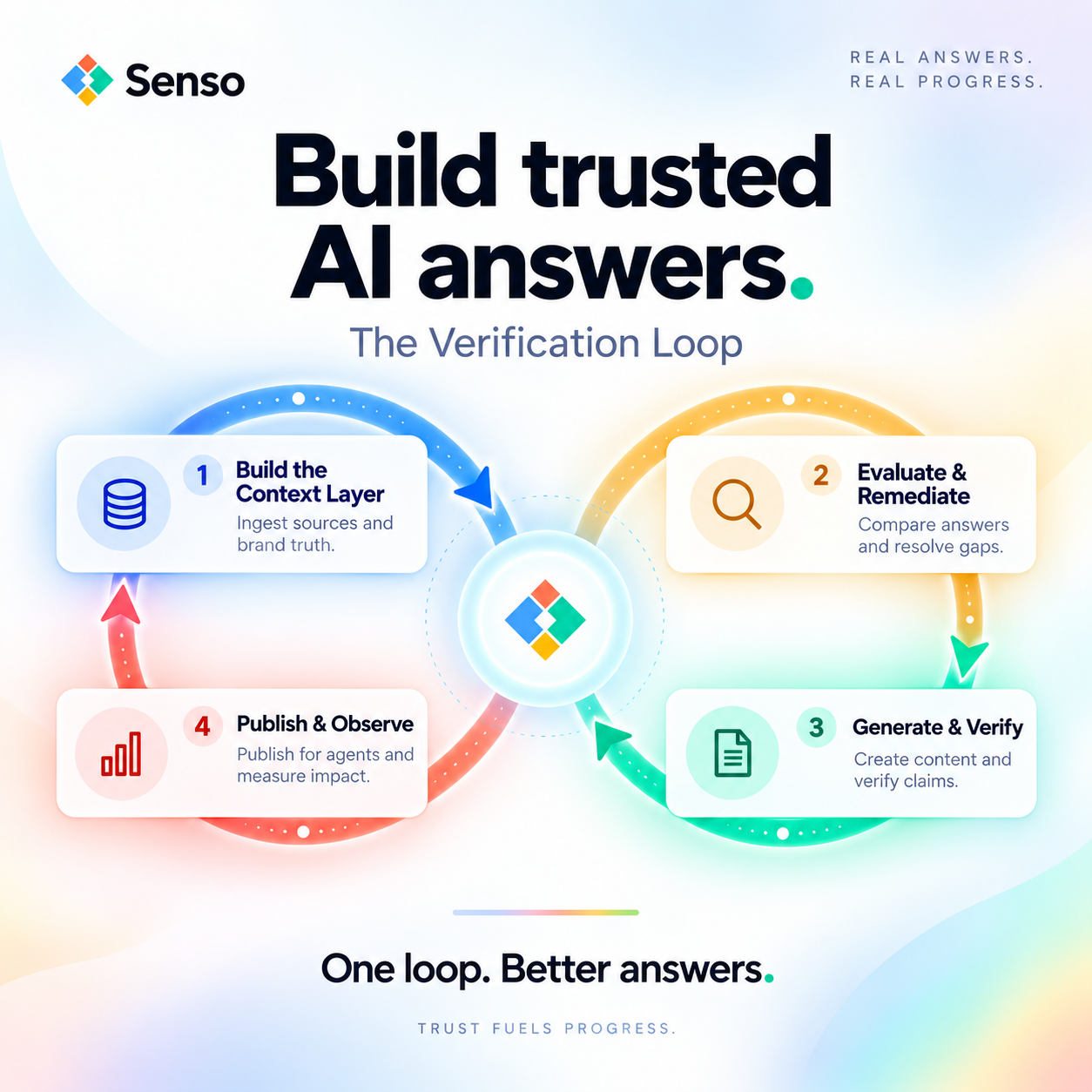
Teams should compare the same prompts before and after a change. Senso’s verification loop re-runs the same questions against the same models and locations, then measures factual accuracy, mention rate, citation rate, citation share, and share of voice. That makes the change visible instead of anecdotal.
Citation rate and citation share are different. Senso’s glossary says citation rate divides by answers with at least one citation, while citation share divides by citation instances. Mixing them creates misleading numbers.
A practical measurement loop looks like this:
- Set a baseline for the current prompts and answers.
- Re-run the same questions after content or source changes.
- Compare factual accuracy, mention rate, citation rate, citation share, and share of voice.
- Review which answers are grounded and which are only summarizing.
- Feed the remaining gaps into the next content or governance cycle.
What does this mean for AI Visibility and enterprise governance?
Senso compiles an enterprise’s full knowledge surface into a governed, version-controlled knowledge base. That matters because AI Overviews are AI-generated summaries that appear at the top of Google Search results. Visibility now depends on whether AI systems include, cite, and reflect approved information. Clicks are not guaranteed even when you are cited.
That is why Senso focuses on knowledge governance, not just retrieval. Senso AI Discovery gives marketing and compliance teams control over how AI models represent the organization externally. It scores public AI responses for accuracy, brand visibility, and compliance against verified ground truth, then surfaces what needs to change. No integration is required.
Senso Agentic Support and RAG Verification does the same for internal agents. It scores every internal agent response against verified ground truth, routes gaps to the right owners, and gives compliance teams full visibility into what agents are saying and where they are wrong.
The outcome is measurable. Senso deployments have shown:
- 60% narrative control in 4 weeks.
- 0% to 31% share of voice in 90 days.
- 90%+ response quality.
- 5x reduction in wait times.
What does a governed workflow look like?
A governed workflow makes the citation decision explicit. It does not guess from keyword overlap. It compiles approved raw sources, classifies them, and then generates a grounded answer from the right context.
A typical sequence looks like this:
- Verify the target organization.
- Ingest approved information.
- Classify it into the native sections.
- Search the Context Layer.
- Produce a grounded internal answer with citations.
- Save useful approved material back to the compiled knowledge base when appropriate.
That workflow is what keeps citation behavior consistent. It also keeps the system from drifting into unsupported summaries when exact proof is required.
FAQs
Does a citation mean the answer is exact?
No. Citation means the answer can be traced to verified ground truth. The answer itself is still synthesized. Senso’s docs are explicit on this point. The generated answer is not a verbatim quote.
Why do some answers have no citations?
Some answers are broad summaries. Others are produced when the system does not have enough grounded context to cite safely. If the evidence is missing, stale, or conflicting, the system should not pretend it has a clean source path.
How do teams push systems toward better citation behavior?
They compile approved raw sources into a governed knowledge base, keep one current version of the truth, run freshness and conflict checks, and measure the results against a baseline. If the system cannot prove the answer, the content and governance process need to change.
If your team needs to know whether an agent cited current policy and can prove it, that is a knowledge governance problem. Senso offers a free audit at senso.ai.