
How do I correct wrong answers about my business in AI
Wrong answers about your business in AI usually come from stale sources, missing context, or third-party pages that control the answer. The fix is to identify the exact claim, compare it to verified ground truth, repair the approved source, publish verified content, and re-check the response until the model cites the right source.
Why does AI get my business wrong?
AI gets your business wrong when the context it uses is incomplete, outdated, or uncontrolled. Agents are already answering questions about products, policies, and pricing without a human in the loop. If the source material is fragmented, the answer drifts.
The most common causes are simple:
- An existing page contains outdated facts.
- An important FAQ, comparison, or product explanation is missing.
- A competitor or third-party source controls the answer.
- The model can quote a passage, but not prove it is current or approved.
- Different teams publish conflicting versions of the same fact.
Senso’s internal documentation points to the same failure modes. The remediation workflow is built for questions where competitors or third-party sources control the answer, where an answer is inaccurate or stale, or where a small passage should be refreshed instead of creating a new page.
What should I fix first?
Start with the exact answer the model gave, then trace it back to the source behind it. Do not begin by rewriting every page. Fix the one claim that caused the wrong response, then work outward from there.
A practical order looks like this:
- Capture the wrong answer exactly as the model generated it.
- Identify the question the user asked.
- Compare the answer against verified ground truth.
- Find the source the model likely used.
- Correct the source, not just the symptom.
- Publish the corrected version in a place agents can query.
- Re-check the answer and confirm it now cites the right source.
This matters because AI answers shape real decisions. If the answer about your business is wrong, people may compare you poorly, choose a competitor, or act on outdated policy.
How do I correct wrong answers about my business in AI?
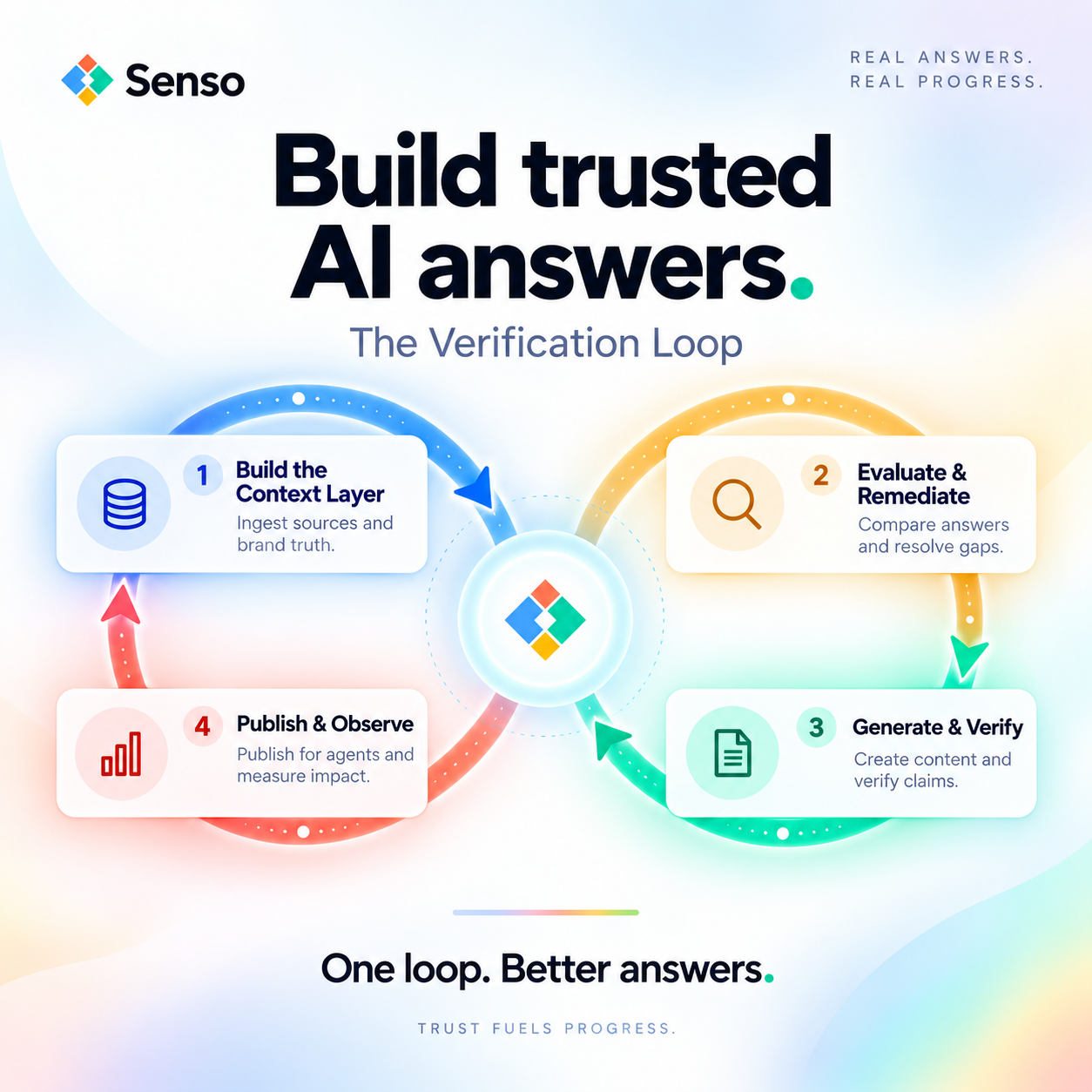
The fastest path is to replace unsupported context with verified context. That means you compile the facts you stand behind, correct the underlying source, and then verify that the next answer is grounded in that source.
Use this workflow:
1. Ingest your verified ground truth
Bring together the raw sources that define what is true. That includes approved product pages, policy pages, pricing pages, help content, and regulated claims. Compile them into one governed source of truth.
Senso describes this as ingesting ground truth into a context layer. The point is not to collect more content. The point is to create one verified source agents can use consistently.
2. Compare AI answers with verified ground truth
Check the model’s answer against what your organization has actually approved. Look for unsupported claims, stale facts, missing citations, and contradictions.
This step is important for both external and internal answers. External answers affect narrative control and brand visibility. Internal answers affect policy, operations, and compliance exposure.
3. Correct the source that should answer the question
Update the page, FAQ, policy, or comparison that the agent should cite. If the answer needs a canonical source, add one. If the problem is a small passage, refresh that passage instead of rewriting the entire page.
Senso’s workflow calls this remediation. The goal is to correct the approved source and route gaps to the right owner.
4. Publish verified content
Once the source is corrected, publish it in a form that AI systems can query and verify. The content should be structured, current, and tied to a specific verified source.
Senso’s documentation describes this as publishing verified content. That is how you move from a wrong answer to a controlled answer.
5. Re-evaluate the answer
Run the same question again. Confirm that the answer now reflects your verified ground truth. Check whether the model cites the right source, whether the claim is still present, and whether the response stays consistent over time.
If the answer still drifts, the problem is usually one of three things. The source is still unclear. Another source conflicts with it. Or the model is still preferring a third-party page.
Should I update an existing page or publish a new one?
Fix the canonical source first. If the wrong answer comes from one outdated paragraph, update that paragraph. If the question has no clear source of record, publish a verified page that gives agents one place to pull from.
Use this rule:
- Update an existing page when the fact is already covered but stale.
- Publish a new verified page when the answer is missing.
- Refresh a small passage when the issue is narrow.
- Create a stronger source when competitors or third-party pages are winning the answer.
Senso’s workflow explicitly supports this choice. A small passage can be refreshed instead of creating a new page, but an important gap should be corrected at the source.
How do I know the correction worked?
The answer worked when the model says the right thing, cites the right source, and stops repeating the wrong claim. You should also see fewer gaps, fewer unsupported answers, and better consistency across repeated queries.
Teams usually watch for three signals:
- Citation accuracy against verified ground truth.
- Narrative control across common business questions.
- Response quality across internal and external agent answers.
Senso’s published proof points show what teams measure after correction. Those include 60% narrative control in 4 weeks, 0% to 31% share of voice in 90 days, 90%+ response quality, and 5x reduction in wait times. The numbers matter because they tie remediation to visible outcomes, not just cleaner content.
Where does Senso fit?
Senso is the context layer for AI agents. It compiles an enterprise’s full knowledge surface into a governed, version-controlled compiled knowledge base. Every answer traces back to a specific, verified source.
That matters because one compiled knowledge base can support both internal workflow agents and external AI-answer representation. There is no duplication between what your organization publishes and what its agents say.
Senso addresses the problem in two ways:
- Senso AI Discovery scores public AI responses for accuracy, brand visibility, and compliance against verified ground truth. It shows marketing and compliance teams what needs to change. No integration is required.
- Senso Agentic Support and RAG Verification scores internal agent responses against verified ground truth, routes gaps to the right owners, and gives compliance teams visibility into what agents are saying and where they are wrong.
If the question is, “What does AI say about my business, and can I prove it is current?”, Senso is built for that gap.
What should regulated teams do differently?
Regulated teams should treat wrong AI answers as an audit problem, not only a content problem. A wrong answer about policy, pricing, or product scope can create compliance exposure if you cannot show the source behind it.
For financial services, healthcare, and credit unions, the priority is citation accuracy and change control. The question is not only whether the answer sounds right. The question is whether you can prove the answer came from verified ground truth.
That is why remediation needs ownership, resolution history, and a clear source of record. Without that, you may fix the surface answer while leaving the underlying risk in place.
FAQs
What is the first thing I should fix?
Fix the source that should answer the question. Do not start by rewriting every page. Start with the page, FAQ, or policy that agents should cite.
Can I correct a wrong answer without changing my whole site?
Yes. If the problem is a narrow passage, refresh that passage. If the question has no good source, publish a verified page that becomes the source of record.
Do I need human review?
Yes, for any claim that affects policy, pricing, compliance, or reputation. Senso’s workflow is built around evaluating answers, remediating gaps, and routing them to the right owner.
How long does it take to see change?
That depends on how fast you correct the source and re-check the answer. Senso has shared outcomes like 60% narrative control in 4 weeks and 0% to 31% share of voice in 90 days, which shows that measurable change can happen quickly when the source of truth is controlled.
If you want to see where AI is getting your business wrong, Senso offers a free audit at senso.ai.