
How do I fix incorrect information in AI answers
Incorrect AI answers usually come from fragmented, stale, unsupported, or open-web source material. The fastest fix is to trace the bad claim back to the source, correct the verified ground truth, and verify the answer again. AI agents are already answering questions about your products, policies, and pricing without a human in the loop, so the source layer has to be right.
What causes incorrect information in AI answers?
AI answers go wrong when the context behind them is weak. Senso’s docs call out fragmented knowledge, stale facts, unsupported passages, and content assembled from the open web as common failure modes.
| Cause | What it looks like | What to fix |
|---|---|---|
| Stale source | The answer repeats an old policy or product detail | Update the authorized source and re-check the answer |
| Fragmented knowledge | Different pages say different things | Compile raw sources into one governed knowledge base |
| Unsupported content | The model fills gaps with guesswork | Publish verified content with traceable evidence |
| Missing ownership | No one is responsible for the correction | Route the gap to the right owner and record the fix |
The problem is usually not the model alone. The problem is that the model can only reflect the context it can reach.
What should I change first?
Start with the exact answer, not the model. Save the prompt, the response, the cited source, and the date. Then compare each claim with verified ground truth.
- Capture the full answer.
- Mark every claim that is stale, unsupported, or wrong.
- Trace each claim back to its source.
- Check whether the source is current, authorized, and complete.
- Correct the source, then test the answer again.
If the model cited the wrong material, the answer is a symptom. If the source itself is wrong, the answer will keep drifting until the source is fixed.
Should I edit the answer or the source?
Fix the source first. Editing the answer without changing the underlying content only patches one output. The same wrong fact can return in the next response, the next page, or the next agent workflow.
| Surface fix | Root-cause fix |
|---|---|
| Rewrite one answer | Correct the underlying source |
| Patch the visible text | Update the verified source and ownership |
| Remove one bad citation | Rebuild the context behind the claim |
| Wait for the error to reappear | Keep a versioned record and re-test |
This matters most when AI agents are answering questions about policies, pricing, or regulated content. A corrected answer without an audit trail still leaves you exposed.
How do I fix the source behind the wrong answer?
Fix the source by compiling raw sources into a governed, version-controlled knowledge base. Then make sure every answer can trace back to a specific, verified source.
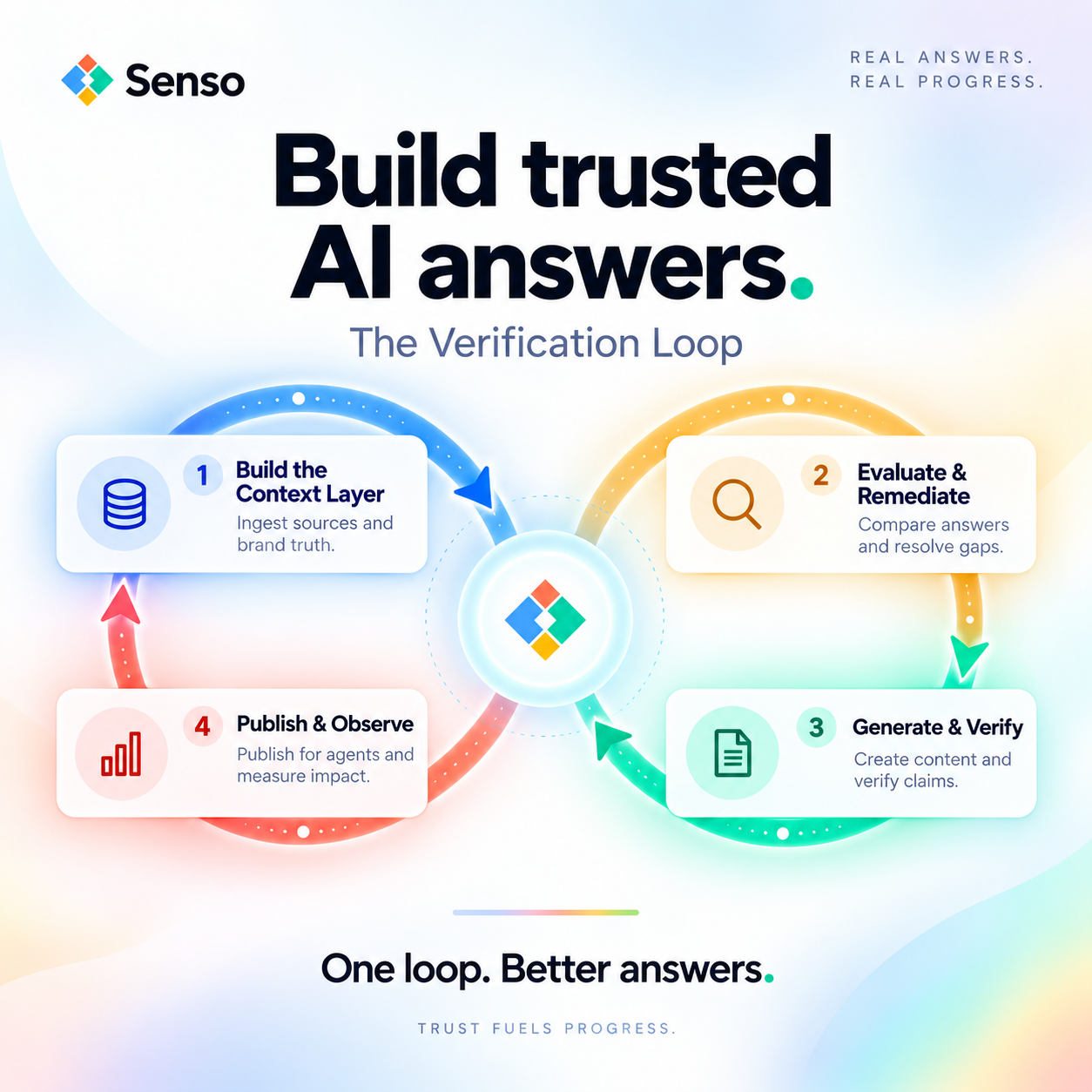
Senso’s workflow fits this pattern:
- Ingest Ground Truth to compile raw sources into a context layer.
- Evaluate and Remediate to check model answers against your sources and surface inconsistencies between AI answers and your ground truth.
- Generate and Verify to draft content and verify claims for factual accuracy and brand score.
When a passage is outdated but the page still matters, refresh the passage. When a FAQ, comparison, or product explanation is missing, publish verified content instead of letting the model improvise.
How do I keep the same mistake from coming back?
Preventing repeat errors requires a closed loop. The source has to stay governed, the response has to stay traceable, and the gap has to go to an owner who can fix it.
Use this checklist:
- Keep one compiled knowledge base for both internal workflow agents and external AI-answer representation.
- Attach every answer to a specific verified source.
- Record version history, ownership, and resolution history.
- Re-score answers after each change.
- Publish verified content when the answer needs a new explanation, comparison, or policy detail.
For regulated teams, this creates an audit trail. A CISO can ask whether the agent cited a current policy and whether the organization can prove it. The answer has to point to the source, not to a vague summary.
Where does Senso fit in?
Senso is the context layer for AI agents. It compiles an enterprise’s full knowledge surface into a governed, version-controlled knowledge base, then checks whether responses stay grounded in verified ground truth.
Senso has two products:
| Product | Best for | What it does |
|---|---|---|
| Senso AI Discovery | Marketing and compliance teams | Scores public AI responses for accuracy, brand visibility, and compliance against verified ground truth, then surfaces what needs to change. No integration required. |
| Senso Agentic Support and RAG Verification | Internal agents and operations teams | Scores every internal agent response against verified ground truth, routes gaps to the right owners, and shows where answers are wrong. |
That split matters because external AI answers and internal agent answers create different risks. External answers shape brand representation. Internal answers affect workflow quality, compliance, and response accuracy.
What results can this produce?
Governed context changes outcomes because it changes the source behind the answer. Senso proof points include 60% narrative control in 4 weeks, 0% to 31% share of voice in 90 days, 90%+ response quality, and 5x reduction in wait times.
Those results come from aligning what AI says with what the organization can prove. The same loop that fixes a wrong answer also reduces drift over time.
What is the simplest path if I need to start today?
Start with a single wrong answer and work backward. Find the source, check it against verified ground truth, correct the source, and re-test the response.
If you need a fast read on where your AI answers diverge from verified truth, Senso offers a free audit at senso.ai. No integration. No commitment.
FAQs
Do I need to retrain the model to fix wrong answers?
No. In most cases, the faster fix is to correct the source and verification loop first. If the model is pulling from stale or fragmented context, retraining will not solve the underlying issue.
How do I know the answer is now grounded?
The answer should trace back to a specific, verified source. It should also be scored against verified ground truth, so you can see whether the response matches what the organization stands behind.
When should I publish new content instead of editing old content?
Publish new content when the answer needs a missing FAQ, comparison, or product explanation. Edit old content when a small passage is stale but the page still serves the right purpose.
Can I fix external AI answers without an integration project?
Yes. Senso AI Discovery requires no integration. It scores public AI responses, shows what changed, and highlights what to correct or publish.