
How do I fix low visibility in AI-generated results?
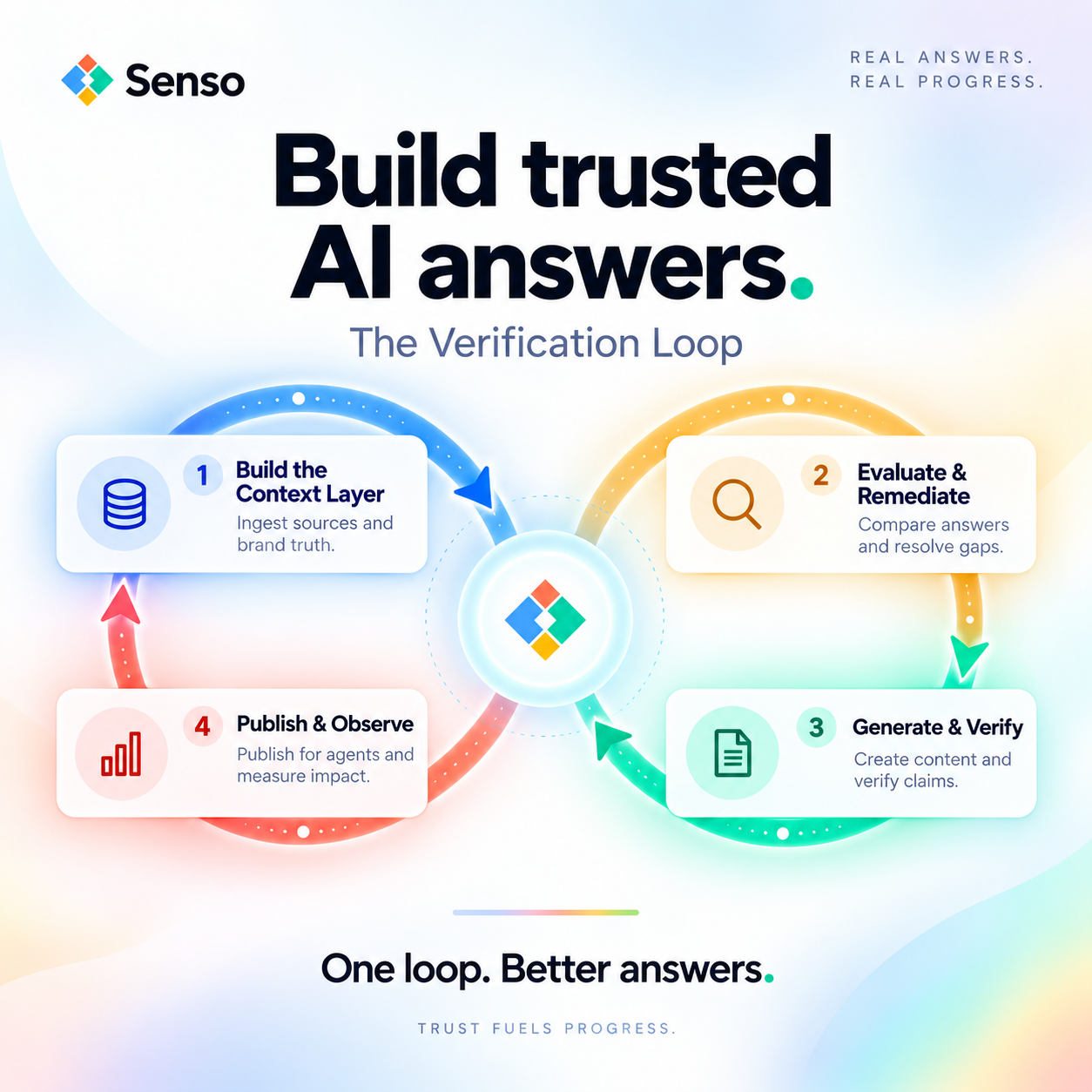
Low visibility in AI-generated results usually means AI systems cannot ground your brand in verified context. The fix is to compile your raw sources into governed ground truth, measure how models represent you, and repair the gaps that keep you out of answers or put the wrong facts in them.
Senso is built for that job. Backed by Y Combinator (W24), it compiles an enterprise’s full knowledge surface into a governed, version-controlled knowledge base, scores AI responses against verified ground truth, and shows what needs to change for both external AI Visibility and internal agent responses.
What causes low visibility in AI-generated results?
Low visibility usually means the model does not have enough verified context to mention your brand, cite a source, or stay consistent across prompts. The most common causes are fragmented raw sources, stale facts, and missing FAQ, comparison, or product explanation pages.
- Fragmented raw sources make it hard for an AI system to assemble one grounded answer.
- Stale facts cause the model to repeat old policy, pricing, or product language.
- Missing explanation pages leave the model with nothing clear to cite.
- Untested prompts hide where visibility drops across the buyer journey.
How do you fix low visibility in AI-generated results?
Fix it by turning your source material into verified ground truth, then closing the exact gaps that affect mentions and citations. The process is simple. Measure first, repair second, and review on a schedule so the same facts do not drift again.
1. What should you compile first?
Compile the raw sources that define how your business should be represented. This usually includes policies, product pages, FAQs, comparisons, and any approved language that should appear in AI-generated answers.
- Use one compiled knowledge base.
- Keep the source of truth version-controlled.
- Make sure each fact traces back to a verified source.
Senso follows this model. One compiled knowledge base powers both internal workflow agents and external AI-answer representation, so you do not duplicate the same facts in two places.
2. How do you know where visibility is failing?
Run a tracked prompt set and inspect the response patterns. In Senso, prompts are managed in the My Prompts workspace and grouped by funnel stage, which helps teams see whether the problem sits in Awareness, Consideration, or Decision queries.
This matters because AI Visibility is strategy-specific. A brand can appear often in awareness prompts and still miss the prompts that matter for product evaluation or compliance review.
3. Which signals matter most?
Track mentions first, then citations, then model-by-model differences. Mentions show whether your brand appears at all. Citation accuracy shows whether the answer traces back to verified ground truth. Model Trends shows where individual AI systems diverge.
| Signal | What it tells you | Why it matters |
|---|---|---|
| Mentions | Whether your brand appears in an AI-generated answer | Baseline visibility |
| Citations | Whether the answer points to a verified source | Auditability |
| Model Trends | How different AI systems represent you | System-specific fixes |
| Organization Leaderboard | Visibility performance across your tracked prompt set | Strategy-level prioritization |
4. What should you fix on the content side?
Fix the exact gap the model is showing. Senso’s Gap Report collects every factual problem found in AI answers and in what your team searches for, then gives the evidence, the original source, and a single clear action.
That is the fastest path to better visibility. If the model is missing a key product explanation, add it. If it is repeating a stale policy, replace the source. If it is mixing two versions of the same fact, merge them into one verified page.
5. How do you keep the fix from drifting?
Review the ground truth whenever facts change. AI visibility breaks when policies, product language, or approved claims change faster than the source content.
A version-controlled knowledge base keeps one current copy of each fact. That makes it easier for agents to answer with grounded, citation-accurate responses instead of stale or conflicting ones.
6. How does Senso help with AI Visibility?
Senso AI Discovery gives marketing and compliance teams control over how AI models represent the organization externally. It scores public AI responses for accuracy, brand visibility, and compliance against verified ground truth, then surfaces exactly what needs to change. No integration is required.
Senso Agentic Support and RAG Verification does the same for internal agents. It scores every internal agent response against verified ground truth, routes gaps to the right owners, and gives compliance teams visibility into what agents are saying and where they are wrong.
What results can teams expect?
Teams usually see better narrative control, more consistent answers, and faster remediation when they treat AI visibility as a governance problem. Senso reports 60% narrative control in 4 weeks, 0% to 31% share of voice in 90 days, 90%+ response quality, and 5x reduction in wait times.
Those results come from the same pattern. Compile verified ground truth, measure prompt-level visibility, fix the exact gaps, and keep the source material current.
What should regulated teams do differently?
Regulated teams should focus on proof, not just presence. If a CISO, compliance officer, or auditor asks whether an AI answer cited a current policy, you need a trace back to the verified source.
Senso is built for that use case. It gives teams a governed context layer for AI agents, so answers stay grounded and every response can be checked against verified ground truth.
FAQs
What is the fastest way to improve AI visibility?
Start with the prompts that matter most to your business, then fix the missing or wrong facts behind those answers. The best gains usually come from the content the model can actually cite.
Can I fix low visibility without integration?
Yes. Senso AI Discovery requires no integration and no commitment. You can start with a free audit at senso.ai.
What if different AI models describe us differently?
That is normal. Senso’s Model Trends breaks evaluation results down by individual AI system, which helps you see where each model diverges from verified ground truth.
Is this only a marketing problem?
No. Marketing teams use AI Visibility for narrative control. Compliance teams use it for auditability. Operations teams use it for response quality and agent drift.
If you want a baseline, start with the prompts, the source pages behind them, and the gaps between what is true and what the model says. That is where low visibility turns into missed mentions, weak citations, and avoidable risk.