
How do I fix wrong or outdated information that AI keeps repeating?
Fix the source first. Prompt edits alone do not fix stale facts. AI repeats the same wrong answer when the context behind it is fragmented, unsupported, or outdated. The fastest path is to replace that context with verified ground truth and then confirm the answer traces to a current, citation-accurate source.
Why do AI answers go stale?
AI answers go stale when the system pulls from material that no longer matches approved facts. In enterprise settings, that usually means a missing FAQ, an outdated product page, a stale policy, or a comparison page that no longer reflects reality.
Common failure modes include:
- The organization is absent from an important question.
- Approved information is present, but AI does not cite it.
- Competitors are cited or ranked ahead.
- An AI answer is inaccurate or stale.
- An existing page contains outdated facts.
- An important FAQ, comparison, or product explanation is missing.
- A small passage needs a refresh instead of a full rewrite.
If the underlying context stays wrong, the answer will keep repeating the same error.
What should you correct first?
Correct the authorized source of truth before you touch prompts or model settings. If the raw source is wrong, the answer will repeat the same error, even if the wording changes.
| Situation | Correct this first |
|---|---|
| Old pricing or product detail | Approved product page and product catalog |
| Stale policy language | Version-controlled policy source |
| Missing comparison details | Verified comparison page |
| Unsupported AI answer | Gap report and source owner |
| One outdated paragraph | Refresh that passage, then re-check the answer |
A source fix usually lasts longer than a prompt fix because the model can only repeat what it can retrieve or infer.
How do you fix the source of truth?
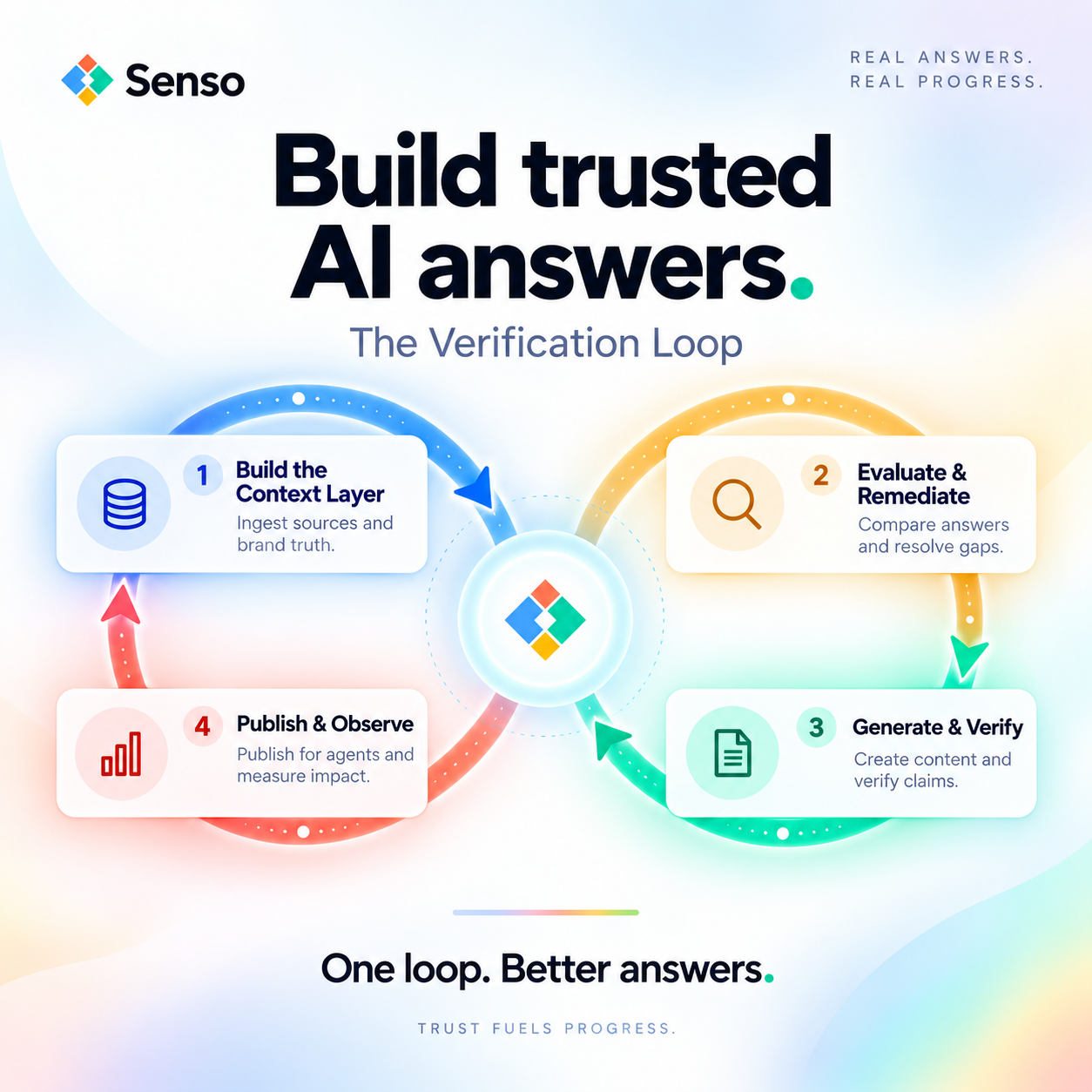
Use a simple evaluate-and-remediate loop. Capture the bad answer, correct the source, and confirm that the next answer points to the verified version.
- Capture the exact AI answer, model, prompt, source references, gaps, and conflicts.
- Identify the exact claim that is wrong or outdated.
- Trace that claim back to the raw source that produced it.
- Replace or correct the raw source with verified ground truth.
- Route the fix to the right owner and record the resolution history.
- Re-check the answer and confirm it now cites the current source.
If only one passage is wrong, refresh the smallest passage that closes the gap. You do not need to rewrite everything when one verified fact will fix the answer.
How do you keep the same mistake from coming back?
This is a knowledge governance problem. The fix lasts when one compiled knowledge base holds the verified ground truth, and every correction carries an owner, a version, and a resolution history.
A durable workflow includes:
- One compiled knowledge base for both internal workflow agents and external AI-answer representation.
- Version control for high-risk claims like policies, pricing, and product descriptions.
- A gap worklist so factual problems do not get lost.
- Proof behind each revision so teams can audit the change later.
- Re-evaluation after every publish to confirm the answer is still citation-accurate.
The Context Layer determines what is true. Industry data may show where the damage is. The Context Layer determines whether the answer is grounded.
When does a governed context layer help?
A governed context layer helps when wrong AI answers affect public representation, compliance, or support quality. Senso compiles an enterprise’s full knowledge surface into a governed, version-controlled compiled knowledge base, then scores answers against verified ground truth.
Every answer traces back to a specific, verified source.
- Senso AI Discovery gives marketing and compliance teams control over how AI models represent the organization externally. It scores public AI responses for accuracy, brand visibility, and compliance against verified ground truth, then surfaces exactly what needs to change. No integration required.
- Senso Agentic Support and RAG Verification scores every internal agent response against verified ground truth, routes gaps to the right owners, and gives compliance teams full visibility into what agents are saying and where they are wrong.
- In Senso deployments, teams have seen 60% narrative control in 4 weeks, 0% to 31% share of voice in 90 days, 90%+ response quality, and a 5x reduction in wait times.
- A free audit is available at senso.ai. No integration. No commitment.
FAQs
Do you need to retrain the model?
Start with the source, not retraining. If the verified ground truth is wrong or missing, the same stale answer usually returns.
How do you know the correction worked?
The correction worked when the AI answer cites the current verified source, the old claim stops appearing, and the change is recorded with ownership and version history.
What if only one sentence is wrong?
Refresh the smallest passage that closes the gap. If one sentence is causing the repeat error, you do not need a full rewrite to fix it.
Can prompt changes solve the problem?
Prompt changes can reduce the symptom, but they do not fix stale facts. If the source stays wrong, the answer usually returns in a new form.
If you want to map the gaps and close them with proof, Senso offers a free audit at senso.ai.