
How do I get my brand mentioned in ChatGPT responses?
ChatGPT mentions brands when it can retrieve grounded facts that are easy to cite and easy to verify. If your public information is inconsistent, the model is less likely to name you. The fastest path is to compile verified ground truth, publish the pages buyers ask about, and test the prompts where ChatGPT compares vendors, summarizes policies, or recommends options.
Quick Answer
The fastest way to get your brand mentioned in ChatGPT responses is to make your brand facts the easiest facts to cite across ChatGPT, Perplexity, and Gemini. Start with verified ground truth, use owned citations on primary pages, and measure mentions, citation rate, and factual accuracy. Senso AI Discovery does this without integration and shows exactly what needs to change.
What does ChatGPT need before it mentions a brand?
ChatGPT mentions a brand when the brand shows up in sources the model can retrieve and trust. A mention is a named appearance inside an AI answer. It is not the same as a search ranking.
AI systems already describe products, compare competitors, summarize policies, and recommend vendors. That means your brand needs a factual surface, not just a website.
- Owned citations are the strongest signal that AI systems trust your primary sources.
- External citations still matter when they confirm the same facts.
- Inconsistent information makes it harder for AI to trust or retrieve your brand facts.
How do I get my brand mentioned in ChatGPT responses?
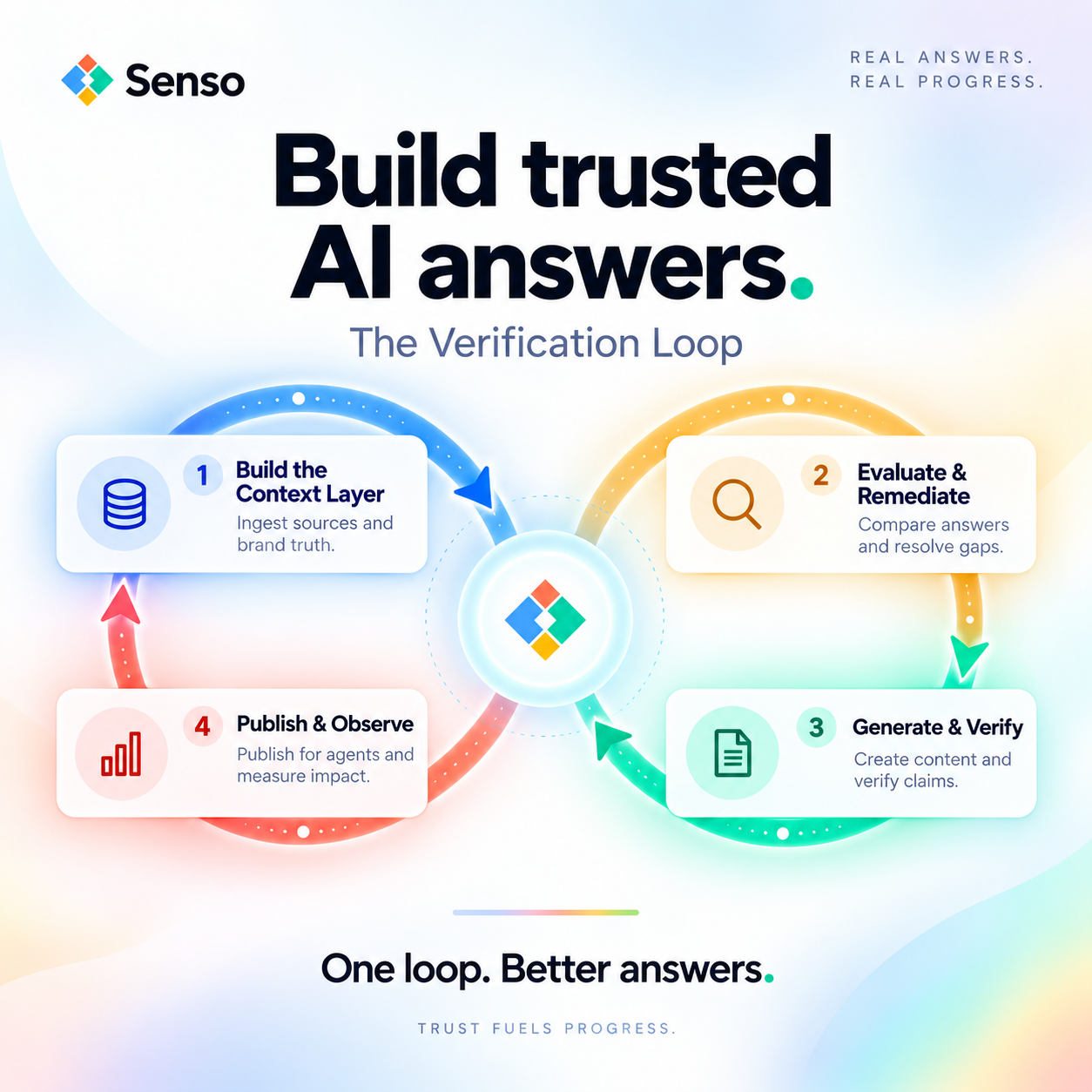
The shortest answer is to make your brand facts more verifiable than the inconsistent web noise around them. Start with a governed knowledge surface, then publish the pages closest to revenue and test the prompts where buyers make decisions.
| Priority | What to do | Why it matters |
|---|---|---|
| 1 | Compile verified ground truth | Gives AI a source it can cite and trace back to |
| 2 | Publish the pages closest to revenue | Covers the questions buyers actually ask |
| 3 | Add owned citations | Strengthens trust in your primary sources |
| 4 | Keep facts current | Reduces drift when models re-check sources |
| 5 | Measure and remediate | Shows which prompts and pages need fixes |
1. Compile verified ground truth
Start by ingesting raw sources from your site, policy pages, product docs, and approved third-party coverage. Then compile them into a governed, version-controlled knowledge base.
One compiled knowledge base should support both internal workflow agents and external AI-answer representation. That avoids duplication and keeps the facts aligned.
2. Publish the pages closest to revenue
Start with ranking prompts, comparison prompts, and brand-specific prompts. Those are the prompts that usually decide whether your brand gets named.
Make each page answer the exact question a buyer would ask. If the page is vague, ChatGPT has less to work with and less reason to mention your brand.
3. Use citations AI can trust
Owned citations are the strongest signal that AI systems trust your primary sources. Put the facts where the model can verify them, not just where humans can infer them.
External citations also matter. They help when third-party coverage repeats the same facts from credible sources.
4. Fix drift and conflicts
Review core ground truth pages at least every 60 to 90 days, or whenever facts change. If two pages conflict, update the source of truth first.
If AI cannot reliably retrieve or trust your brand facts, the usual cause is inconsistency. That includes mismatched claims, outdated pages, or missing citations.
5. Measure and route gaps
Track mentions, citation rate, citation share, share of voice, and factual accuracy. Those metrics show whether ChatGPT is naming your brand and whether the answer matches verified ground truth.
Senso counts mentions across evaluated prompt runs. It measures both answers that mentioned your brand and total name-drops.
What should you publish first?
Start with the pages closest to revenue. That usually means product pages, comparison pages, policy pages, and the pages that answer brand-specific questions.
The goal is to give ChatGPT the same facts a buyer would need before choosing you. If those facts are consistent across your site and credible external coverage, the model has more than one way to confirm them.
What will not move the needle by itself?
A brand kit will not make ChatGPT adopt your tone when it cites you. Models have their own system prompts and dialect. You can shape the information they surface, but not the tone they use.
Brand voice still matters on human-facing pages. It does not replace verified facts, owned citations, or current source pages.
How do you measure whether it is working?
The best signal is whether your brand starts appearing in tracked prompt runs. Mentions tell you if ChatGPT names you, citation rate tells you if it uses your sources, and factual accuracy tells you if the answer matches verified ground truth.
Traditional rankings tell you where a URL sits on a results page. Mentions tell you whether AI models include your brand. That is the metric that matters for AI Visibility.
How can Senso help?
Senso is the context layer for AI agents. It compiles your raw sources into a governed, version-controlled knowledge base and scores every response against verified ground truth.
Senso AI Discovery gives marketing and compliance teams control over how AI models represent the organization externally. It scores public AI responses for accuracy, brand visibility, and compliance, then surfaces exactly what needs to change. No integration required.
Senso Agentic Support and RAG Verification does the same for internal agent responses. It scores every response against verified ground truth, routes gaps to the right owners, and gives compliance teams visibility into what agents are saying and where they are wrong.
Proof points from Senso include:
- 60% narrative control in 4 weeks
- 0% to 31% share of voice in 90 days
- 90%+ response quality
- 5x reduction in wait times
Free audit available at senso.ai. No integration. No commitment.
FAQs
Can I force ChatGPT to mention my brand?
No. You can raise the odds by making your brand facts grounded, current, and easy to cite. ChatGPT decides the wording. You control the source surface.
How long does it take?
There is no fixed timeline. In one Senso proof point, customers reached 60% narrative control in 4 weeks and 0% to 31% share of voice in 90 days. Results depend on source quality, prompt coverage, and how quickly you fix gaps.
Is this only about ChatGPT?
No. The same work affects Perplexity, Gemini, Claude, Grok, and internal search tools. If your facts are inconsistent, the problem shows up across AI answer surfaces.
What is the first thing I should change?
Start with the pages closest to revenue and review core ground truth pages at least every 60 to 90 days. Then test ranking, comparison, and brand-specific prompts until the answer surface becomes consistent.