
How do I make sure AI-generated financial advice about my firm is compliant?
You make AI-generated financial advice about your firm compliant by grounding every response in verified ground truth, forcing a citation to an approved source, and blocking any answer that cannot be traced to a current policy, rate, disclosure, or eligibility rule. In financial services, a fluent answer is not enough. The answer has to be current, attributable, and auditable.
AI agents are already answering questions about products, policies, pricing, and eligibility without a human in the loop. If the firm cannot prove where the answer came from, the firm owns the risk. This is an operational framework, not legal advice.
The operational rule is simple. No citation, no answer.
What makes a financial AI answer compliant?
A compliant answer is one that uses current approved sources, cites the exact source, and leaves a review trail. If any claim cannot be traced to verified ground truth, the answer is not ready for customer-facing use. In policy-rich industries, compliance depends on evidence that the claim was checked against an authorized source and was current at the time of use.
| Requirement | What it means in practice |
|---|---|
| Current | The answer uses the latest approved rate, policy, disclosure, or eligibility rule. |
| Attributable | Each claim traces to a specific verified source. |
| Reviewable | A named reviewer can inspect what the model used and why. |
| Reproducible | The same question returns the same answer until the source changes. |
| Defensible | The firm can show the source, the reviewer, and the change history. |
If one of these fails, the answer is not compliant enough for customer use.
Which sources should the model use?
Use a governed set of raw sources that define what your firm can say. That set should live in a compiled knowledge base, not in scattered drafts or ad hoc prompts. Senso compiles an enterprise’s full knowledge surface into a governed, version-controlled compiled knowledge base, so one source of truth can support both internal workflow agents and external AI-answer representation.
The source set should include:
- Approved product facts and product catalog entries.
- Current pricing, rate, and fee schedules.
- Policy, compliance, and disclosure language.
- Eligibility rules and exception handling rules.
- Approved FAQ responses for customers and staff.
- Versioned archives with effective dates.
- Brand guidelines that define how the firm should be represented.
Do not let the model rely on generic web pages or unsanctioned drafts when the answer can affect advice. Prefer approved first-party material whenever the answer changes a customer decision.
How do you keep answers auditable?
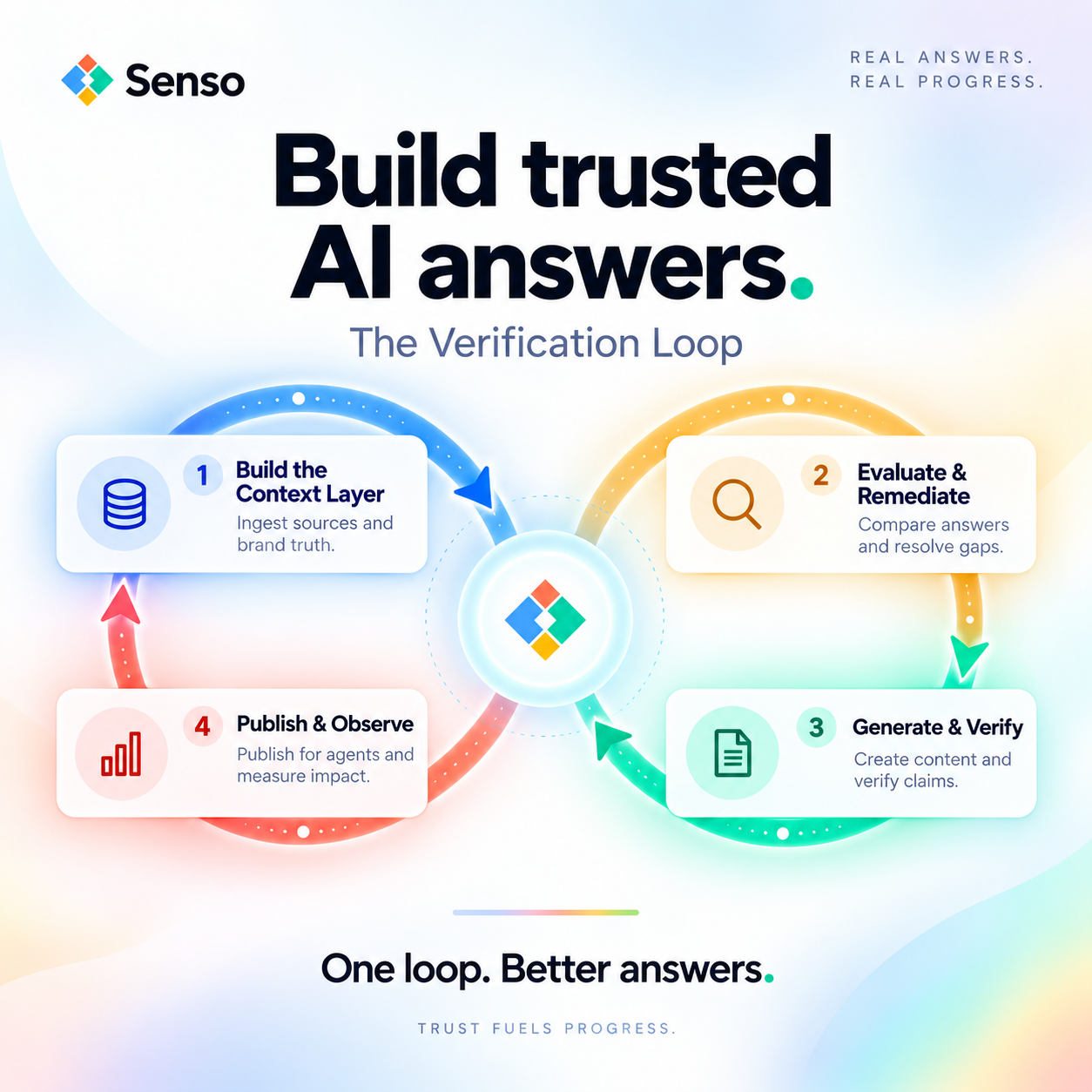
You keep answers auditable by verifying output before publication and checking it again after the source changes. Senso’s verification loop does this in four steps: ingest ground truth, evaluate and remediate answers, generate and verify content, then publish and observe. That gives compliance teams a repeatable way to prove what the model used and when it changed.
A strong audit trail should include:
- The exact verified source used.
- The human reviewer who approved the content.
- The brand or compliance rule the content followed.
- The factual accuracy score for the response.
- The timestamp and version history.
Senso attaches a receipt to citations. The receipt contains the embedded sources used to generate the content, the human reviewer, adherence to brand guidelines, and factual accuracy. That makes the answer traceable instead of just plausible.
What controls should compliance require before launch?
The controls should make it impossible for an unsupported answer to reach a customer without leaving evidence. Compliance should require source control, version control, review control, and monitoring control before the model is allowed to answer on behalf of the firm.
| Control | Why it matters | What to require |
|---|---|---|
| Source allowlist | Keeps the model on approved ground truth | Only verified raw sources are queryable |
| Version control | Prevents stale policy from resurfacing | Effective dates, owners, and change history |
| Citation requirement | Makes each claim traceable | Exact source attached to each claim |
| Human approval | Catches high-risk advice and disclosure gaps | Named reviewer before publish |
| Exception routing | Handles gaps and edge cases | Unresolved answers go to legal, compliance, or product owners |
| Audit trail | Proves what the firm knew and when | Source, reviewer, timestamp, and receipt |
If the system cannot show those controls, it is not ready for regulated use.
How do you monitor public AI responses?
You monitor the same questions customers ask and score how models represent the firm over time. That is the AI Visibility side of the problem. Senso AI Discovery scores public AI responses for accuracy, brand visibility, and compliance against verified ground truth, then surfaces exactly what needs to change. No integration required.
The recurring evaluation should track:
- Mention rate.
- Citation rate.
- Citation share.
- Share of voice.
- Average rank or relative position.
- Factual accuracy.
- Freshness of the answer.
Senso runs this kind of external evaluation across models and markets to show where the firm is mentioned, where competitors are being recommended ahead of it, and where the answer is inaccurate or unsupported. That turns public AI output into something the business can measure.
What should you do when the answer is wrong?
Treat the source as the first fix. If the answer is wrong or unsupported, remove or update the source, rerun verification, republish the verified source, and observe the change again. The loop does not try to make AI say whatever a company wants. It gives AI agents accurate, current, attributable information, then proves whether that information changed the answer.
A useful rule is this:
- If the source is wrong, fix the source.
- If the answer is wrong, verify the answer.
- If the answer cannot be verified, block it or escalate it.
That keeps the problem in the right place. Compliance is a source problem first, and a model problem second.
What outcomes should you measure?
You should measure both control and speed. Governance should reduce wrong answers and make review faster, not slower. Senso proof points include 60% narrative control in 4 weeks, 0% to 31% share of voice in 90 days, 90%+ response quality, and 5x reduction in wait times.
Those numbers matter because they show two things at once. The firm can improve how AI represents it, and it can reduce the friction of keeping answers current and compliant.
FAQs
Can retrieval alone make financial answers compliant?
No. Retrieval can surface raw sources, but compliance needs version control, citation accuracy, human approval, and audit trails. If the system cannot prove the current source, retrieval alone is not enough for regulated use.
Do all responses need human approval?
No. But any answer that affects advice, pricing, suitability, or disclosures needs a defined approval path. High-risk content should route to named owners before it reaches a customer.
How is AI Visibility different from compliance?
AI Visibility tells you what public models say about the firm. Compliance proves those answers came from verified ground truth and were current when used. One measures exposure. The other proves control.
Where does Senso fit?
Senso gives you a governed, version-controlled compiled knowledge base, then scores every agent response against verified ground truth. Senso AI Discovery covers external AI Visibility, and Senso Agentic Support and RAG Verification covers internal agent responses and compliance visibility.
If you want a starting point, run a free audit at senso.ai. No integration. No commitment.