
How do I make sure my nonprofit or public agency shows up correctly in AI search?
Make AI search describe your nonprofit or public agency correctly by controlling the verified sources it can cite, then checking the answers against those sources on a schedule. AI agents already answer questions about services, policies, access, and pricing without a person in the loop. If the facts are fragmented or stale, the answer will be too.
For public-sector teams, the goal is citation-accurate answers, current policy, and a proof trail you can show to auditors, staff, and residents. That is knowledge governance, not content volume.
What does “show up correctly” mean in AI search?
It means an AI-generated answer uses current facts, cites a verified source, and does not contradict your published policy. In AI Visibility terms, the model should represent your organization the way your own approved material says it should.
For a nonprofit or public agency, that matters because one wrong answer can affect eligibility, service access, compliance, or public trust. A correct answer is grounded. A useful answer is also traceable back to verified ground truth.
What should you publish first?
Start with the pages that answer the questions people ask most often. AI systems are more likely to answer correctly when the same facts live in one canonical place and not across conflicting pages.
| Source type | What it should answer | Why it matters |
|---|---|---|
| Service and program pages | What you offer, who qualifies, and where to start | Reduces confusion about access and eligibility |
| Policy pages | Current rules, exceptions, and effective dates | Prevents stale policy from being repeated |
| Contact and hours pages | Where to call, visit, or submit a request | Avoids wrong directions and missed deadlines |
| Governance pages | Authority, approvals, and ownership | Supports accountability and public review |
| Change log or archive | What changed and when | Helps prove the current version is the right one |
A good rule is simple. If a resident, donor, client, or staff member would ask it, publish one clear source that answers it.
How do you build a verified source of truth?
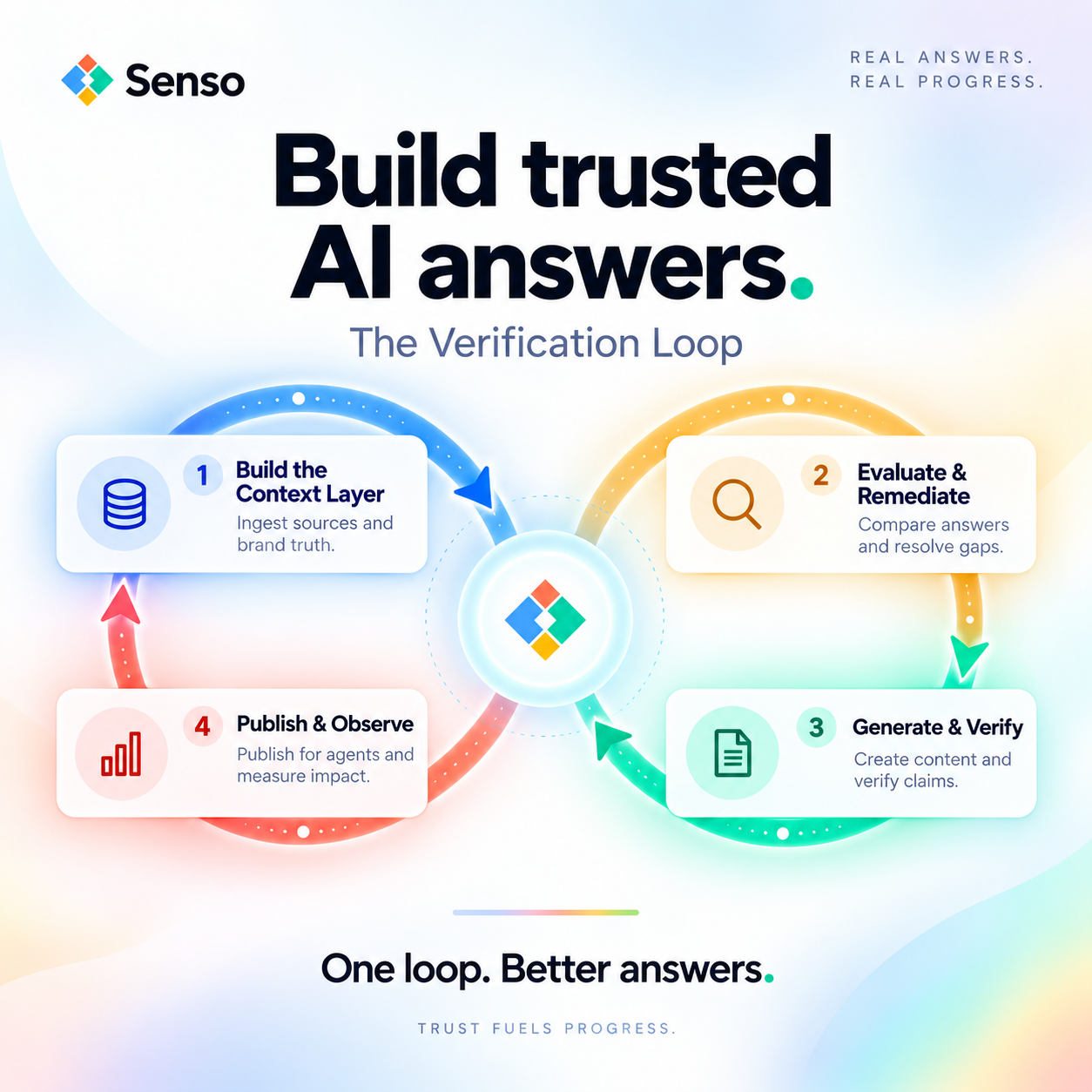
Build one governed knowledge base, then make sure every important claim points back to it. Senso calls this a compiled knowledge base. It collects an organization’s full knowledge surface into one version-controlled place, so responses stay tied to verified ground truth.
A practical workflow looks like this:
-
Identify the canonical pages.
Pick one approved page for each major topic. Remove duplicate sources where possible. -
Compile approved raw sources.
Bring in the pages, policies, and records your organization stands behind. Keep the source set small and current. -
Assign an owner to each topic.
Every policy, service page, and program description needs one person or team that can approve changes. -
Publish verified sources with history.
A verified source should show what it claims, where it came from, who reviewed it, and when it was last checked. -
Review core pages on a schedule.
As a rule, review core ground truth pages at least every 60 days, and review them sooner when policy changes.
This matters because AI systems do not know which page is authoritative unless you make it obvious. If one page says one thing and an old PDF says another, the model can cite the wrong version.
How do you check whether AI is describing you correctly?
Ask the exact questions your audience asks, then compare the AI answer with your verified source. Do not test only brand names. Test the real questions people use to decide whether to apply, visit, call, donate, or comply.
Examples of tracked prompts include:
- What services does this agency provide?
- Who qualifies for this program?
- What is the current policy or eligibility rule?
- Where is the nearest office?
- What are the current hours or contact options?
- What changed since last year?
In Senso, mentions measure whether your organization appears in an AI-generated answer for a tracked prompt. The Organization Leaderboard shows visibility performance across those tracked prompts. That gives you a baseline signal for whether AI is including you, excluding you, or misrepresenting you.
Traditional rankings tell you where a URL sits on a results page. Mentions tell you whether AI models include your organization in the answer.
What should you do when AI gets it wrong?
Fix the source, not just the answer. If an AI response is wrong, the real problem is usually stale content, conflicting pages, or an unclear authority chain.
Use this sequence:
-
Find the incorrect claim.
Identify exactly which sentence is wrong. -
Trace it to the source.
Check which page, policy, or record should have been cited. -
Update the verified source.
Correct the canonical page first, not the copied summary. -
Retire or redirect conflicting pages.
Remove old versions that can keep getting cited. -
Rerun the prompt.
Confirm the model now cites the right source and uses the right language. -
Route the gap to the right owner.
If the issue is policy, send it to the policy owner. If it is public messaging, send it to communications. If it is access rules, send it to operations.
Senso AI Discovery is built for this external visibility problem. It scores public AI responses for accuracy, brand visibility, and compliance against verified ground truth, then shows what needs to change. No integration is required.
How does Senso help nonprofits and public agencies?
Senso helps when you need AI answers to stay grounded and auditable. It is a context layer for AI agents, backed by Y Combinator W24, and it compiles approved knowledge into one governed, version-controlled knowledge base.
That matters for two groups inside public and nonprofit organizations.
- Marketing and communications teams need control over how AI models represent the organization externally.
- Compliance, IT, and operations teams need visibility into what agents are saying, where they are wrong, and whether the answer can be proven.
Senso Agentic Support and RAG Verification scores every internal agent response against verified ground truth, routes gaps to the right owners, and gives teams full visibility into answer quality. One compiled knowledge base can support both internal workflow agents and external AI-answer representation, so you do not duplicate the source of truth.
In customer results, Senso has reported 60% narrative control in 4 weeks, 0% to 31% share of voice in 90 days, 90%+ response quality, and 5x reduction in wait times. Those numbers are useful because they show the operational effect of governing the source, not just the output.
What is the fastest way to get started?
Start with a small, verified set of pages and a short list of prompts. You do not need to rebuild your whole website before you can improve AI search visibility.
A practical starting plan is:
- Pick 10 to 20 canonical pages.
- Review them against approved ground truth.
- Publish or update those pages with clear ownership and dates.
- Track 10 to 20 prompts that reflect real public questions.
- Compare the AI answers with your verified sources.
- Fix the source when the answer drifts.
That process gives you a baseline, a correction loop, and a way to prove progress.
FAQs
How often should we review our core content?
Review core ground truth pages at least every 60 days. Review sooner whenever policy, eligibility, service hours, or public guidance changes.
Do we need integrations to start?
No. Senso AI Discovery does not require integration. You can start by defining tracked prompts and confirming which pages are the verified sources.
What matters most, citations or mentions?
Both matter, but they answer different questions. Citations show whether the model can point to a source. Mentions show whether the organization appears in the answer at all.
Can one source support both internal and external agents?
Yes. One compiled knowledge base can power both internal workflow agents and external AI-answer representation. That reduces duplication and keeps answers aligned.
If you want, I can also turn this into a shorter agency checklist, a nonprofit version, or a more technical internal guide for IT and compliance teams.