
How do I manage my brand reputation in AI search
Brand reputation in AI search is controlled by what AI systems can verify, cite, and repeat about your company. If the model cannot ground an answer in verified sources, it will still generate one, and that answer can shape buyer, staff, and regulator perception.
The practical job is to align verified ground truth with AI-generated answers, then correct drift fast. That matters because AI agents are already the interface to your business, answering questions about products, policies, and pricing without a human in the loop.
What does this mean in practice?
AI search reputation is not just about being mentioned. It is about whether AI models describe your brand correctly, cite sources you stand behind, and recommend you over competitors for the right reasons.
AI Visibility is the measure of how visible, credible, and influential your brand is inside AI-generated answers. Traditional rankings tell you where a URL sits on a results page. Mentions tell you whether AI models include your brand at all.
Why does it drift so quickly?
It drifts quickly because model outputs change as sources shift, competitors publish new content, and enterprise knowledge stays fragmented. Senso tracks weekly at minimum because AI answers change quickly.
Most enterprise knowledge is too fragmented and unstructured for agents to use reliably. That creates a gap between what your business knows and what AI says in public.
For regulated teams, that gap is not cosmetic. When a CISO asks whether an agent cited a current policy and whether the organization can prove it, standard retrieval tools often have no answer.
Which signals should you track?
You should track the signals that show whether AI is representing your brand accurately and consistently. The core signals are mentions, citations, share of voice, and answer quality.
| Signal | What it tells you | Why it matters |
|---|---|---|
| Mentions | Whether your brand appears in the answer | Mentions are the baseline signal of visibility |
| Citations | Whether the answer points to sources you stand behind | Citations are a trust mechanic for AI engines |
| Share of Voice | How much of the answer is dedicated to your brand | Share of Voice measures answer dominance |
| Answer quality | Whether the answer matches verified ground truth | Quality shows if AI is grounded or drifting |
| Compliance | Whether the answer follows approved policy | Compliance reduces exposure in regulated teams |
Senso evaluates AI answers by converting each model response into structured visibility signals tied to the Prompt. That gives teams a repeatable way to see what changed and why.
How do you manage it step by step?
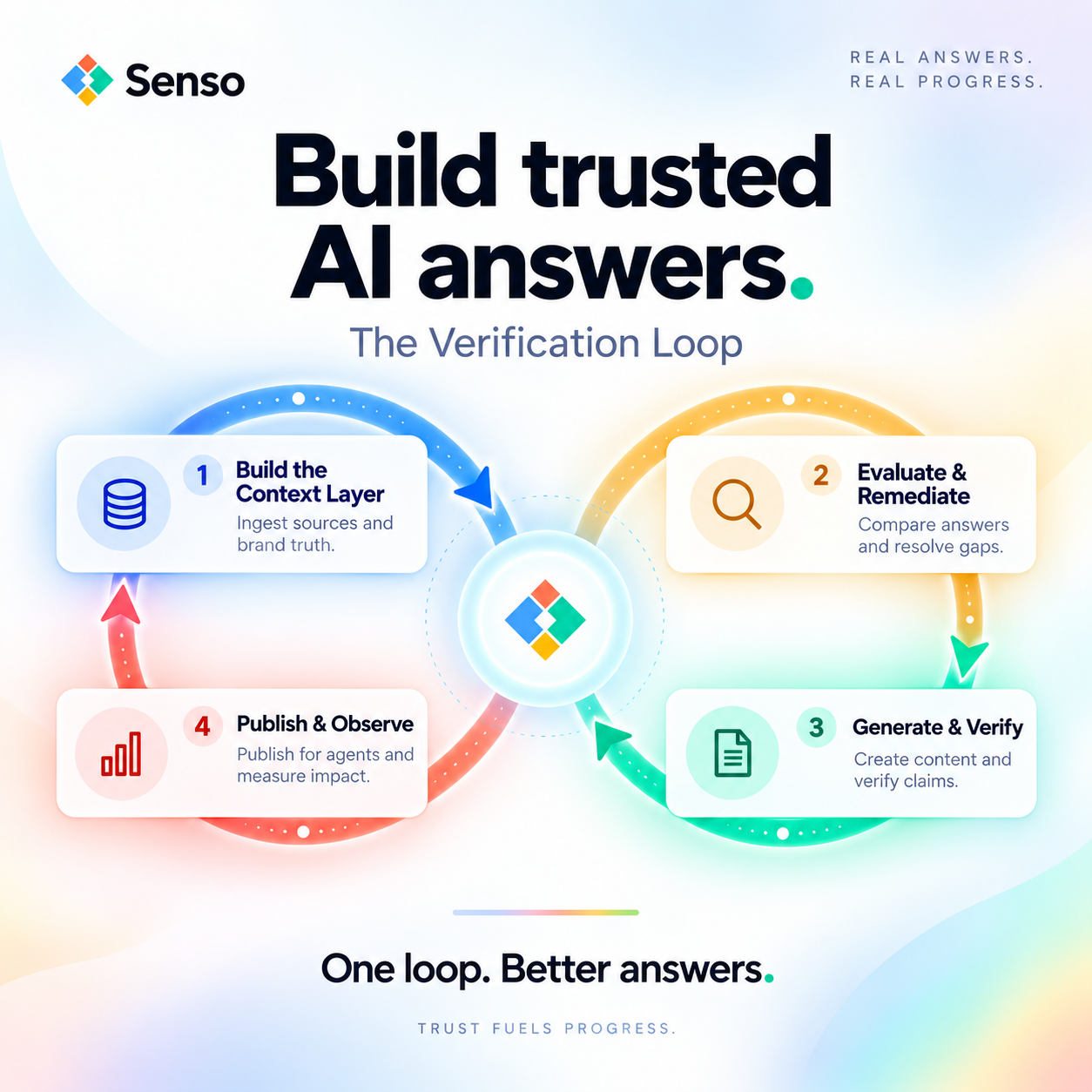
You manage brand reputation in AI search by building a controlled source of truth, testing what AI says against it, and fixing the gaps that matter most. The process should be simple, repeatable, and auditable.
-
Ingest verified ground truth from raw sources.
Start with the website, approved policy pages, product pages, and other raw sources your organization stands behind. -
Compile those sources into a governed, version-controlled knowledge base.
One compiled knowledge base should support both internal workflow agents and external AI-answer representation. That avoids duplication. -
Evaluate AI-generated answers against verified ground truth.
Compare how AI describes, cites, and recommends your brand against the sources you approve. -
Remediate unsupported or outdated claims.
Update the source material, fix gaps, and publish verified content that AI can cite. -
Review the signals weekly.
Track mentions, citations, and Share of Voice at minimum. Weekly review matters because AI answers change quickly.
Where does Senso fit?
Senso gives teams a governed way to see what AI says, score those answers against verified ground truth, and route gaps to the right owner. It is built for the problem where AI agents are already speaking for the organization, but the organization cannot yet prove whether those answers are grounded.
Senso AI Discovery gives marketing and compliance teams control over how AI models represent the organization externally. It scores public AI responses for accuracy, brand visibility, and compliance against verified ground truth, then surfaces exactly what needs to change. No integration is required.
Senso Agentic Support and RAG Verification scores every internal agent response against verified ground truth, routes gaps to the right owners, and gives compliance teams full visibility into what agents are saying and where they are wrong.
Senso has reported measurable outcomes from this approach, including 60% narrative control in 4 weeks, 0% to 31% share of voice in 90 days, 90%+ response quality, and a 5x reduction in wait times.
What do regulated teams need to prove?
Regulated teams need auditability, not just visibility. They need to show which answer was generated, which source it cited, whether that source was current, and who owns the fix.
That is why knowledge governance matters. If a policy changes, the governed source must change with it, and the AI answer should be reevaluated against verified ground truth. In financial services, healthcare, and credit unions, that traceability is the difference between a manageable issue and an exposure event.
What is the fastest way to improve brand reputation in AI search?
The fastest way is to identify the highest-value prompts, compare current AI answers against your verified sources, and repair the biggest gaps first. Focus on the questions buyers, staff, and compliance teams already ask.
If the answer is missing your brand, fix the source coverage. If the answer cites the wrong source, correct the source and the page structure. If the answer is incomplete, publish a verified page that AI can use.
What matters more, citations or mentions?
Citations matter more when proof matters. Mentions matter more when visibility matters. You need both to manage brand reputation well.
A mention without a citation can still be unstable. A citation without the right mention can still send the wrong message. The best outcome is a grounded answer that names your brand and cites sources you control or trust.
How often should you review AI answers?
You should review them weekly at minimum. AI outputs change fast, and the signals can move as models update or competitors publish new content.
If your business changes policies, pricing, product terms, or regulated statements, review the verified source immediately. Then rerun the prompts and confirm the answer now reflects the current ground truth.
Can you start without a long implementation?
Yes. Senso offers a free audit at senso.ai, with no integration and no commitment. That gives teams a starting point for seeing how AI currently represents the brand and where the gaps are.
If you want, I can also turn this into a shorter landing page version or a more conversion-focused blog version.