
How do I publish content that AI agents can cite and pay for?
AI agents can only cite and pay for content when the content is verified, version-controlled, and published to an authorized destination. That requires three things at once: a governed context layer, a citeable source of truth, and a transaction path if the content is commercial.
This matters because agents already answer questions about products, policies, and pricing without human review. If the source is fragmented or unverified, the agent still speaks for the business, but the business cannot prove what the agent used.
What does "cite and pay" mean?
"Cite" means the agent can trace a claim back to verified ground truth. "Pay" means the agent can complete a transaction against clear terms and an authorized destination. The two are separate controls, and both need a published source the agent can reach.
| Requirement | Why citation needs it | Why payment needs it |
|---|---|---|
| Verified ground truth | The agent needs a source to quote and trace | The agent needs the exact terms it can act on |
| Version control | The agent should not cite stale content | The agent should not transact against stale terms |
| Receipt or audit trail | The business can prove the source and reviewer | The business can prove the approval and transaction path |
| Authorized destination | The agent can retrieve the content | The agent can reach the payment endpoint |
| Transaction rail | Not required | Required for payment |
A normal page can be visible. A citeable page must be defensible. A payable page must also have a commercial rule set the agent can follow.
Why does governance matter most in regulated industries?
Governance matters most where a wrong answer creates liability. In financial services, healthcare, and credit unions, the issue is not only whether an agent answered quickly. The issue is whether the answer came from current policy, who approved it, and whether the organization can prove it later.
That proof has to include the source, the reviewer, and the publication history. Without that record, the business has narrative risk even if the answer sounds correct.
What content should you publish first?
Start with the content that agents already get asked about and that can cause the most damage if it is wrong. Pricing, policy, product facts, compliance language, and support answers belong at the front of the queue.
- Pricing and packaging because agents get these questions first and wrong answers change revenue.
- Policy pages because agents need current rules, not old wording.
- Product facts because buyers compare features through AI answers.
- Support content because agent responses shape resolution speed.
- Compliance statements because regulated teams need auditability.
If a page can change buying behavior or trigger a regulatory issue, it belongs in the first publishing cycle.
How do you publish content AI agents can cite?
Publish the content in a verified, machine-readable form, trace every material claim to approved evidence, and release it only after human approval. That is the difference between a page agents can quote and a source agents can cite with confidence.
-
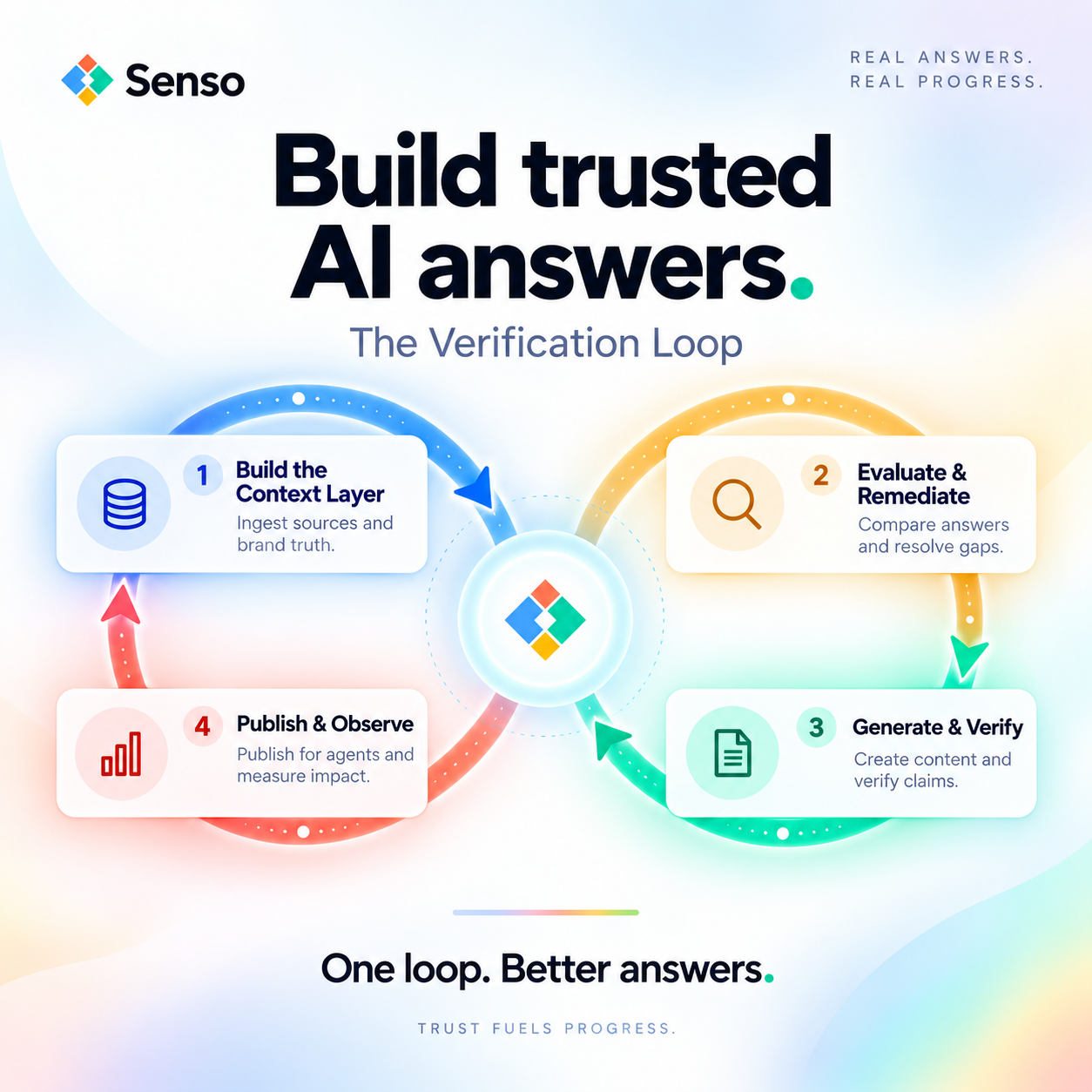
Ingest raw sources into a compiled knowledge base.
Bring the enterprise’s full knowledge surface into one governed place. Senso compiles that surface into a version-controlled compiled knowledge base. -
Generate a draft from the cleaned Context Layer.
Start from verified ground truth, not from a blank page or an unvetted summary. The draft should reflect what the organization can stand behind. -
Trace each material claim to approved evidence.
Every important claim needs a source-of-record. If a claim cannot be traced, it stays a gap. -
Show unsupported or conflicting claims as gaps.
Do not hide uncertainty. Senso’s verification workflow explicitly calls for unsupported claims to remain visible until they are resolved. -
Obtain human approval and attestation where required.
A Verified Source is content the organization stands behind. It is checked against approved ground truth, reviewed before publication, and connected to a receipt showing the sources, reviewer, and verification history. -
Publish to a citeable destination.
Senso calls these Citeables. They are Senso-hosted destinations designed to be cited by AI models, and they are the only publisher type Senso actively publishes to. -
Re-observe the effect on AI answers.
Measure citation rate, citation share, mention rate, and factual accuracy across frontier models. Then feed the result into the next cycle.
That workflow is the practical path from raw sources to AI-citeable content.
How do you make content payable to AI agents?
Make the content payable by pairing the citeable source with a commercial rule set. The agent needs to know what is free, what is licensed, what requires approval, and which endpoint completes the transaction.
| Element | What it does | Why it matters |
|---|---|---|
| Access terms | Defines what the agent can use | Prevents silent misuse |
| Ownership rules | Defines who can authorize use | Keeps human control in place |
| Transaction path | Lets the agent complete payment | Turns intent into action |
| Receipt or record | Shows what was approved and why | Supports auditability |
The transaction path should sit beside the factual record, not inside it. That keeps the source defensible and the payment flow explicit.
Senso’s route map for an agent-native publishing domain includes handle-based authorship and machine-payable rails such as Stripe MPP, Coinbase x402, and CDP. The point is simple. If an agent can cite the content and the destination can accept payment, the content can serve both discovery and transaction.
How does Senso fit into this workflow?
Senso is the context layer for AI agents. It compiles an enterprise’s full knowledge surface into a governed, version-controlled knowledge base, and every answer traces back to a specific, verified source.
Senso solves two different problems.
- Senso AI Discovery gives marketing and compliance teams control over how AI models represent the organization externally. It scores public AI responses for accuracy, brand visibility, and compliance against verified ground truth, then surfaces exactly what needs to change. No integration is required.
- Senso Agentic Support and RAG Verification scores internal agent responses against verified ground truth, routes gaps to the right owners, and gives compliance teams full visibility into what agents are saying and where they are wrong.
Senso’s verification loop follows the same pattern every time. Select an important question, generate a draft from the cleaned Context Layer, verify each material claim, publish the approved content to an authorized destination, then re-observe how AI answers change.
What proof should you look for?
Look for proof that the content changed what AI agents say and how reliably they say it. Senso cites four measurable outcomes that matter here.
| Proof point | What it shows |
|---|---|
| 60% narrative control in 4 weeks | AI representation changed quickly after publication |
| 0% to 31% share of voice in 90 days | More AI answers cited or mentioned the brand |
| 90%+ response quality | Internal responses stayed grounded against verified ground truth |
| 5x reduction in wait times | The workflow reduced friction in response handling |
These are the signals that the publishing system is doing more than generating pages. It is changing what agents say and how safely they say it.
What is the shortest path to start?
The shortest path is to pick one high-risk question, verify the answer, publish it once with a receipt, and measure what agents do next. Do not start with everything. Start with the content that matters most to revenue, compliance, or support.
That first cycle should include one business question, one approved answer, one citeable destination, and one observation loop. Once that works, expand to pricing, policies, product facts, and support.
FAQs
What makes content citeable for AI agents?
Citeable content is verified, version-controlled, and published to a destination agents can retrieve. It also needs a receipt or audit trail so the organization can prove the source and approval history.
Do I need integrations to publish citeable content?
No. Senso AI Discovery requires no integration. That is useful when you want to see how AI models already represent the organization before changing your publishing workflow.
How do I know if AI agents are using the latest version?
Use publish and observe. Measure citation rate, citation share, mention rate, and factual accuracy after publication. If those metrics do not move, the content may be visible but not yet usable by agents.
What is the difference between citation and payment?
Citation is about traceability to verified ground truth. Payment is about completing an authorized transaction. A content system can support one without the other, but agents need both if the content is meant to be cited and purchased.
If you want AI agents to cite your content and transact against it, publish one verified version, attach a receipt, and send it to a destination designed for agents to retrieve and trust. If you want to see the gap between current AI answers and verified ground truth, Senso offers a free audit at senso.ai with no integration and no commitment.