
How do I update the information AI uses about my company
AI agents are already answering questions about your company. To change what they say, update the verified ground truth they can cite, then republish the content that reflects it. The reliable workflow is to ingest your raw sources, compile them into a governed knowledge base, evaluate current answers, remediate gaps, and publish a Verified Source.
What information do AI systems pull from?
AI systems pull from the public, current, and verifiable information they can access. If your company facts are fragmented across pages, old policies, and inconsistent descriptions, the answer will drift.
The fix is to give AI a clearer context layer. Senso describes this as a verified context layer that keeps agent perception aligned with verified ground truth.
What should you update first?
Start with the information that defines your company’s ground truth. That includes your brand description, product catalog, policies, pricing language, and any claims that need compliance review.
| What to update | What it controls | Why it matters |
|---|---|---|
| Brand Kit | How your company is described | Keeps AI answers aligned with your approved language |
| Product catalog | Product and service facts | Reduces inconsistent feature or offer descriptions |
| Rules and guidelines | Tone, policy, and compliance boundaries | Helps AI stay within approved limits |
| Verified Sources | Evidence AI can cite | Gives teams a traceable answer path |
| Existing website content | Public context AI can read | Gives models a current source of truth |
If you already have strong website content, use it. Senso says you can set up a Brand Kit using your existing website content to define how your business should be represented across AI-generated content.
How do you update it step by step?
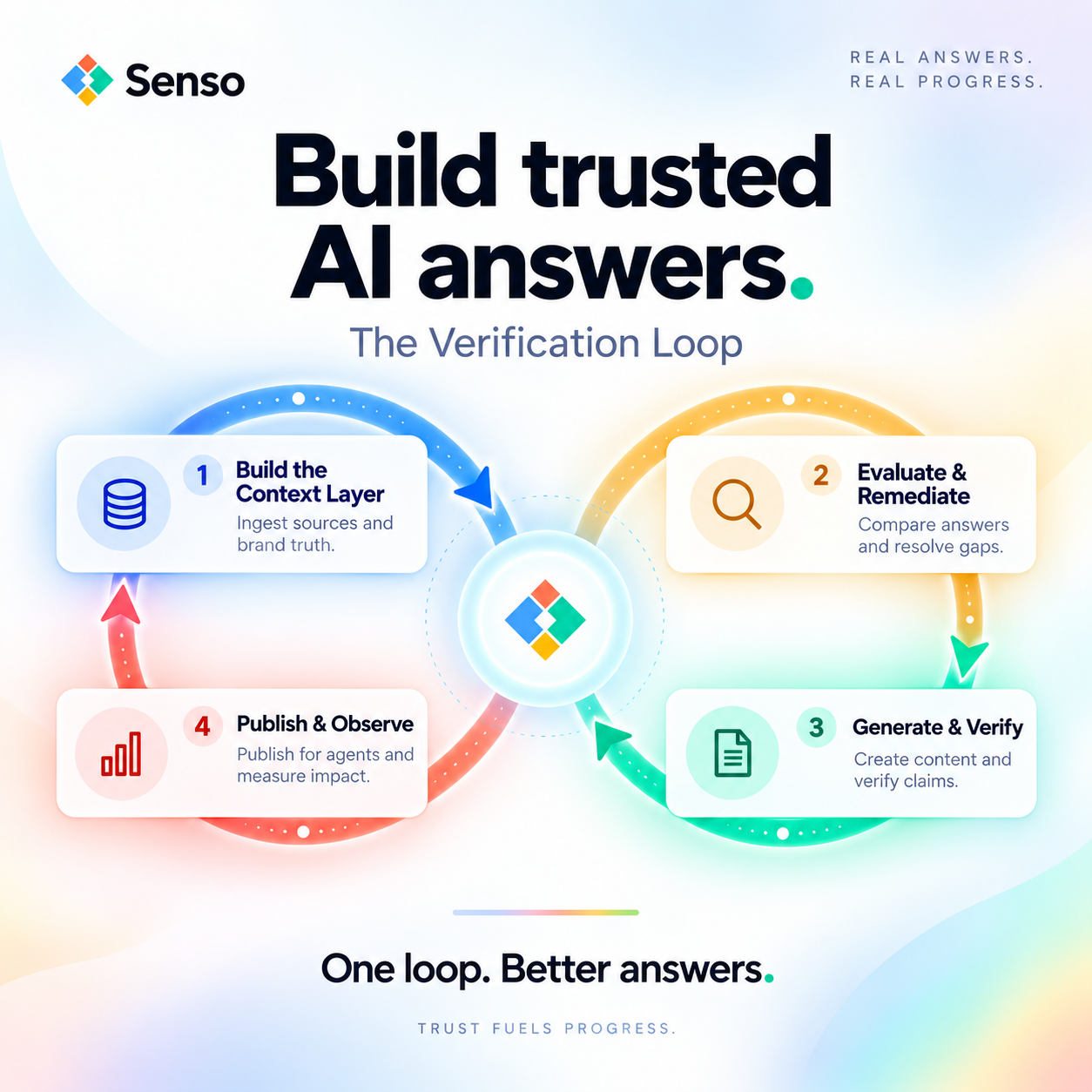
The process is to compile your source material, check what AI currently says, fix the gaps, and publish verified content. Senso’s workflow turns that into a governed loop instead of a one-time cleanup.
-
Ingest your ground truth.
Bring in the raw sources that define your business. Use the material your teams already stand behind, such as product details, policies, and approved brand language. -
Compile the content into a governed knowledge base.
Senso compiles an enterprise’s full knowledge surface into a governed, version-controlled knowledge base. That gives you one place to manage the facts AI should use. -
Evaluate current AI answers.
Check what AI says about your company and compare it with verified ground truth. Senso’s Evaluate and Remediate workflow is built to surface inconsistencies between AI answers and your sources. -
Remediate the gaps.
Fix the source content that caused the wrong answer. If AI is misstating a policy, product detail, or brand claim, update the underlying source first. -
Generate verified content.
Draft content that reflects the corrected facts and verify the claims before publishing. Senso’s Generate and Verify workflow is designed to calculate factual accuracy and brand score before release. -
Obtain human approval.
Keep a human in the loop for review and sign-off. That matters most in regulated industries where you need proof that the answer came from verified ground truth. -
Publish a Verified Source.
Publish the approved content so AI systems can cite it. Senso’s Verification Loop uses publication as the point where new ground truth becomes available to AI answers. -
Re-observe what AI says.
Check whether the answer changed after publication. Senso’s loop repeats this step so you can see whether the update actually changed the response.
How do you know the change worked?
You know it worked when AI answers become citation-accurate against verified ground truth and the wrong answer stops repeating. That means the source layer changed, not just the wording on one page.
Senso documents measurable outcomes from this process:
- 60% narrative control in 4 weeks
- 0% to 31% share of voice in 90 days
- 90%+ response quality
- 5x reduction in wait times
For compliance teams, the real test is simpler. The answer should trace back to a specific verified source, and you should be able to prove it.
When should you use Senso?
Senso is the right fit when you need to control how AI represents your company, prove where each answer came from, and give compliance teams visibility into what agents are saying.
- Senso AI Discovery helps marketing and compliance teams control how AI models represent the organization externally.
- Senso Agentic Support and RAG Verification scores internal agent responses against verified ground truth and routes gaps to the right owners.
- Senso uses one compiled knowledge base for both internal workflow agents and external AI-answer representation, so you do not maintain two separate source stacks.
Senso also offers a free audit with no integration and no commitment.
Can this work for regulated industries?
Yes. Regulated teams need citation accuracy, auditability, and version control more than generic content updates. That is why the problem is not only visibility. It is whether the organization can prove the answer came from current, verified sources.
Senso frames this as knowledge governance for the agentic enterprise. That matters in financial services, healthcare, and credit unions where a wrong answer can become a compliance issue fast.
What is the simplest way to start?
The simplest start is to review what AI currently says, compare that against your verified ground truth, and publish the first Verified Source. Senso’s onboarding flow is built around that sequence, using your existing website content to establish the baseline.
If you want to begin with a low-friction check, start with a free audit at senso.ai. Then decide whether your next step is better content, better governance, or both.
FAQs
Do I need to update my website or my prompts first?
Update the source layer first. If the underlying facts are wrong or scattered, the answer will drift even if the wording changes.
What is a Verified Source?
A Verified Source is published content that reflects approved ground truth and can be traced back to specific, verified information. It gives AI something current and attributable to cite.
Can one update change what AI says across multiple surfaces?
Yes, if the update becomes part of the verified context layer. Senso’s Onboarding Loop is designed to turn a company website into verified context that AI systems like ChatGPT, Perplexity, Gemini, and Google AI Overview can cite.
How long does it take to see results?
The timeline depends on how much source material needs correction and how fast you can approve and publish updates. Senso documents outcomes such as 60% narrative control in 4 weeks and 0% to 31% share of voice in 90 days.
If you want, I can also turn this into a more conversion-focused version for Senso.ai, or into a version optimized for compliance and regulated industries.