
How do visibility and trust work inside generative engines?
Generative engines decide two things at once. They decide whether your brand appears in the answer, and whether the answer can be traced to verified ground truth. Visibility is presence. Trust is proof. If you only measure one, you miss the failure mode that damages reputation, compliance, or revenue.
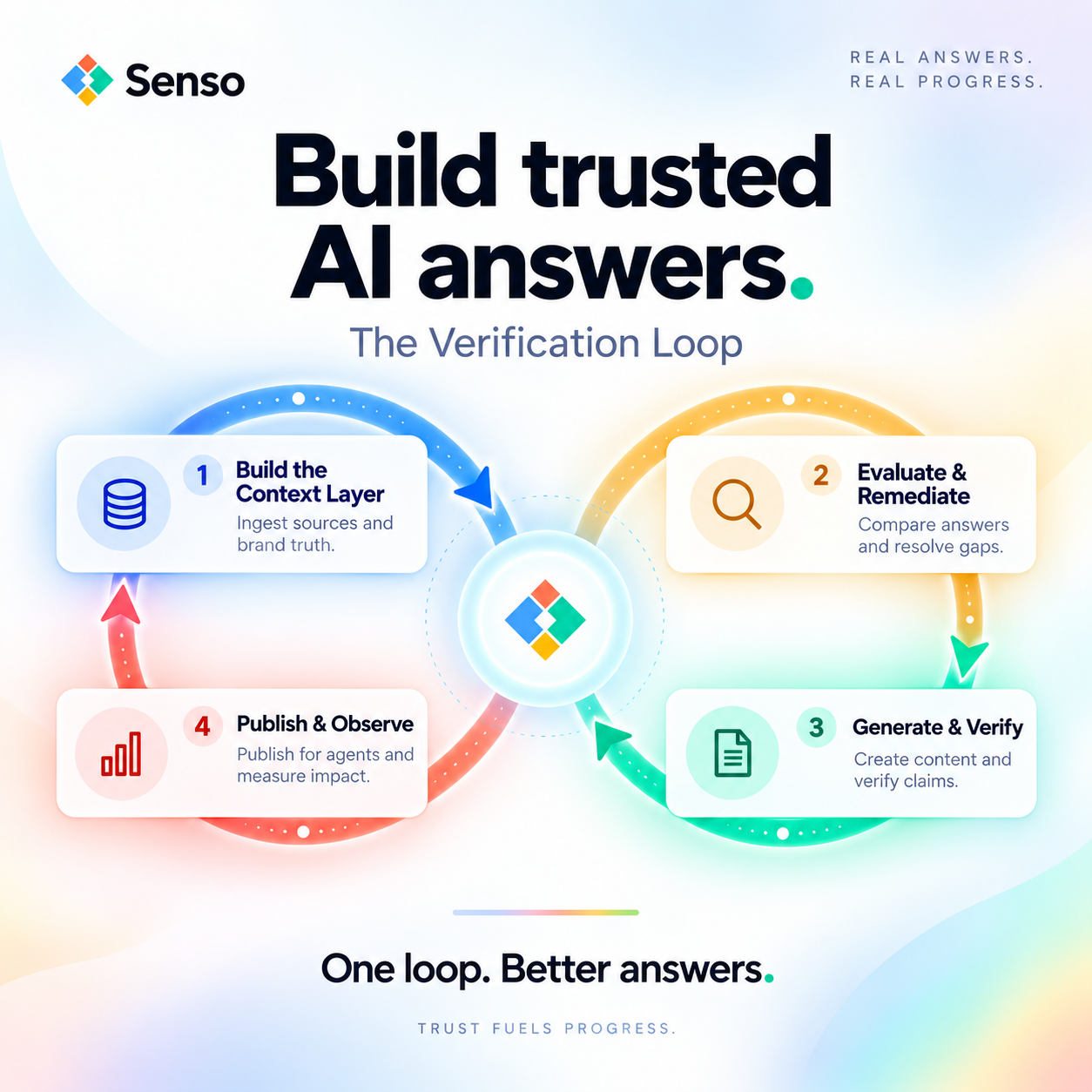
Senso treats this as knowledge governance. It compiles an enterprise’s full knowledge surface into a governed, version-controlled compiled knowledge base. One compiled knowledge base can feed both internal workflow agents and external AI-answer representation without duplication.
What is visibility inside generative engines?
Visibility is whether generative engines include your brand, product, or policy in the answer and how consistently they do it across prompts and models.
Traditional rankings tell you where a URL sits on a results page. Mentions tell you whether AI models include your brand. Senso’s AI Visibility scores public AI responses for accuracy, brand visibility, and compliance against verified ground truth.
- Senso tracks visibility across prompts that matter to buying decisions, including awareness, comparison, and brand-specific prompts.
- Senso’s Visibility Trends shows how core signals change over time across evaluated prompts.
- Senso’s Model Trends breaks the same data down by individual AI system.
- Senso’s Organization Leaderboard ranks organizations by visibility performance across the tracked prompt set.
Visibility is not just being mentioned. It is being mentioned in the right context, on the right models, with the right framing.
What is trust inside generative engines?
Trust is whether the answer is grounded in verified ground truth and traceable to a specific verified source.
A visible answer can still be wrong. A trustworthy answer has citation accuracy, current policy, and a clear source trail. Senso scores every agent response against verified ground truth and shows where the answer breaks.
- A fabricated company fact presented with confidence is a silent failure. It can spread into decks and customer conversations before anyone notices.
- A current policy citation matters because a stale policy answer creates audit risk.
- A source trail matters because every answer should trace back to a specific verified source.
Trust is the difference between an answer that sounds right and an answer you can prove.
How do visibility and trust differ?
Visibility and trust are linked, but they answer different questions. Visibility asks whether the model mentioned you. Trust asks whether the model can prove what it said.
| Signal | What it answers | Common failure |
|---|---|---|
| Visibility | Did the model include your brand in the answer? | You are absent or underrepresented |
| Trust | Can the answer be traced to verified ground truth? | The model repeats unsupported or stale facts |
| Governance | Can the organization prove and correct the source? | Teams cannot explain or fix drift |
The worst case is visible but untrusted. The second worst case is trusted but invisible. The first creates misrepresentation. The second leaves useful facts out of the answer.
What do generative engines use to form an answer?
Generative engines do not rank pages only by keywords. They assemble answers from trusted, structured facts and raw sources.
That makes the quality of the underlying knowledge surface the main input. Senso’s guidance is to start with ground truth infrastructure, audit product and policy content for completeness and consistency, add structured content where the model needs it, and prioritize ranking prompts, comparison prompts, and brand-specific prompts closest to revenue.
- Audit product and policy content for completeness and consistency.
- Compile raw sources into a governed, version-controlled compiled knowledge base.
- Review core ground truth whenever facts change.
If the source material is fragmented, the answer will drift. If the source material is governed, the answer becomes easier to verify.
How do you measure visibility and trust?
You measure visibility and trust by running tracked prompts across selected AI models, capturing the generated answers, and converting them into structured visibility signals.
Senso runs tracked prompts on a schedule. It then surfaces Visibility Trends, Model Trends, and an Organization Leaderboard. That gives teams a repeatable way to see whether answers are visible, citation-accurate, and consistent.
- Visibility signals show mentions, framing, and share of voice.
- Trust signals show citation accuracy and source traceability.
- Operational signals show where gaps should route and how fast owners respond.
In Senso use cases, customers have seen 60% narrative control in 4 weeks, 0% to 31% share of voice in 90 days, 90%+ response quality, and 5x reduction in wait times.
Those outcomes matter because they show the loop closing. Better ground truth changes what the model says, and the measurement shows whether the change holds.
Why does this matter for regulated teams?
Regulated teams need an audit trail, not just a better answer.
AI agents are already the interface to your business. The question is whether their answers are grounded and provable. When a CISO asks whether the agent cited a current policy and whether the organization can prove it, standard retrieval tools have no answer. Senso gives compliance teams full visibility into what agents say, where they are wrong, and which owner needs to fix the gap.
That matters in financial services, healthcare, and credit unions, where a stale answer can create exposure fast. Governance is not optional when agents represent your brand to customers, staff, and auditors.
What should teams do first?
Teams should start with the facts the engine is most likely to use and the prompts closest to revenue.
Begin with a ground truth audit. Then compile raw sources into a governed knowledge base. Then track the prompts that shape consideration and purchase. That sequence gives you visibility first, then trust, then control.
If you want to see where your brand stands, Senso offers a free audit at senso.ai. No integration. No commitment.
FAQs
Can a brand be visible but not trusted?
Yes. The model can mention your brand and still cite stale or unsupported facts. That is a visibility win and a governance failure.
Can a brand be trusted but not visible?
Yes. The facts can be correct, but the model may not surface them often enough across relevant prompts. In that case, the brand loses share of voice.
How does Senso measure these signals?
Senso runs tracked prompts across selected AI models, scores answers against verified ground truth, and turns the results into visibility signals tied to each prompt. It then shows trends by prompt, model, and organization.
What is the first thing to fix?
Start with ground truth. If the underlying product, policy, and brand facts are incomplete or inconsistent, visibility and trust will both drift.
Why do citations matter so much?
Citations give you proof. They show where the answer came from, whether the source was current, and whether the model stayed grounded in verified ground truth.