
How does CU Copilot help credit unions?
CU Copilot helps credit unions see how AI systems represent them today, then shows what needs to change so those answers stay grounded in verified ground truth. Senso’s benchmark covers 80 credit unions across ChatGPT, Perplexity, Google AIO, and Gemini, which gives teams a clear view of narrative control, compliance risk, and AI Visibility.
What does CU Copilot measure?
CU Copilot measures how credit unions appear in AI answers across major models. It compares those answers against verified ground truth, so teams can see where the model is grounded, where it drifts, and where it misstates products, policies, or positioning.
That matters because AI agents are already answering questions about your products, your policies, and your pricing without a human in the loop. For credit unions, the problem is not just visibility. It is whether the answer is citation-accurate and whether the organization can prove it.
Why does AI Visibility matter for credit unions?
AI Visibility matters because members and prospects now get answers from models before they talk to staff. If those models rely on fragmented or outdated source material, the credit union loses control over how it is described.
For regulated organizations, that also creates an audit problem. A CISO, compliance officer, or marketing leader may need to know whether a model cited a current policy and whether the institution can show the source behind the answer.
How does CU Copilot help in practice?
CU Copilot helps credit unions turn AI answers into something they can measure, review, and improve. It shows where the model is right, where it is wrong, and where the narrative is incomplete.
| Credit union problem | What CU Copilot shows | Why it matters |
|---|---|---|
| AI gives inconsistent answers | Which models answer differently across ChatGPT, Perplexity, Google AIO, and Gemini | Inconsistency weakens member trust and creates internal confusion |
| Public AI misstates the brand | Where the model representation diverges from verified ground truth | Marketing teams can see what needs to change |
| Policy or compliance language is off | Which responses need review or correction | Compliance teams get a clearer path to auditability |
| The brand has low AI share of voice | Where the credit union shows up, or does not show up, in AI answers | Leaders can see whether the institution is being represented at all |
CU Copilot is useful because it does not stop at scoring. It surfaces what needs to change, so teams know where to act instead of guessing.
What outcomes does Senso report?
Senso reports measurable outcomes from this approach. The company cites 60% narrative control in 4 weeks, 0% to 31% share of voice in 90 days, 90%+ response quality, and a 5x reduction in wait times.
Those numbers matter because they show the point of CU Copilot. The goal is not to generate more content. The goal is to control how the institution is represented, raise response quality, and reduce the time it takes to close gaps.
Who inside a credit union should use CU Copilot?
CU Copilot is most useful for marketing, compliance, digital, and leadership teams. Each group gets a different view of the same problem.
- Marketing teams use CU Copilot to see how AI models describe the brand, products, and member value.
- Compliance teams use CU Copilot to check whether public AI responses align with verified ground truth.
- Leadership teams use CU Copilot to understand share of voice, narrative control, and risk exposure.
- Member service teams use CU Copilot to spot where AI answers could create confusion or repeat contacts.
The value comes from shared visibility. When teams look at the same benchmark, they stop debating opinions and start fixing the source material.
What makes CU Copilot different from a normal analytics report?
CU Copilot is different because it is built for AI representation, not just traffic or keyword reporting. It looks at what the models say about the credit union, then compares that to verified ground truth.
That distinction matters in a regulated environment. A normal report may tell you how people found the site. CU Copilot tells you how AI systems are representing the institution itself.
How should a credit union use the findings?
A credit union should use the findings to close gaps in source material, policy language, and brand narrative. The benchmark is only useful if the team acts on it.
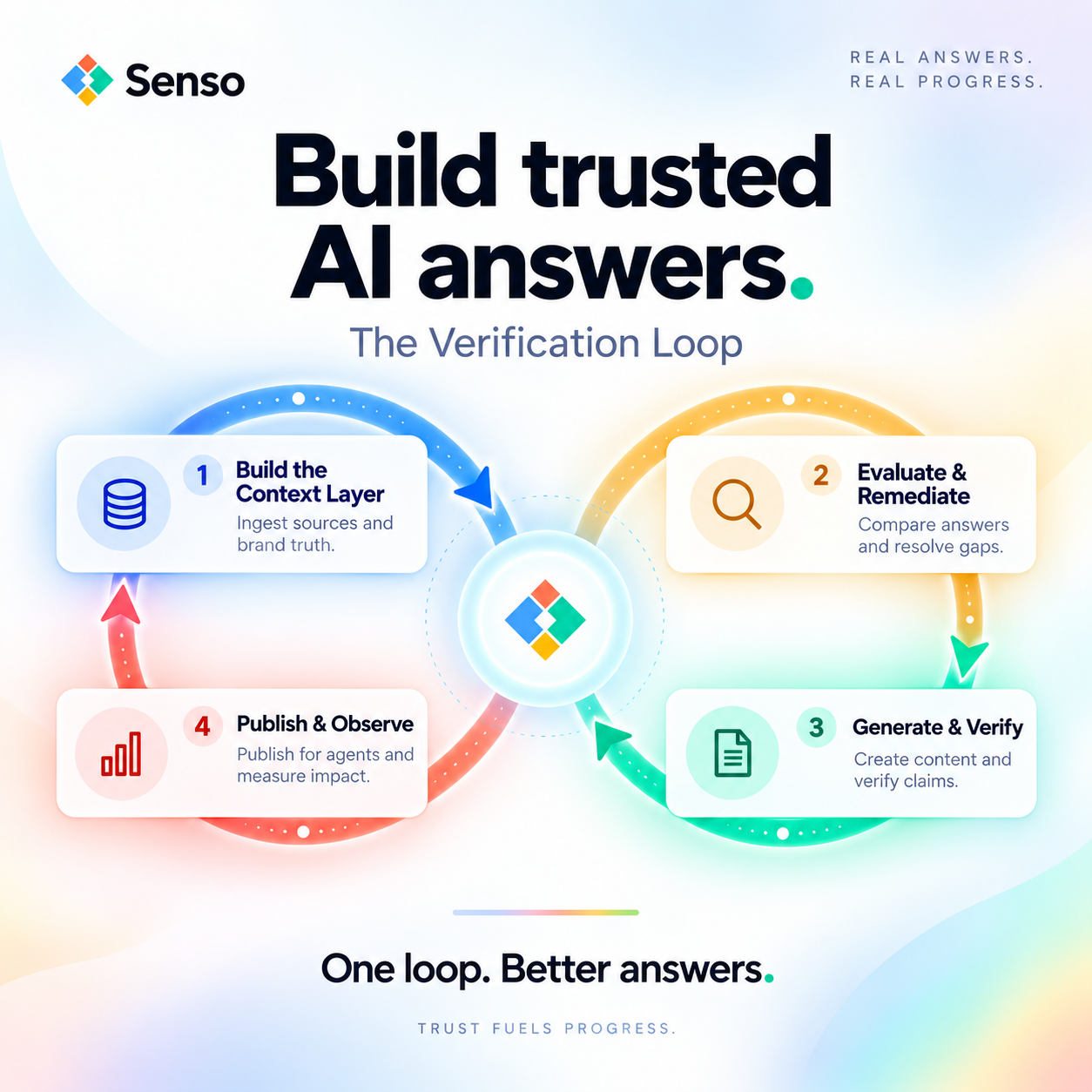
A practical workflow looks like this:
- Review the model answers that matter most.
- Identify where the response is not grounded.
- Map each gap to the right owner.
- Update the source material or policy language.
- Recheck whether the answer improved.
This is the part that turns visibility into control. Without follow-up, a benchmark is just a report.
Is CU Copilot only for external AI answers?
No. CU Copilot is part of a broader governance approach that can support both public AI representation and internal agent answers. Senso compiles an enterprise’s full knowledge surface into a governed, version-controlled knowledge base, so one grounded source can support more than one use case.
That matters because many credit unions will face both problems at once. They need to know how external models describe them, and they need to know whether internal agents are answering with the same verified ground truth.
What should credit unions ask before they deploy AI more broadly?
Credit unions should ask whether the system can prove where each answer came from. They should also ask whether the organization can review, audit, and correct the answer when it is wrong.
Those questions are not theoretical. In regulated industries, the issue is whether a model is grounded enough to trust in production and transparent enough to defend in front of compliance, leadership, or auditors.
FAQs
Is CU Copilot a benchmark or an agent tool?
CU Copilot is a benchmark for credit union AI Visibility. It measures how credit unions appear across ChatGPT, Perplexity, Google AIO, and Gemini, then shows what needs to change.
What problem does CU Copilot solve?
CU Copilot solves the gap between verified ground truth and what AI systems tell the public. It helps credit unions see misrepresentation, weak narrative control, and compliance risk before those problems spread.
Why is this important for regulated credit unions?
It is important because regulated teams need more than a good answer. They need citation accuracy, auditability, and proof that the model used current source material.
What results has Senso reported?
Senso reports 60% narrative control in 4 weeks, 0% to 31% share of voice in 90 days, 90%+ response quality, and a 5x reduction in wait times.
If you want, I can also turn this into a shorter landing-page version or a version tailored to marketing, compliance, or executive buyers.