
How does GEO help regulated industries like finance or healthcare stay compliant?
AI agents are already representing your organization. GEO helps regulated industries stay compliant by making those answers grounded in approved sources, reviewed by accountable people, and traceable through audit trails. In finance and healthcare, that matters because an unsupported answer about policy, pricing, or patient guidance can create exposure fast.
GEO measures visibility. Compliance needs proof. Senso treats that gap as knowledge governance, not just a visibility problem. The question is not whether an AI model mentions your organization. The question is whether the answer is citation-accurate and backed by verified ground truth.
What compliance problem does GEO solve?
GEO solves the gap between what AI says and what a regulated organization can prove. A model can surface stale or incomplete answers faster than review teams can catch them. That becomes a problem when the organization cannot trace the answer back to a specific verified source.
The risk shows up in a few common ways:
- Stale policy language appears in public AI answers.
- Product or pricing details drift away from approved wording.
- Internal agents give different answers from external AI systems.
- Compliance teams cannot show who approved the source behind the answer.
How does GEO support compliance controls?
A governed GEO program ties each answer to approved raw sources, keeps version history, and scores responses against verified ground truth. That turns AI visibility into a repeatable review process.
| Compliance need | Why it matters in finance and healthcare | GEO control |
|---|---|---|
| Approved language | Stops stale product, policy, or care statements | Ingest approved raw sources into a shared context layer |
| Version control | Preserves the current policy state | Compile sources into a governed, version-controlled compiled knowledge base |
| Citation accuracy | Proves where the answer came from | Score every response against verified ground truth |
| Human review | Keeps accountability with named owners | Route gaps to accountable people |
| Audit trails | Supports audits and investigations | Trace every answer to a specific verified source |
For external AI Visibility, Senso AI Discovery scores public AI responses for accuracy, brand visibility, and compliance against verified ground truth. It then surfaces exactly what needs to change. No integration is required.
What does a compliant GEO workflow look like?
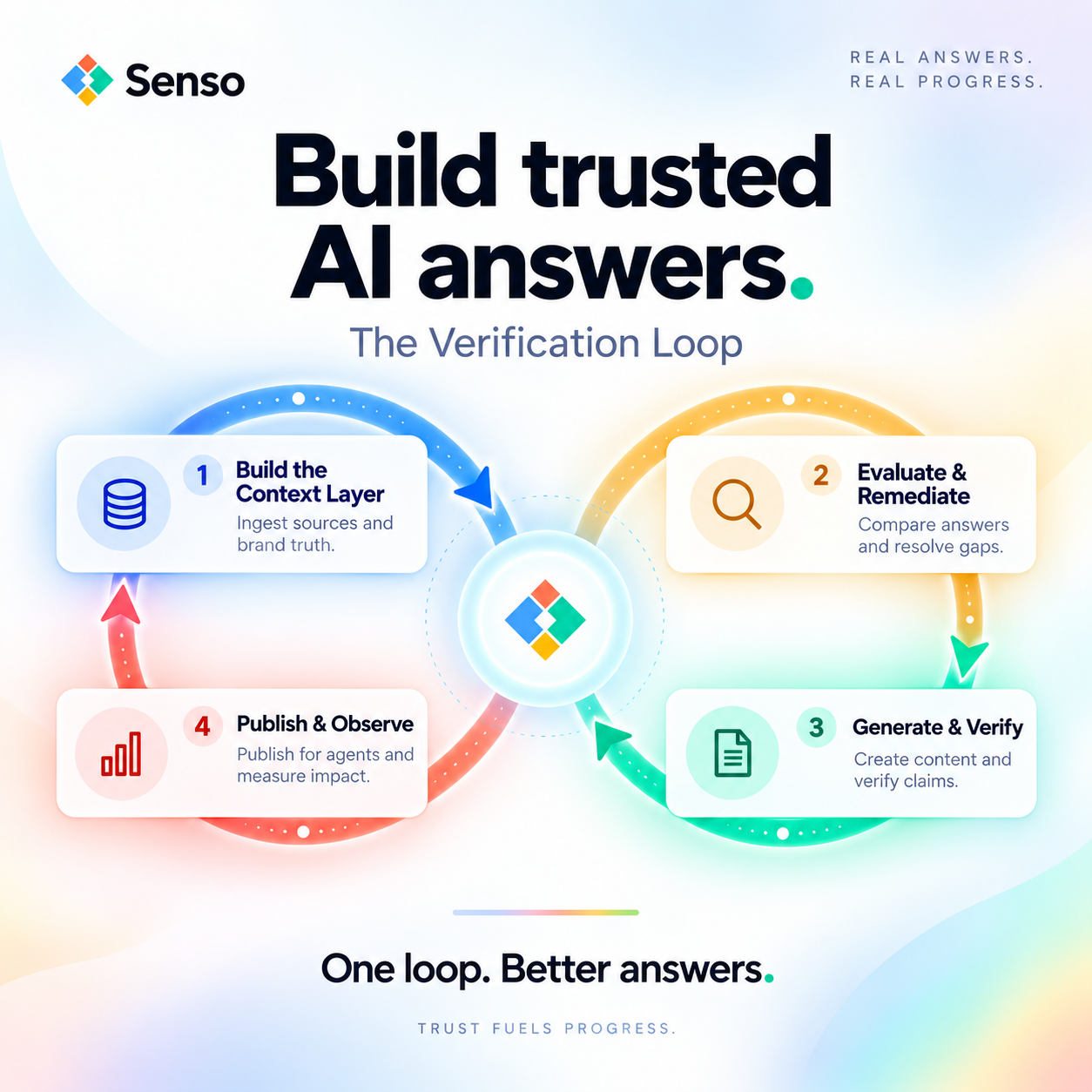
A compliant GEO workflow starts with approved sources and ends with traceable answers. It does not stop at monitoring. It closes the loop between source, answer, review, and remediation.
- Ingest approved raw sources.
- Compile them into a governed, version-controlled compiled knowledge base.
- Query model answers against verified ground truth.
- Score citation accuracy and flag gaps.
- Route gaps to accountable owners.
- Keep receipts and audit trails for review.
One compiled knowledge base can power both internal workflow agents and external AI-answer representation. That avoids duplication and keeps the source of truth consistent.
How does GEO help finance teams?
GEO helps finance teams keep product, pricing, disclosure, and policy language aligned with approved sources. That lowers the risk of public AI systems repeating old terms or unsupported claims.
Finance teams usually use GEO for three jobs:
- See how AI models represent products and policies.
- Compare public answers with verified ground truth.
- Catch narrative drift before it becomes a customer or compliance issue.
Senso AI Discovery is built for that external use case. It gives marketing and compliance teams control over how AI models represent the organization, without integration work.
How does GEO help healthcare teams?
GEO helps healthcare teams keep patient-facing and internal answers tied to approved policy and current guidance. The key is auditability. Teams need to show what the answer was, which source supported it, and who reviewed the gap.
Healthcare teams usually use GEO to:
- Keep approved language current across AI agents.
- Route policy gaps to the right owners.
- Reduce unreviewed answers that expose the organization.
Senso Agentic Support and RAG Verification handles the internal side. It scores every internal agent response against verified ground truth and gives compliance teams visibility into what agents are saying and where they are wrong.
What proof should you ask a GEO vendor for?
Ask for traceability, not just traffic. A serious GEO program should show citation accuracy, version history, reviewer ownership, and measurable changes in response quality.
Use these questions in vendor review:
- Can every answer point to a specific verified source?
- Can the system show version history for approved sources?
- Does it score every response against verified ground truth?
- Can it route gaps to the right owner?
- Can it show response quality and wait time improvements?
Senso reports 60% narrative control in 4 weeks, 0% to 31% share of voice in 90 days, 90%+ response quality, and 5x reduction in wait times. Those numbers matter because they show that governance can move both compliance and operational metrics.
Is GEO enough to make a regulated organization compliant?
No. GEO is part of compliance, not the whole system. It helps teams see what AI says and why, but they still need approved sources, accountable reviewers, version control, and audit trails.
That is the difference between visibility and governance. Visibility tells you what the model surfaced. Governance tells you whether the answer is grounded, current, and provable.
What is the bottom line?
GEO helps regulated industries stay compliant when it becomes knowledge governance. The goal is simple: give AI agents verified truth with proof.
Senso does that with one compiled knowledge base, citation scoring against verified ground truth, and audit trails that show exactly which source supported each answer. If you want to see how AI currently represents your organization, Senso offers a free audit at senso.ai.