
How does Google AI Overviews impact my marketing strategy?
Google AI Overviews changes marketing strategy because search visibility now depends on whether Google can include, cite, and summarize your content, not just rank it. Google AI Overviews are AI-generated summaries at the top of Google Search results for many queries, and clicks are not guaranteed even when you are cited.
That shifts marketing from traffic only to answer control. The brands that adapt fastest are the ones with current, verified ground truth, especially in finance, healthcare, and other categories where trust, accuracy, and comparison drive decisions.
What changes when Google AI Overviews appear in search?
Google AI Overviews move the decision point into the results page. A user can get a summary, a citation, and a recommendation without visiting your site, so your content has to be understandable, verifiable, and current enough for Google to quote.
The practical effect is simple:
- Your page can lose influence even when it still ranks.
- Your brand can appear without earning a click.
- Your claims can be summarized by Google before a human reaches your site.
- Your public narrative can drift if your source pages are outdated.
The old model rewarded blue-link rankings. The new model rewards inclusion, citation, and answer quality.
Which metrics should now matter more?
The right dashboard tracks mentions, citations, and share of voice. Those three metrics show whether your brand appears, whether Google can ground the answer, and how much of the answer you own relative to competitors.
| Metric | What it tells you | Why it matters |
|---|---|---|
| Mentions | Whether your brand appears in an AI-generated answer for a tracked prompt | This is the baseline signal of visibility |
| Citations | Whether the answer points to your owned pages or credible external sources | Citations are a trust mechanic for AI engines |
| Share of Voice | How much of the answer is dedicated to your brand compared with others | This measures answer dominance |
Track these weekly at minimum. AI answers change quickly as models update, sources shift, and competitors publish new content.
How should your content strategy change?
Your content should function as trusted ground truth. Review core pages every 60 to 90 days and whenever facts change, then make sure the public claims on those pages match the facts Google’s AI will summarize.
That means focusing on the pages Google can safely reuse:
- Product and service pages.
- Pricing and packaging pages.
- Policy and compliance pages.
- Comparison pages.
- FAQ pages that answer high-intent questions directly.
Write with citation in mind. Short, specific statements are easier for Google to summarize than broad marketing copy. If a claim matters to the buyer, it should also be backed by a source that a reviewer can verify later.
One compiled source of truth should feed both your public content and your internal workflows. Duplication creates drift, and drift is where AI summaries go wrong.
Which teams feel the biggest impact?
Marketing, compliance, and customer-facing teams feel this first because Google AI Overviews can represent the company before a human conversation begins. Regulated industries feel it most because a wrong summary is a brand risk and a compliance risk.
The biggest impact is in industries where trust, accuracy, and comparison drive decisions. That includes finance and healthcare, where a summary that omits a policy, misstates an offer, or presents an outdated claim can change how people evaluate you.
This is not only a traffic issue. It is a governance issue.
What does a practical response look like?
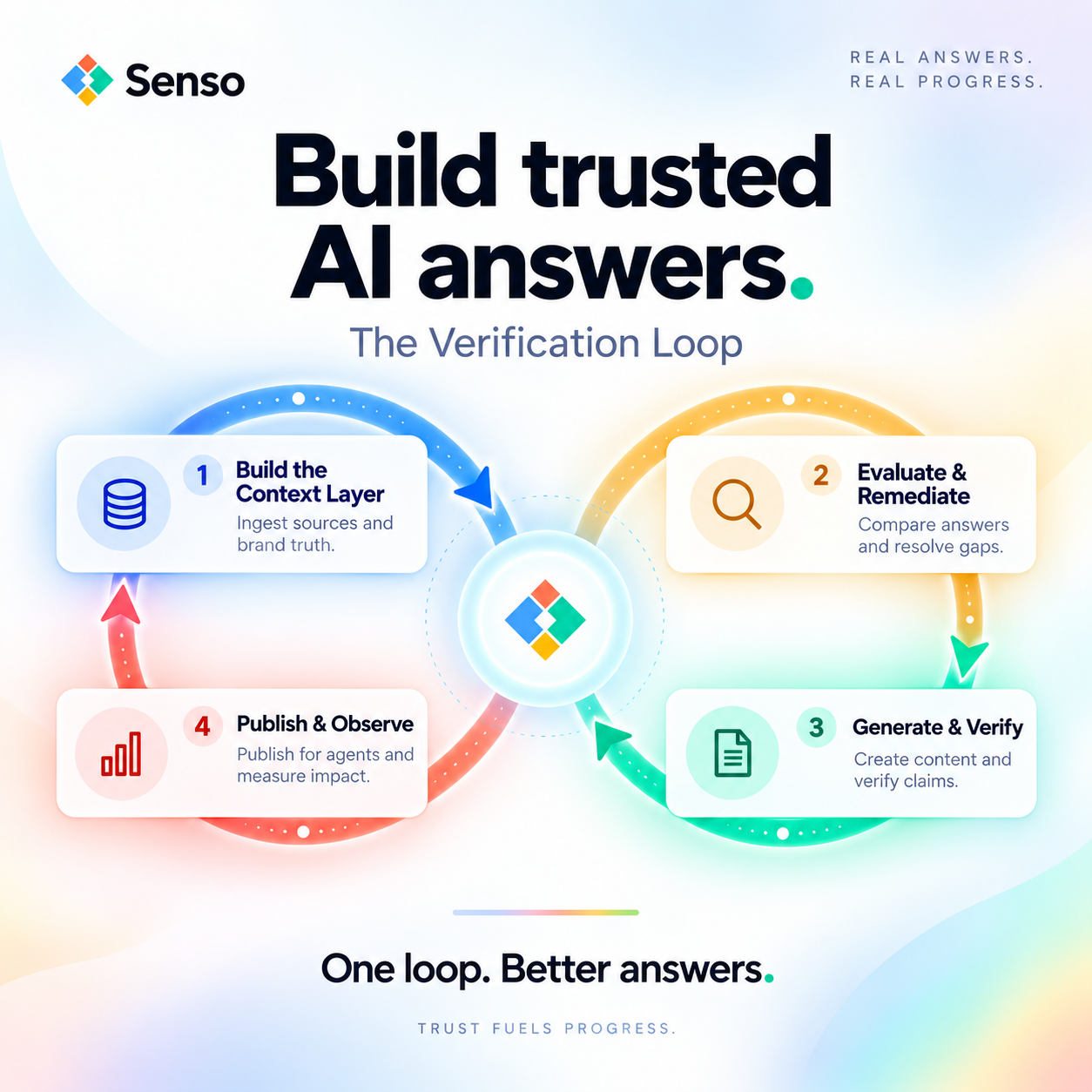
Start with a baseline audit of what Google AI Overviews already says about your brand. Then close the gap between public content and verified ground truth, and track the result by prompt and topic over time.
A simple process looks like this:
- Pick the prompts that matter most to revenue, compliance, or support.
- Review what Google AI Overviews says and cites for those prompts.
- Identify missing, stale, or contradictory facts.
- Update the source pages that Google depends on.
- Recheck weekly and after any major product, policy, or pricing change.
If you only measure clicks, you will miss the part of the funnel where the answer is already formed.
What measurable results can a governed approach deliver?
A governed approach should improve narrative control, response quality, and citation accuracy. In documented Senso work, teams reached 60% narrative control in 4 weeks, moved from 0% to 31% share of voice in 90 days, reached 90%+ response quality, and reduced wait times by 5x.
Those outcomes are not guaranteed for every brand. They do show what changes when AI visibility is tied to verified ground truth instead of scattered source pages.
How does this affect your overall marketing strategy?
It changes strategy in three ways. First, brand visibility becomes a search and answer problem, not only a content and traffic problem. Second, compliance and marketing have to work from the same verified facts. Third, your measurement stack has to include AI visibility, not just website analytics.
That means planning content around the questions buyers ask, the claims Google can safely summarize, and the sources that prove those claims are current.
Does Google AI Overviews reduce traffic?
It can. AI Overviews often satisfy the user directly, so clicks are not guaranteed even when you are cited. That means traffic is no longer the only success signal.
The better question is whether Google is representing your brand correctly. If the answer is yes, you may win the click later in the journey. If the answer is no, you can lose the buyer before they ever reach your site.
How often should you update core pages?
Review core ground truth pages at least every 60 to 90 days and whenever facts change. That cadence matters because AI answers change quickly as models update, sources shift, and competitors publish new content.
If a page contains pricing, policy, or comparison data, treat it like a living source. Stale facts create stale summaries.
What should you do next?
Begin with a prompt-level audit of how Google AI Overviews represents your brand. Then map each gap back to the source page, the owner, and the date it was last verified.
If you want a faster baseline, Senso AI Discovery scores public AI responses for accuracy, brand visibility, and compliance against verified ground truth, then surfaces exactly what needs to change. It requires no integration.
Google AI Overviews is changing marketing strategy because the answer now matters as much as the click. Brands that keep their ground truth current, measurable, and governed will control more of that answer.