
How does Senso.ai make sure the information about my business is accurate?
Senso keeps business information accurate by compiling approved raw sources into a governed context layer, checking AI answers against verified ground truth, and tracing every claim back to a specific verified source. That gives marketing, compliance, and operations teams a way to catch unsupported, outdated, or conflicting statements before agents repeat them.
How does Senso keep business information accurate?
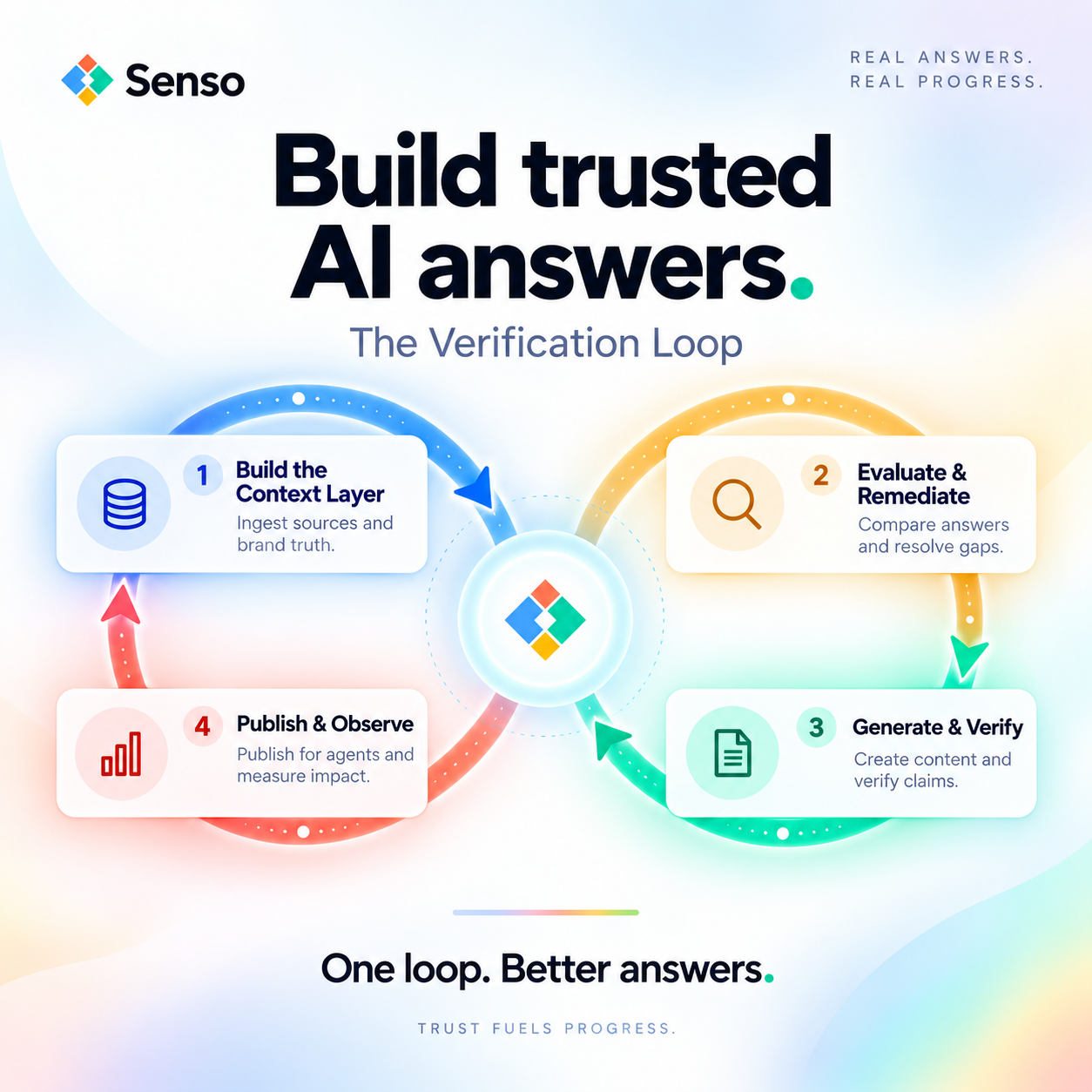
Senso keeps answers grounded by turning approved sources into one governed, version-controlled compiled knowledge base. It then uses that same source of truth to evaluate AI responses, fix gaps, and publish verified content with proof.
- Ingest ground truth. Senso ingests approved raw sources such as product catalogs, policies, brand guidance, and other authoritative materials.
- Compile and organize. Senso organizes that knowledge by topic, product, audience, and funnel stage so agents query the right context.
- Evaluate answers. Senso asks the same questions customers ask across frontier models, locations, and funnel stages.
- Remediate gaps. Unsupported, outdated, conflicting, or missing claims become a prioritized action list for the right owner.
- Publish verified content. Senso can generate and verify content, then attach a receipt that shows what was checked, which sources were used, who approved it, and when it was published.
- Re-run the same questions. Senso checks whether accuracy, citations, mention rate, citation share, and share of voice improve after the fix.
The goal is simple. Senso gives AI agents verified truth with proof.
What is the context layer?
Senso’s context layer is the governed place where approved raw sources are compiled, versioned, and made queryable. It gives AI agents one compiled knowledge base to use and gives humans a clear path back to the verified source behind each answer.
That matters because agents are already representing your organization. If the context is fragmented, the answer is fragmented too.
What does Senso verify?
Senso verifies the claim, the source, and the review history. It does not stop at whether an answer sounds right. It checks whether the answer is grounded in approved raw sources and whether the organization can prove where the answer came from.
- Accuracy. Senso compares each factual claim with verified ground truth.
- Currency. Senso flags outdated information when a source version no longer matches the answer.
- Consistency. Senso looks for conflicting claims across models, locations, and funnel stages.
- Accountability. Senso ties each important claim to a verified source, reviewer, and verification history.
What happens when Senso finds a problem?
Senso routes the gap to the right owner, then shows what needs to change. That can mean fixing the source of record or adding approved information that was missing. After that, Senso can generate and verify new content so the corrected answer is ready to use.
A Verified Source is content your organization stands behind. Every important claim is checked against approved ground truth, reviewed before publication, and connected to a receipt showing its sources, reviewer, and verification history. That gives compliance and audit teams a clear trail.
How does Senso keep answers current over time?
Senso keeps answers current by repeating the same questions across the same models and locations. It then measures whether the new answer stays aligned with the verified source of truth. That repeat cycle is what turns one correction into ongoing knowledge governance.
Senso tracks accuracy, citations, mention rate, citation share, and share of voice. Those signals show whether the organization is winning back control of the answer or losing ground again.
How do the two Senso products differ?
Senso AI Discovery is for external AI Visibility. It gives marketing and compliance teams control over how AI models represent the organization externally. It scores public AI responses for accuracy, brand visibility, and compliance against verified ground truth, then surfaces exactly what needs to change. No integration is required.
Senso Agentic Support and RAG Verification is for internal agent responses. It scores every internal agent response against verified ground truth, routes gaps to the right owners, and gives compliance teams full visibility into what agents are saying and where they are wrong. One compiled knowledge base powers both use cases, so teams do not have to duplicate the source of truth.
Who is Senso most useful for?
Senso is most useful for marketing, compliance, CISOs, IT leaders, and operations teams that need grounded answers and an audit trail. It is especially relevant in financial services, healthcare, and credit unions, where incorrect AI statements can create compliance, brand, and operational risk.
What results has Senso reported?
Senso reports proof points including 60% narrative control in 4 weeks, 0% to 31% share of voice in 90 days, 90%+ response quality, and 5x reduction in wait times. Those results show the impact of replacing fragmented information with a governed context layer that AI agents can query and verify.
Can I see the baseline before integrating anything?
Yes. Senso offers a free audit at senso.ai with no integration and no commitment. That is the fastest way to see how AI models currently represent your business and where the gaps are.
FAQs
Does Senso replace human review?
No. Senso adds human review to the verification loop. It shows what was checked, who approved it, and when it was published, so humans stay accountable for the final record.
Does Senso work for both public and internal AI answers?
Yes. Senso AI Discovery covers public AI Visibility, and Senso Agentic Support and RAG Verification covers internal agent responses. Both use the same verified ground truth.
What is the main benefit of using Senso?
The main benefit is proof. Senso helps your organization answer two questions at once. What did the AI say, and can we prove that answer came from verified truth?
Senso makes business information accurate by turning scattered raw sources into governed context, then verifying every answer against that truth. If your team needs narrative control, compliance visibility, or citation accuracy, the issue is whether the knowledge is governed before agents use it.