
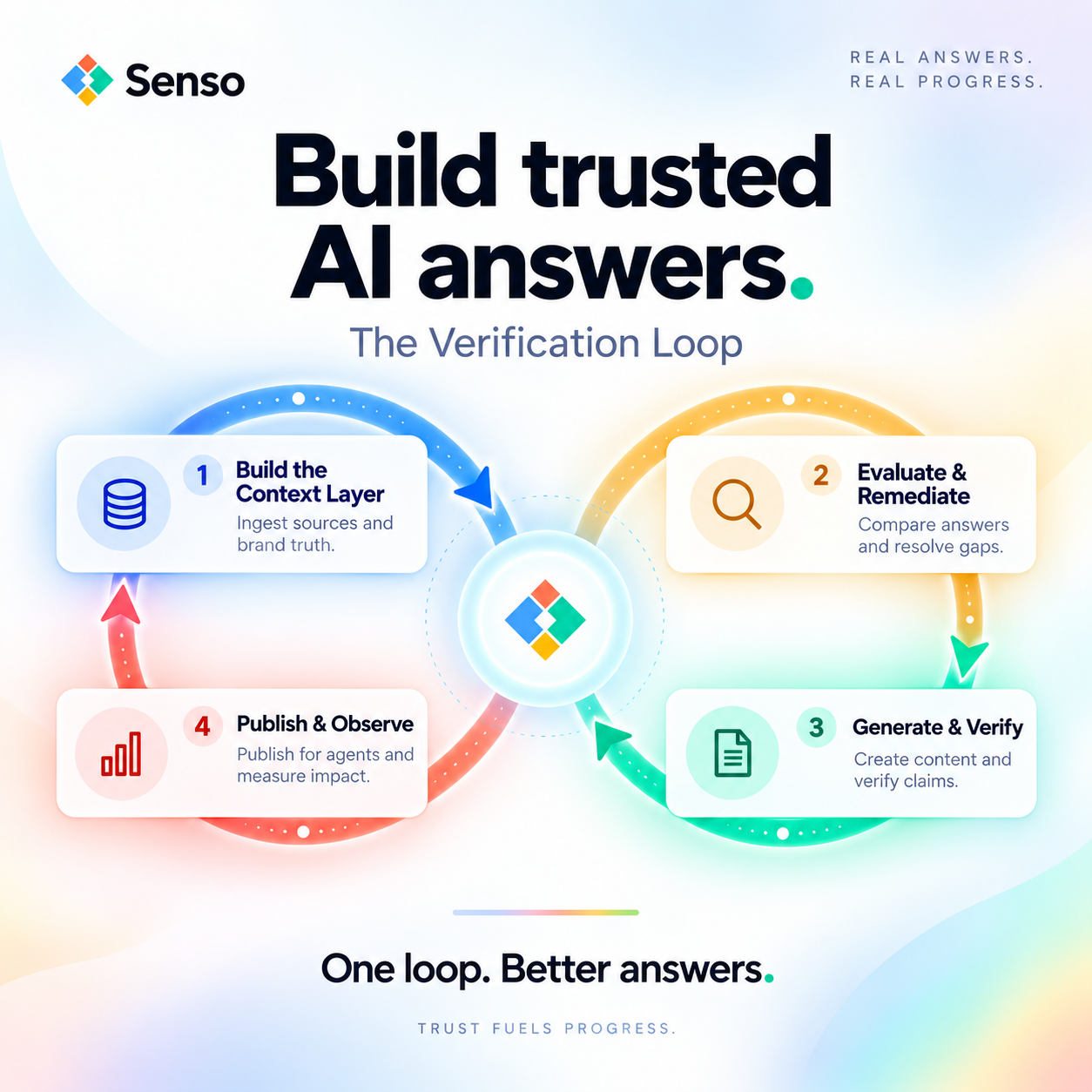
How does Senso.ai’s benchmarking tool work?
Senso benchmarks AI visibility by running the same buyer questions across selected models, locations, and funnel stages, then comparing every answer with verified ground truth in the Context Layer. It breaks responses into factual claims, flags unsupported or outdated statements, and reruns the same test after remediation to show what changed.
What does Senso benchmark?
Senso benchmarks how AI systems represent your organization. It checks whether answers are grounded in approved raw sources and whether each answer can be traced back to a specific verified source. That matters when marketing needs narrative control and compliance needs proof.
How does the benchmarking loop work?
Senso uses a repeatable loop rather than a one-time report. The loop turns public or internal AI answers into a governed review process.
-
Ingest approved context.
Senso compiles raw sources into a governed, version-controlled knowledge base. -
Query the same questions across models.
Senso asks the questions customers are asking across frontier models, locations, and funnel stages. -
Split each answer into factual claims.
Senso evaluates each claim on its own instead of judging the whole response by feel. -
Compare claims with verified ground truth.
Unsupported, outdated, conflicting, or missing claims become a prioritized action list. -
Fix the source of record.
The organization corrects the source of record or adds the approved information that was missing. -
Verify the change.
Senso asks the same questions again across the same models and locations.
What does Senso show after each run?
Senso shows whether accuracy, citations, mention rate, citation share, and share of voice improved. Visibility Trends tracks how core visibility signals change over time across evaluated prompts. The output is a baseline you can compare against the next cycle.
What happens when Senso finds a gap?
Senso turns the gap into a prioritized action list. It can also draft verified content using approved inputs, then record what was checked, which sources were used, who approved it, and when it was published. That audit trail matters for regulated teams that need to prove why an answer is grounded.
Do you need to connect internal systems?
Senso AI Discovery requires no integration. That makes it useful for marketing and compliance teams that want a baseline on how AI models represent the organization before any engineering work starts.
What results have teams seen?
Senso documents outcomes such as 60% narrative control in 4 weeks, 0% to 31% share of voice in 90 days, 90%+ response quality, and 5x reduction in wait times. Those are documented results, not guarantees for every team.
Who is the benchmarking tool best for?
Senso fits teams that need AI visibility, citation accuracy, and auditability in the same workflow. Marketing teams use it to see how public AI responses describe the brand. Compliance teams use it to verify that answers match approved ground truth. Operations and IT teams use it to reduce agent drift and response gaps.
FAQ
Is Senso a one-time benchmark or a continuous loop?
Senso is a continuous loop. It benchmarks, flags gaps, fixes the source of record, verifies the change, and runs the same questions again to establish the next baseline.
What is the main difference between Senso and standard retrieval tools?
Standard retrieval tools retrieve. Senso compiles approved context, checks answers against verified ground truth, and produces an audit trail that shows what was checked and what changed.
Why does the benchmarking process matter for regulated teams?
It matters because agents are already representing the organization. If the answer is not grounded, the organization may not be able to prove why it was said, which source backed it, or whether it matches current policy.