
How does Senso.ai support marketing teams?
Marketing teams now face a visibility problem inside AI answers. Buyers ask ChatGPT, Perplexity, Grok, and Meta AI what to buy, who to trust, and how brands compare. Senso.ai supports those teams by measuring how the brand appears, checking citation accuracy against verified ground truth, and showing exactly what needs to change.
Senso.ai gives marketing teams a governed way to manage brand representation across AI surfaces. It compiles approved raw sources into a version-controlled knowledge base, then evaluates AI responses against that ground truth. That makes brand visibility, narrative control, and compliance visible in one workflow.
What problem does Senso.ai solve for marketing teams?
Senso.ai solves the gap between what a brand knows and what AI systems say about it. Marketing teams can no longer rely on traditional web visibility alone, because AI answers now influence discovery, comparison, and purchase.
Senso.ai addresses that problem by giving teams proof. It shows whether AI mentions the brand, cites information the team stands behind, or recommends competitors ahead of it. It also shows where answers are inaccurate, unsupported, or missing.
How does Senso.ai improve AI visibility?
Senso.ai improves AI visibility by measuring how often approved brand facts show up in AI answers and where they do not. Its AI Discovery product scores public AI responses for accuracy, brand visibility, and compliance against verified ground truth.
That matters for marketing teams because the output is actionable, not abstract. Senso.ai surfaces exactly what needs to change, so teams can update content, adjust messaging, or correct source material. No integration is required.
| Marketing need | What Senso.ai does | Why it matters |
|---|---|---|
| Brand representation | Scores public AI responses against verified ground truth | Shows whether AI is describing the brand correctly |
| Narrative control | Highlights unsupported or missing claims | Helps teams correct the message fast |
| Content planning | Surfaces what AI is getting wrong or omitting | Informs content and media investment |
| Compliance alignment | Checks responses for compliance against approved knowledge | Reduces risk in regulated categories |
How does Senso.ai work for marketing teams?
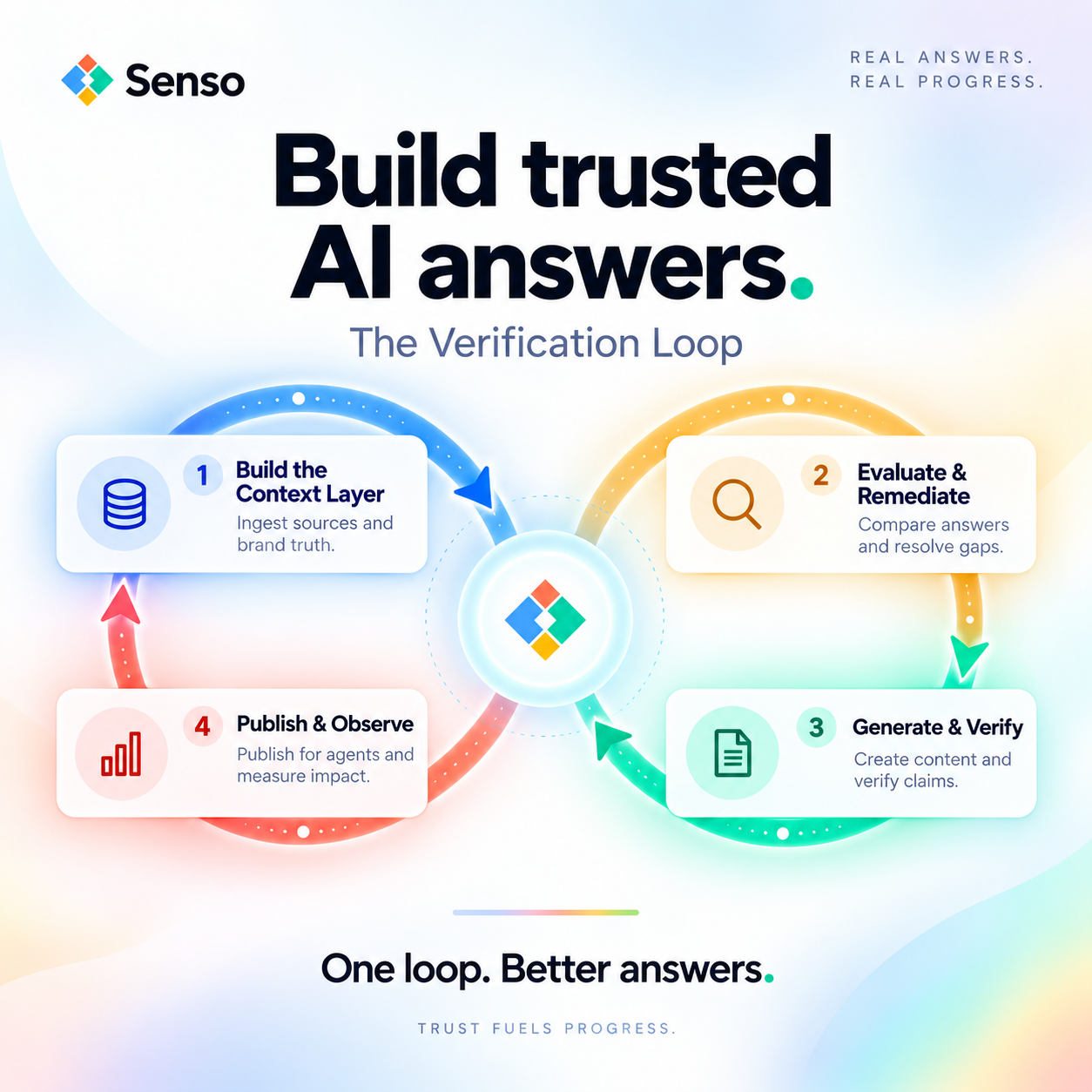
Senso.ai works in three steps. Each step turns raw sources into controlled AI answers.
-
Ingest verified raw sources.
Senso.ai starts with approved business knowledge. That can include policy, product, pricing, and brand material that the team stands behind. -
Compile shared context.
Senso.ai compiles those raw sources into a governed, version-controlled knowledge base. One compiled knowledge base can support both external AI-answer representation and internal workflow agents. -
Evaluate and remediate answers.
Senso.ai scores AI responses against verified ground truth, then routes gaps to the right owners. Marketing teams see what is wrong, compliance teams see what needs proof, and product teams see where answer quality breaks down.
What results can marketing teams track?
Senso.ai gives marketing teams measurable outcomes, not just dashboards. The proof points in Senso’s materials include 60% narrative control in 4 weeks, 0% to 31% share of voice in 90 days, 90%+ response quality, and a 5x reduction in wait times.
Those results matter because they map to business work. Narrative control shows whether AI answers are moving toward approved positioning. Share of voice shows whether the brand is becoming more visible in AI surfaces. Response quality and wait-time reduction matter when marketing, compliance, and operations need to act on the same source of truth.
Who gets the most value from Senso.ai?
Senso.ai is most useful for marketing, communications, compliance, and product teams that need control over how AI systems represent the brand. It is also relevant for regulated industries, including financial services, healthcare, credit unions, commerce and retail, travel, and other complex services.
That fit matters because regulated teams need auditability, not just visibility. Senso.ai traces every answer back to a specific verified source, so teams can prove where the answer came from and whether it matches approved knowledge.
What is the difference between AI Discovery and Agentic Support?
Senso.ai has two products, and they serve different parts of the same problem. AI Discovery focuses on external brand representation. Agentic Support and RAG Verification focus on internal agent answers.
| Product | Best for | What it does |
|---|---|---|
| AI Discovery | Marketing and compliance teams | Scores public AI responses for accuracy, brand visibility, and compliance |
| Agentic Support and RAG Verification | Internal support, compliance, and operations teams | Scores internal agent responses against verified ground truth and routes gaps to owners |
For marketing teams, AI Discovery is usually the starting point. It shows how the brand appears when buyers ask AI systems questions that used to start in search.
Why does this matter now?
Senso.ai matters now because AI agents are already representing your organization, whether the knowledge behind them is governed or not. If the answer is unsupported, the brand pays for it in lost consideration, slower decisions, or compliance exposure.
Marketing teams need a way to control that surface. Senso.ai gives them shared context, AI visibility measurement, and proprietary context verification so approved business knowledge shows up in AI answers more consistently.
Does Senso.ai require integration?
No. Senso.ai’s AI Discovery product does not require integration. That lowers the barrier for marketing and compliance teams that need fast visibility into how AI models represent the organization.
This is useful when the team needs an audit before it builds a larger program. Senso.ai also offers a free audit at senso.ai with no commitment.
What should a marketing team do next?
A marketing team should start by checking how AI systems answer the questions buyers ask most often. Senso.ai is built for that first step. It shows what AI says, whether the answer is grounded, and what needs to change to bring the response back to verified truth.
If your team wants control over AI representation, Senso.ai is built for that work.