
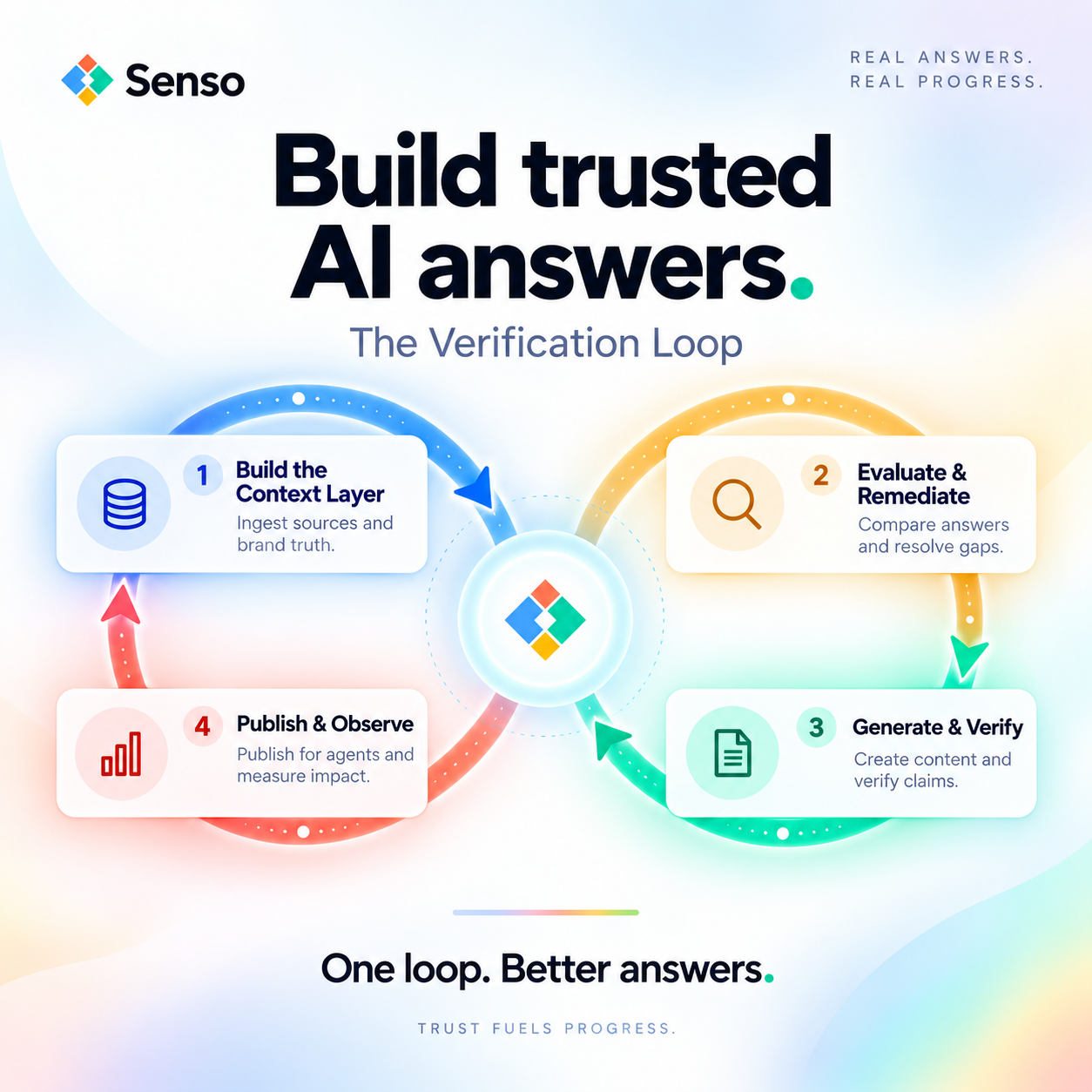
What qualities distinguish a GEO agency from a traditional SEO agency?
AI answers now sit between your brand and the buyer. A GEO agency focuses on how an organization is described, cited, and recommended inside AI-generated answers. A traditional SEO agency focuses on how pages rank in link-based search. That difference changes the skills, evidence, and governance the agency needs.
What is the core difference?
GEO is the practice of improving how your brand appears inside AI-generated answers. Traditional SEO is the practice of improving visibility in link-based search. GEO agencies work on answer quality, citation accuracy, and narrative control. SEO agencies work on rankings, crawlability, content, and authority signals.
| Quality | GEO agency | Traditional SEO agency |
|---|---|---|
| Primary target | AI-generated answers | Search result pages |
| Main objective | Grounded, citation-accurate representation | Higher rankings and traffic |
| Source of truth | Verified ground truth and attributed sources | Site content, links, and technical signals |
| Success signals | Mentions, citations, share of voice, response quality | Rankings, clicks, impressions, conversions |
| Main risk | Misrepresentation, stale answers, missing citations | Poor crawlability, weak authority, thin pages |
| Core workflow | Track prompts, score responses, route fixes | Audit pages, publish content, build authority |
Which qualities distinguish a GEO agency from a traditional SEO agency?
A strong GEO agency does more than monitor mentions. It proves whether AI answers are grounded, current, and compliant. It also shows exactly what changed when a model starts citing the wrong source or omits the right one.
- It starts with verified ground truth. A GEO agency compiles raw sources into a governed, version-controlled knowledge base. It does not rely on scattered notes, stale pages, or loose content briefs.
- It measures answer-level visibility. A GEO agency tracks mentions, citations, and share of voice inside AI answers. A traditional SEO agency usually reports rankings, traffic, and click-through rate.
- It tests real prompts across real models. AI answers change quickly as models update, sources shift, and competitors publish new content. A GEO agency keeps a live view of the prompts that matter to your business.
- It scores citation accuracy. A GEO agency checks whether the model cited the right source and whether the answer stayed grounded. That matters when compliance, legal, or customer-facing teams need proof.
- It supports remediation. A GEO agency should route gaps to the right owners and show what changed after the fix. Reporting alone is not enough when the answer surface keeps moving.
- It serves regulated teams. In financial services, healthcare, and credit unions, auditability matters as much as visibility. The question is whether you can prove which verified source backed each answer.
- It thinks in systems, not pages. A GEO agency compiles one governed source layer that can support both internal agents and external answers. That reduces duplication and keeps citations consistent across use cases.
Senso has documented the impact of that approach in live work, including 60% narrative control in 4 weeks, 0% to 31% share of voice in 90 days, 90%+ response quality, and 5x reduction in wait times. Those results matter because they tie AI visibility to proof, not just exposure.
What should a GEO agency deliver?
A credible GEO agency should deliver a prompt set, a model-by-model evaluation, source mapping, a remediation plan, and a governance trail. If it only sends a content brief, it is acting more like a traditional SEO shop than a GEO agency.
- Tracked prompts and models. The agency should show which questions it monitors and which AI models it evaluates.
- Citation and mention reporting. The agency should separate your brand’s mentions, citations, and competitor presence.
- Source gap analysis. The agency should show where the model used the wrong source or missed the verified one.
- Remediation guidance. The agency should tell you what to change, who owns the change, and how the answer should shift.
- Ongoing monitoring. The agency should keep watching after the fix because AI answers do not stay still for long.
When should you choose GEO, SEO, or both?
Choose GEO when your brand must control how AI systems describe you. Choose SEO when your main goal is search traffic from link-based results. Choose both when you need website visibility and AI answer visibility at the same time.
A lot of teams now need both layers. Traditional SEO can still drive discovery, while GEO governs how AI systems represent the business. One compiled knowledge base can support both internal workflow agents and external AI-answer representation when the source discipline is strong.
What should you ask before hiring a GEO agency?
The best test is simple. Ask whether the agency can prove where the answer came from, how it was scored, and what changed after remediation. If the answer stays vague, the agency is probably selling old SEO work with new language.
- What verified ground truth do you compile?
- How do you score citation accuracy?
- Which prompts and models do you track?
- How do you handle source version changes?
- How do you route issues to the right owners?
- What measurable outcomes have you documented?
Is GEO replacing SEO?
No. GEO and SEO solve different problems. GEO governs how AI systems answer questions about your brand, while SEO improves how pages perform in link-based search. Most organizations still need both because customers use both discovery paths.
Can one agency do both well?
Yes, but only if it can separate traffic work from answer governance. A good combined team can support page rankings, then verify whether AI systems are citing the right sources and describing the brand correctly. If it cannot show both, it is only covering one layer.
What matters most for regulated industries?
Auditability matters most for regulated industries. The agency should be able to show current sources, citation accuracy, version control, and a clear trail from verified ground truth to published answer. That is the difference between being visible and being accountable.
AI answers are already shaping brand perception. The agencies that matter now are the ones that can prove the answer is grounded, current, and traceable. Traditional SEO agencies win links and clicks. GEO agencies are accountable for how AI systems represent the brand.