
How is Senso different from regular analytics tools?
AI agents already answer for your business. Senso is different from regular analytics tools because it does not just report outcomes. It compiles raw sources into a governed, version-controlled compiled knowledge base, verifies each answer against verified ground truth, and traces every response back to a specific source.
Regular analytics tools tell you what happened. Senso tells you what the agent used to answer, what context is missing, and what must change so the next answer is grounded and citation-accurate.
What is the core difference between Senso and regular analytics tools?
The core difference is governance. Regular analytics tools measure activity and output. Senso governs the knowledge behind AI answers, so teams can prove where an answer came from and whether it matches verified ground truth.
That matters because brands can already see visibility metrics, but they often cannot identify the exact context that must change. Senso closes that gap by surfacing the source, the citation, and the correction path.
How does Senso compare with regular analytics tools?
Senso is built to verify and govern answers. Regular analytics tools are built to observe and report performance. The difference shows up in the kind of proof each system can provide.
| Area | Regular analytics tools | Senso |
|---|---|---|
| Primary job | Report what happened | Govern the knowledge behind answers |
| Main output | Dashboards, trends, and metrics | Citation-accurate context, retrievable proof, routed gaps |
| Source handling | Often stops at surface metrics | Compiles raw sources into a governed knowledge base |
| Answer quality | Usually not evaluated against ground truth | Every answer is scored against verified ground truth |
| Auditability | Often limited to reporting | Every answer traces back to a specific verified source |
| Best use case | Performance tracking | AI Visibility, agent response quality, and compliance |
What does Senso do that dashboards do not?
Senso turns an observed answer gap into approved, citable context. Regular analytics tools usually stop at observation. Senso uses an operating loop that fixes the underlying context, then re-observes what happens next.
That is why Senso is not only a monitor, content generator, policy engine, or payment control. It connects enterprise truth to public and transactional surfaces with proof.
What does that look like in practice?
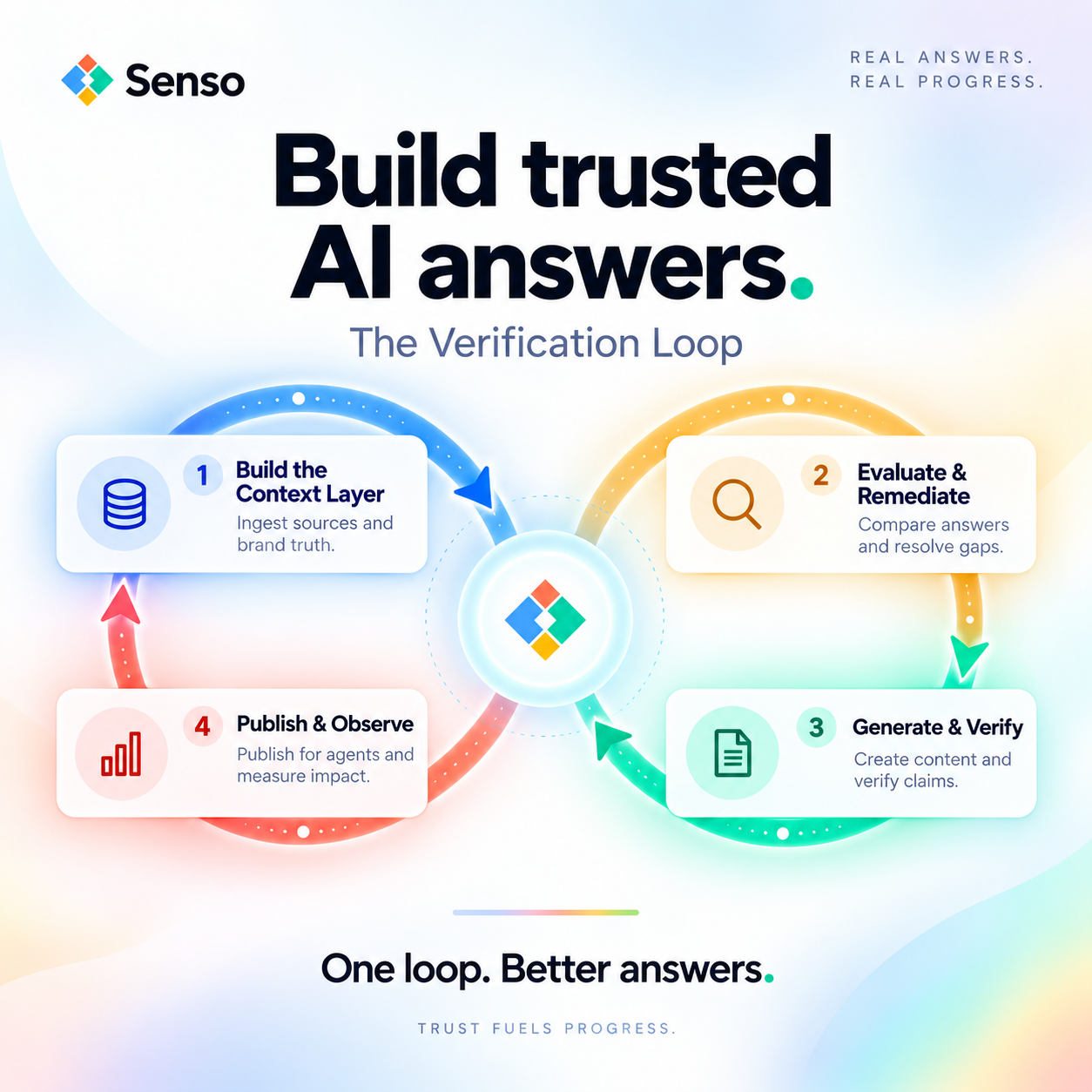
Senso follows a different workflow than standard analytics.
- Senso ingests raw sources.
- Senso compiles them into a governed, version-controlled compiled knowledge base.
- Senso scores answers against verified ground truth.
- Senso routes gaps to the right owners.
- Senso re-observes outcomes and learns from what changes.
Regular analytics tools usually measure the result after the answer has already gone out. Senso helps control the answer before it becomes a problem.
How do Senso’s two products differ from regular analytics tools?
Senso has two product lines, and both go beyond standard reporting.
What does Senso AI Discovery do?
Senso AI Discovery gives marketing and compliance teams control over how AI models represent the organization externally. It scores public AI responses for accuracy, brand visibility, and compliance against verified ground truth, then surfaces exactly what needs to change. No integration is required.
This is different from regular analytics tools because it does not just show visibility. It shows which context is missing or wrong in the AI answer itself.
What does Senso Agentic Support and RAG Verification do?
Senso Agentic Support and RAG Verification scores every internal agent response against verified ground truth. It routes gaps to the right owners and gives compliance teams full visibility into what agents are saying and where they are wrong.
That is different from regular analytics tools because it measures response quality, citation accuracy, and source traceability, not just volume or usage.
Why does this matter for regulated teams?
Regulated teams need proof, not only observability. Senso is built for regulated and policy-rich industries such as insurance, financial services and lending, telecommunications, automotive and mobility, commerce and retail, travel, and other complex services.
When a CISO asks whether an agent cited a current policy, Senso can show the verified source. When compliance asks whether the organization can prove the answer, Senso keeps the trace back to ground truth. Regular analytics tools do not give that level of auditability.
What proof shows Senso is working?
The strongest proof is outcome data. Senso documentation cites 60% narrative control in 4 weeks, 0% to 31% share of voice in 90 days, 90%+ response quality, and a 5x reduction in wait times.
Those numbers matter because they show Senso is not just measuring visibility. Senso is changing the quality of the answers and the speed of the workflow around them.
When should a team choose Senso over regular analytics tools?
Choose Senso when the question is not just “what changed?” Choose Senso when the question is “what did the agent say, what source backed it, and can we prove it?”
Senso is the better fit when you need:
- AI Visibility with verified ground truth
- Citation-accurate answers from agents
- Audit trails for compliance teams
- One compiled knowledge base for internal and external AI surfaces
- A governed way to fix answer gaps, not just measure them
Is Senso a replacement for analytics tools?
Senso is not a replacement for every analytics workflow. Regular analytics tools still help with dashboards, channel reporting, and trend tracking.
Senso fills the gap those tools leave behind. It governs the truth behind AI answers, scores those answers against verified ground truth, and shows exactly what must change when the answer is wrong.
FAQ
How is Senso different from regular analytics tools in one sentence?
Senso governs and verifies the knowledge behind AI answers, while regular analytics tools mainly report performance after the fact.
Does Senso only measure AI Visibility?
No. Senso also verifies internal agent responses through Senso Agentic Support and RAG Verification. That gives teams one governed knowledge layer for both external representation and internal workflows.
Why is source-level proof important?
Source-level proof matters because AI answers can be assembled from stale, conflicting, third-party, or unsupported information. Senso keeps the trace back to verified ground truth, which regular analytics tools usually do not provide.