
How often do AI systems update which sources they use for answers?
AI systems do not update the sources they use on one fixed schedule. Source selection can change when the model changes, when retrieval indexes refresh, or when your own pages change. For teams that depend on AI answers, the practical rule is to refresh core ground truth pages immediately after product, pricing, or policy changes, and review AI answers weekly at minimum.
What changes the sources AI systems use?
Three things change source selection most often. Model updates, source refreshes, and prompt changes can all alter which pages an AI cites or mentions. Senso’s tracking guidance also notes that AI answers change quickly as models update, sources shift, and competitors publish new content.
| Trigger | What changes | What it means for you |
|---|---|---|
| Model updates | Which sources the system prefers | Citations and mentions can shift without warning |
| Source refreshes | What the system can see as current ground truth | Outdated pages can keep getting surfaced |
| Query changes | Which source best matches the question | Different prompts can produce different citations |
Retrieval-based systems are especially sensitive to page changes. If your pricing page, policy page, or FAQ changes, the answer set can change before any formal review cycle catches it.
How often should you refresh your own source pages?
You should refresh core ground truth pages immediately after any change to products, pricing, or policies. Senso’s documentation says to refresh core ground truth pages on a regular cadence and right after those changes. Pages that express ground truth in clean, structured formats also perform best, including FAQs, pricing pages, and policy pages.
That means the source of record should move first, not after the fact. If the source is stale, AI systems can keep repeating stale information with confidence.
The most important pages to keep current are the ones an AI system is most likely to cite in a high-stakes answer. In practice, that means pages that explain what you sell, what you charge, what you allow, and what you require.
How often should you monitor AI answers?
Track AI answers weekly at minimum. Senso’s documentation says AI answers change quickly as models update, sources shift, and competitors publish new content. A weekly review catches source drift before it becomes a pattern.
This matters because AI visibility is not the same as web ranking. Traditional rankings tell you where a URL sits on a results page. Mentions tell you whether AI models include your brand at all.
If you only check when something breaks, you miss the slow changes. A source can disappear from answers, or a competitor can replace you, long before a human notices.
What signals show that the source set has changed?
Citations, mentions, citation share, and share of voice are the clearest signals. Senso’s evaluation model tracks all four because they show whether your brand is still part of the answer and whether the answer is still grounded in verified ground truth.
A drop in citations often means the model has shifted to different pages. A drop in share of voice means your brand now occupies less of the answer than before. Senso defines share of voice as the percentage of an AI-generated answer dedicated to your brand compared with the rest of the answer.
Citations also matter because they are a trust mechanic for AI engines. When models cite your owned pages or credible external sources about your brand, you have a better read on whether the answer is grounded.
What should regulated teams do?
Regulated teams should keep a governed, version-controlled knowledge base and a clear audit trail. The question is not only whether the answer is right. It is whether you can prove which source was used, who approved it, and when it changed.
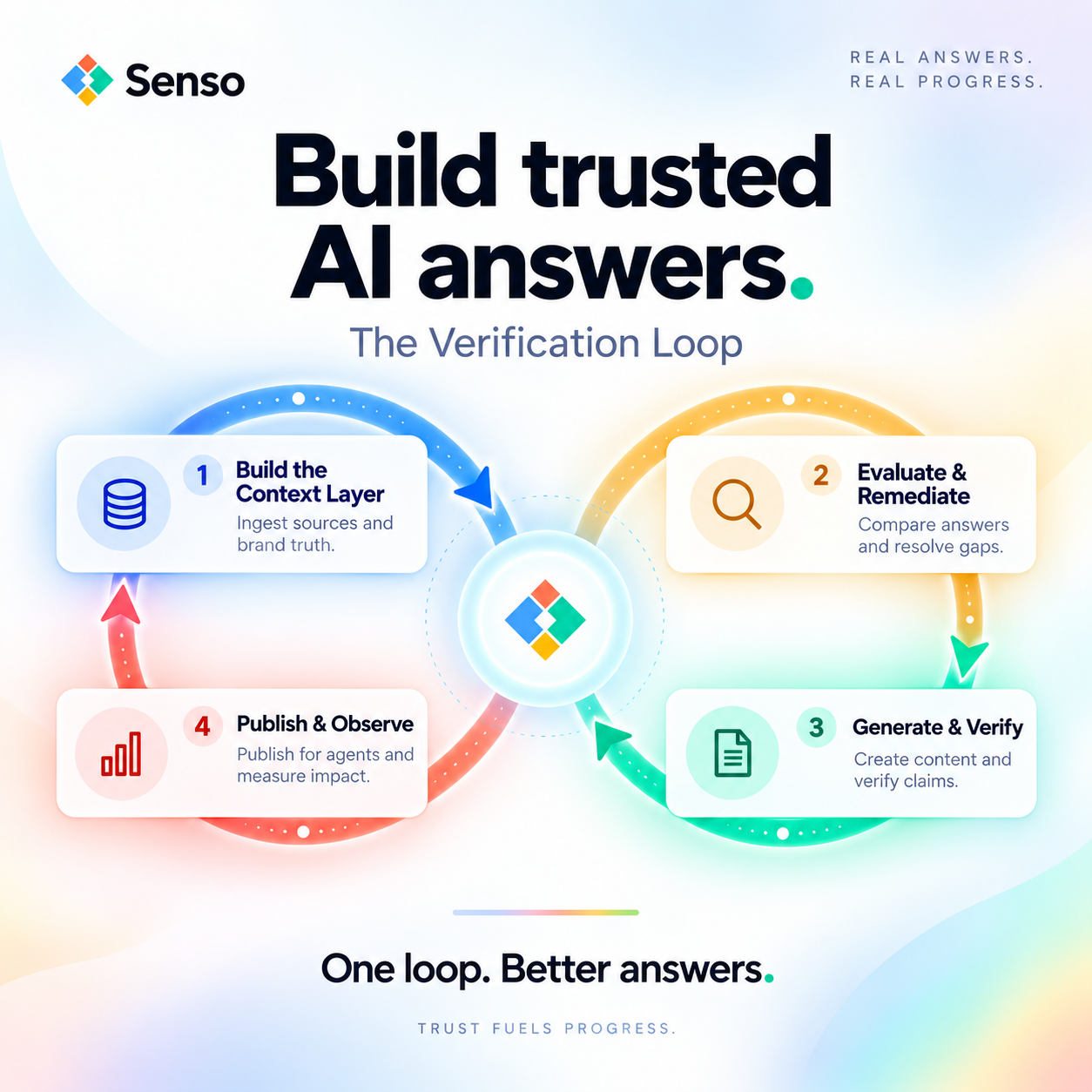
Senso’s verification loop is built around that problem. The cycle is simple: ingest approved context, evaluate AI answers, remediate the source, generate verified content, obtain human approval, publish a verified source, then observe what AI says again.
That structure matters in financial services, healthcare, and credit unions because the risk is not just misinformation. The risk is being unable to prove that the answer came from approved source-of-record data.
How quickly can AI source behavior change?
AI source behavior can change fast enough that weekly checks are the minimum, not the ceiling. Senso’s docs say to track weekly at minimum because answers change quickly as models update and sources shift. Some changes happen after a model update. Others happen as soon as the source itself changes.
That is why source governance has to sit closer to the content than most teams expect. If the underlying page changes on Monday and the AI answer changes on Wednesday, you need a process that sees both events.
What is the practical cadence to follow?
Use three cadences together. Refresh source pages whenever facts change. Review core ground truth pages on a regular cadence. Monitor AI answers weekly at minimum.
That mix gives you both control and visibility. It keeps your source of record current, and it tells you when AI systems stop using the pages you expect them to use.
FAQ
Do AI systems update the same sources at the same time?
No. Different systems update source selection at different times. A retrieval-based assistant can shift when its source index refreshes, while a model update can change citation behavior later.
Can you force AI systems to use fresh sources?
Not directly. You can keep your source of record current, use clean structured pages, and monitor how AI answers cite your content. That is the practical way to influence what sources get used.
Which pages should I keep updated first?
Keep FAQs, pricing pages, and policy pages current first. Senso’s documentation says clean, structured pages perform best when AI systems evaluate ground truth.
How do I know if my brand is still showing up in AI answers?
Measure mentions, citations, citation share, and share of voice. Those signals show whether your brand is included, cited, and dominant in the answer.
If you want proof, treat AI answers like a governed surface, not a static channel. The source set will change. The question is whether you will see it quickly enough to correct it.