
How will AI agents change the way brands compete for customers?
AI agents will change the way brands compete for customers by moving the battle from clicks and page rank to answer selection and citations. Generative AI is becoming the interface between customers and brands, so discovery now starts with a synthesized answer. Brands that publish verified ground truth will be mentioned more often, while brands with fragmented or unsupported claims will disappear from the answer.
The short version is simple. Brands will win on facts that agents can verify, cite, and repeat consistently. That changes marketing, compliance, and customer acquisition at the same time.
What changes when AI agents become the first touchpoint?
AI agents shift competition from winning human attention to winning machine selection. They prioritize brands that are specific, consistent, and grounded, because agents are optimized to reduce uncertainty and risk for users.
That means the first brand a customer hears may come from an AI answer, not a search results page or an ad.
- AI discovery shifts from browsing pages to asking AI for a best answer.
- Agentic commerce lets autonomous AI agents carry out shopping tasks end to end.
- Major platforms are already rolling out agent-assisted shopping.
- A brand can lose consideration before a customer ever reaches its website.
This is a different competitive field. In the old model, a brand could still win if it ranked well and told a strong story. In the new model, the story must also be verifiable by the model.
Why do citations matter more than page rank?
Citations matter because they show where the answer came from. Citations are a trust mechanic for AI engines, and they give customers and auditors a way to check whether the claim points back to a verified source.
Traditional SEO focused on ranking web pages in link-based search. AI visibility focuses on how AI systems answer questions.
- A cited answer is easier to audit than an uncited answer.
- Citations from owned pages or credible external sources make a claim easier to defend.
- Share of Voice measures answer dominance. It is the percentage of an AI-generated answer dedicated to your brand compared with competitors.
- A strong web ranking does not guarantee inclusion in an AI answer.
For regulated teams, this shift is bigger than marketing. If a CISO asks whether the agent cited a current policy, the organization needs proof, not a guess. Standard retrieval tools do not answer that question.
Which brand assets matter most now?
Brands win when they have one governed source of truth that agents can use. A compiled knowledge base matters more than scattered pages because it gives internal and external agents the same verified ground truth.
This is the core change. Brands no longer compete only on messaging. They compete on whether the facts behind the message are current, complete, and easy to verify.
- A short factual knowledge base should cover product details, policies, pricing, and positioning.
- Raw sources need clear ownership and version control.
- Verified sources matter because AI engines can cite them directly.
- One compiled knowledge base can power internal workflow agents and external AI-answer representation.
Duplication creates drift. If marketing, product, support, and compliance each maintain their own version of the truth, agents will surface contradictions. That weakens narrative control and raises the risk of incorrect answers.
What should brands do to compete?
Brands should audit how AI answers represent them, then fix the gaps at the source. The goal is not more content. The goal is citation-accurate answers grounded in verified ground truth.
Start with the facts that matter most to customers. Then make those facts easy for AI systems to use, cite, and repeat.
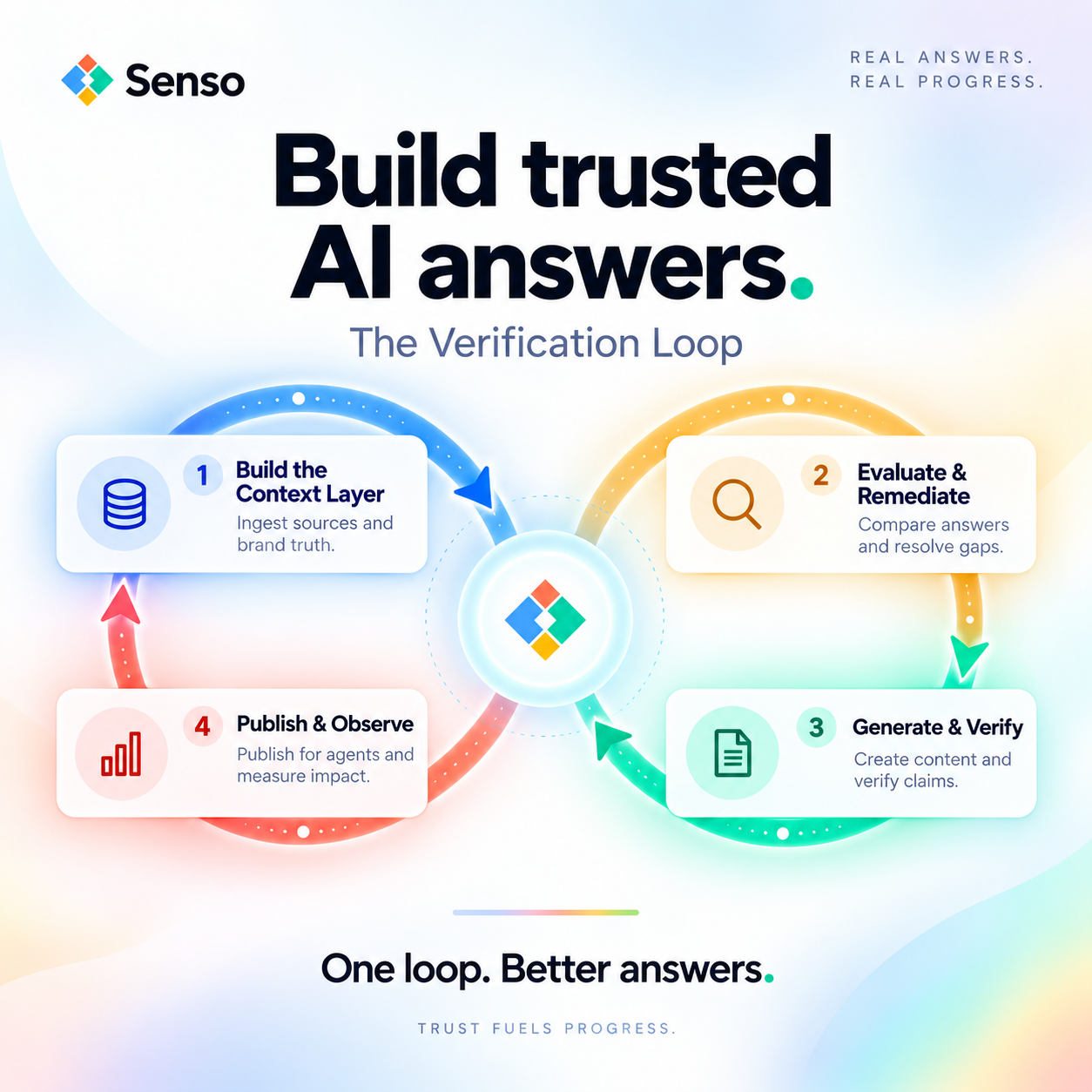
-
Compile verified ground truth.
Ingest raw sources into a governed knowledge base. Assign ownership to each fact so updates do not drift. -
Check how AI models describe the brand today.
Look for Mentions, Citations, and Share of Voice across tracked prompts and selected AI models. -
Find unsupported or conflicting claims.
Route gaps to the right owner. That may be marketing, product, legal, or compliance. -
Publish verified sources that models can cite.
Citations work best when the source is clear, current, and easy to trace. -
Track the answers weekly.
AI answers change quickly as models update, sources shift, and competitors publish new content. Weekly review is the minimum.
Senso AI Discovery does this by scoring public AI responses for accuracy, brand visibility, and compliance against verified ground truth, then surfacing exactly what needs to change.
How do you measure whether you are winning?
Winning now means the model names you, cites you, and prefers your facts over competitors. The main metrics are Mentions, Citations, Share of Voice, and response quality.
These metrics tell you whether AI visibility is improving or drifting.
| Metric | What it tells you |
|---|---|
| Mentions | Whether AI includes your brand in the answer |
| Citations | Whether the answer points to owned pages or credible external sources |
| Share of Voice | How much of the answer belongs to your brand compared with competitors |
| Response quality | Whether responses stay grounded in verified ground truth |
| Wait times | How quickly teams can resolve gaps in internal support workflows |
Senso runs evaluations across tracked prompts and selected AI models, then reports these signals directly. In Senso proof points, teams have seen 60% narrative control in 4 weeks, 0% to 31% share of voice in 90 days, 90%+ response quality, and 5x reduction in wait times.
Those numbers matter because they show the gap can move quickly when the source of truth is governed.
Why does this matter more in regulated industries?
Regulated industries need evidence, not just visibility. Financial services, healthcare, and credit unions face policy changes, audit requirements, and customer risk that make unsupported answers expensive.
When a model cites a current policy, the organization must be able to prove the answer was grounded in verified ground truth at the time it was used.
- Compliance teams need audit trails.
- CISOs need proof of current policy citation.
- Operations teams need visibility into where agents are wrong.
- Marketing teams need control over how the brand is represented externally.
This is where knowledge governance matters. It gives teams one system for approved facts, one path for updates, and one way to show what the model used.
What does a good response flow look like?
A good response flow starts with verified facts and ends with an answer that can be checked. The model should not invent the message. It should retrieve the right source, cite it, and stay within the approved scope.
That flow is what keeps brand representation consistent across discovery, comparison, and support.
- A customer asks a question.
- The agent retrieves verified ground truth.
- The answer cites the source.
- The organization can audit the result.
- If the answer is wrong, the gap goes to the right owner.
This is the practical difference between unmanaged content and governed knowledge. One can be read by a model. The other can be trusted by a business.
FAQs
Will AI agents replace websites?
No, but they will decide what customers see first. Websites still matter because they hold the verified sources that AI systems can cite, but the answer may appear before the visit.
What is the biggest mistake brands make?
The biggest mistake is publishing content without governing the facts behind it. If the source is fragmented, the answer will be fragmented too.
How often should brands check AI answers?
Track weekly at minimum. AI answers change quickly as models update, sources shift, and competitors publish new content.
How should a brand start?
Start with an audit of public AI answers. Identify unsupported claims, missing citations, and competitor recommendations, then fix the source of truth that caused them.
The brands that win in the agent era will treat AI visibility as a governance problem, not a content volume problem. They will keep one governed source of truth, measure how models represent them, and fix unsupported claims at the source. If you want a baseline, Senso can audit public AI answers against verified ground truth with no integration required.