
How will AI agents discover and evaluate financial products?
AI agents will discover financial products by querying verified sources, not by reading pages the way people do. They will compare current product facts, eligibility, pricing, policies, and disclosures, then rank only what they can trace back to approved evidence. In finance, the products that are easy to verify will be easier for agents to recommend.
This matters for banks, credit unions, fintechs, and compliance teams. The decision is no longer just whether a person can find the product. It is whether an agent can find, check, and cite the right facts without drift.
What will AI agents look for first?
AI agents will start with facts that are current, explicit, and easy to trace. They do not need marketing language. They need product terms, fees, eligibility rules, disclosures, and proof that the source was approved and current at the time of use.
In financial services, agents will favor answers that can be tied to verified ground truth. If the information is fragmented, stale, or unsupported, the agent will either avoid the product or present it with low confidence.
What does an agent evaluate before recommending a financial product?
| What the agent checks | Why it matters | What the institution needs |
|---|---|---|
| Current product terms | Prevents stale answers | A version-controlled source of truth |
| Eligibility rules | Avoids bad matches | Clear, approved criteria |
| Pricing and fees | Supports comparison | One canonical pricing source |
| Disclosures and limits | Supports compliance | Approved disclosure language |
| Source provenance | Enables proof | Traceable citations to raw sources |
| Update status | Confirms recency | Ownership and refresh dates |
How will AI agents compare financial products?
AI agents will compare products by fit, not by brand polish. They will weigh the user’s needs against verified criteria such as account type, eligibility, pricing, risk limits, and product availability.
A good answer for a consumer loan, deposit account, or credit product will not just say which option exists. It will explain why that option fits the request and cite the source that supports the claim.
Why does source quality matter so much?
Source quality matters because AI discovery is shifting from links to synthesized answers. The open web can contain conflicting pages, old PDFs, and unsupported claims. Agents will treat that as a reliability problem, not a branding issue.
The market gap is simple. AI agents are already answering questions about products, policies, and pricing without a human in the loop. If the enterprise cannot prove the answer came from a current approved source, the product is exposed to misrepresentation and compliance risk.
What makes a financial product easy for agents to discover?
A financial product is easy for agents to discover when its facts are compiled, governed, and consistent. Agents need one compiled knowledge base that holds the approved version of the truth, not a pile of scattered raw sources.
The strongest signals are clear product names, current terms, explicit eligibility rules, approved disclosures, and stable source links. If those facts change often, the institution needs version control and ownership so the agent does not mix old and new information.
What makes a financial product easy for agents to evaluate?
A financial product is easy to evaluate when the agent can answer four questions quickly. What is this product, who is it for, what does it cost, and what proof supports the answer.
If the institution cannot answer those questions with citations, the agent has to guess. That is where errors begin. In regulated industries, a guessed answer is a liability.
How do AI agents handle conflicting information?
AI agents should reject conflicting information unless one source is clearly verified ground truth. If a product page, a PDF, and a policy article disagree, the agent needs a rule for which source wins.
That is why governance matters. Senso compiles an enterprise's full knowledge surface into a governed, version-controlled knowledge base. Every answer traces back to a specific, verified source, so the agent can show its work instead of producing an uncheckable summary.
What should banks, credit unions, and fintechs do now?
They should prepare for machine-facing discovery, not just human browsing. Humans can tolerate scattered pages. Agents cannot.
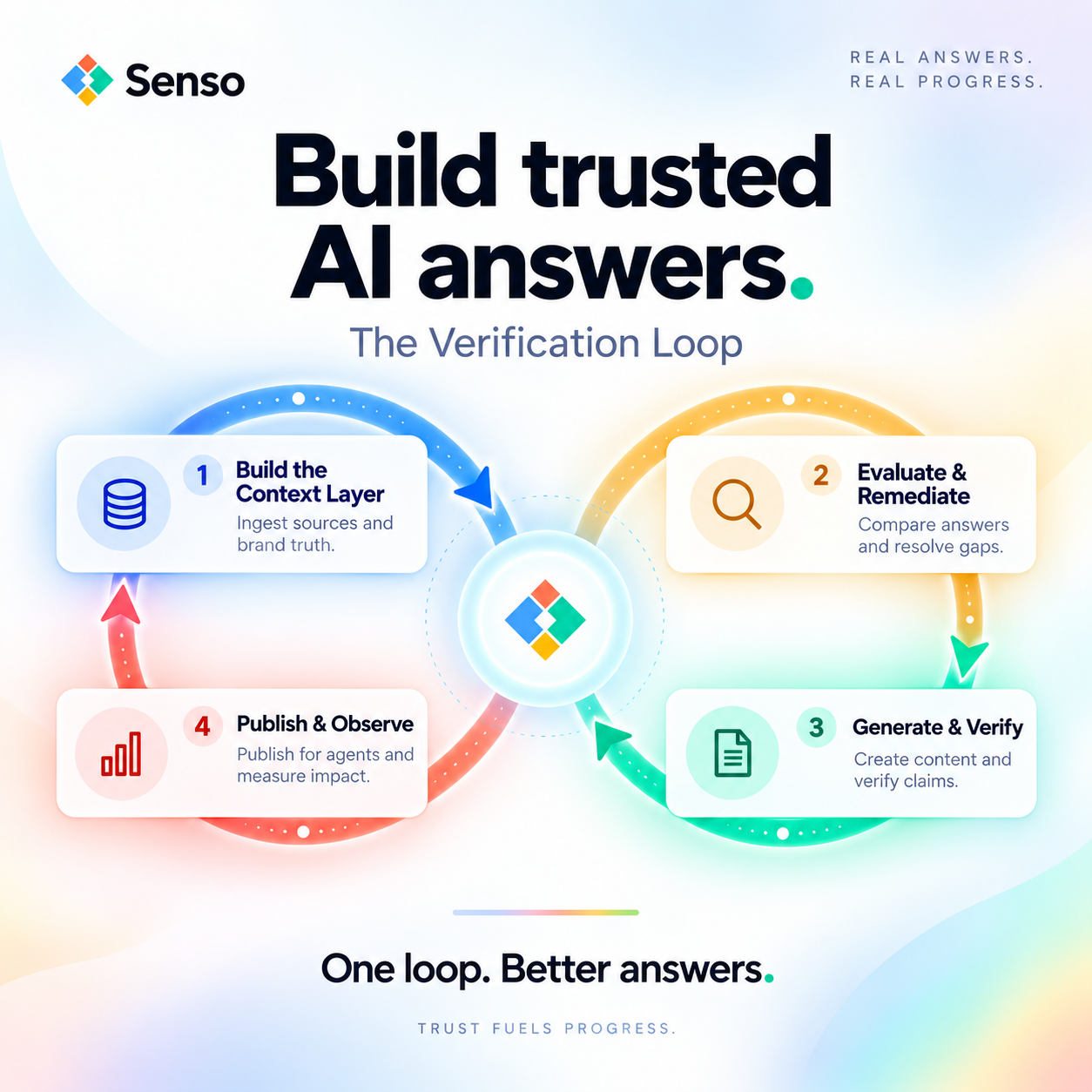
The practical steps are straightforward:
- Ingest every approved source of product truth.
- Compile it into one governed knowledge base.
- Assign ownership for products, policies, pricing, and disclosures.
- Track which answers are citation-accurate and which are not.
- Close gaps before agents repeat the wrong answer at scale.
That workflow gives the institution one source of truth for both internal agents and external AI answers. It also reduces duplication because the same compiled knowledge base can support both use cases.
Where does Senso fit in this workflow?
Senso sits in the context layer between enterprise knowledge and AI agents. It compiles verified ground truth into a governed, version-controlled knowledge base and scores every agent response for citation accuracy against that source.
Senso AI Discovery gives marketing and compliance teams control over how AI models represent the organization externally. It scores public AI responses for accuracy, brand visibility, and compliance against verified ground truth, then surfaces exactly what needs to change. No integration is required.
Senso Agentic Support and RAG Verification does the same for internal agents. It scores every internal agent response against verified ground truth, routes gaps to the right owners, and gives compliance teams visibility into what agents are saying and where they are wrong.
Senso has also reported concrete outcomes from this model. Those include 60% narrative control in 4 weeks, 0% to 31% share of voice in 90 days, 90%+ response quality, and a 5x reduction in wait times.
What will change for regulated financial products?
Regulated products will be judged on proof, not polish. A current policy, an approved disclosure, and a traceable citation will matter more than a well-written landing page.
That is especially true in financial services, where product terms change, eligibility is narrow, and compliance teams need evidence. If an agent can show the source and the source is current, the answer is usable. If not, the product may never make it into the recommendation set.
FAQ
Will AI agents use search engines to find financial products?
They may start with retrieval, but the final answer will depend on verified sources. The winning products will be the ones that expose current facts in a format agents can check and cite.
Will AI agents rank products by popularity or by fit?
They will rank products by fit first. A product that matches eligibility, pricing, policy, and use case will beat a more visible product with weaker source quality.
Can AI agents prove where a financial answer came from?
Yes, if the institution provides verified ground truth and source traceability. Without that, the answer may be useful, but it will not be provable.
What is the biggest mistake institutions make today?
They assume one product page is enough. In practice, agents need a consistent set of approved facts across pricing, eligibility, disclosures, and policy.
If you want to see how your products appear to AI agents today, Senso offers a free audit at senso.ai. No integration. No commitment.