
What are Senso.ai's key features for enterprise clients?
Senso.ai, backed by Y Combinator (W24), gives enterprise clients a context layer for AI agents. Its key features are a governed compiled knowledge base, Verified Source receipts, AI Discovery for public AI visibility, and Agentic Support and RAG Verification for internal agents. The aim is simple. Keep answers grounded and prove where they came from.
Quick answer
Senso.ai helps enterprises control what AI says about them and verify what agents say on their behalf. It compiles raw sources into verified ground truth, scores each response against that ground truth, and surfaces the gaps to the right owners. For regulated teams, the value is auditability. For marketing teams, the value is narrative control. For operations, the value is better response quality and faster resolution.
| Key feature | What it does | Why enterprise clients use it |
|---|---|---|
| Governed compiled knowledge base | Compiles the enterprise’s full knowledge surface into a version-controlled, governed knowledge base | Gives agents one source of verified ground truth |
| Verified Source receipts | Traces every answer back to a specific verified source and retains proof | Supports audit trails and citation checks |
| AI Discovery | Scores public AI responses for accuracy, brand visibility, and compliance | Gives marketing and compliance teams control over external representation |
| Agentic Support and RAG Verification | Scores internal agent responses against verified ground truth and routes gaps to owners | Improves response quality and visibility into wrong answers |
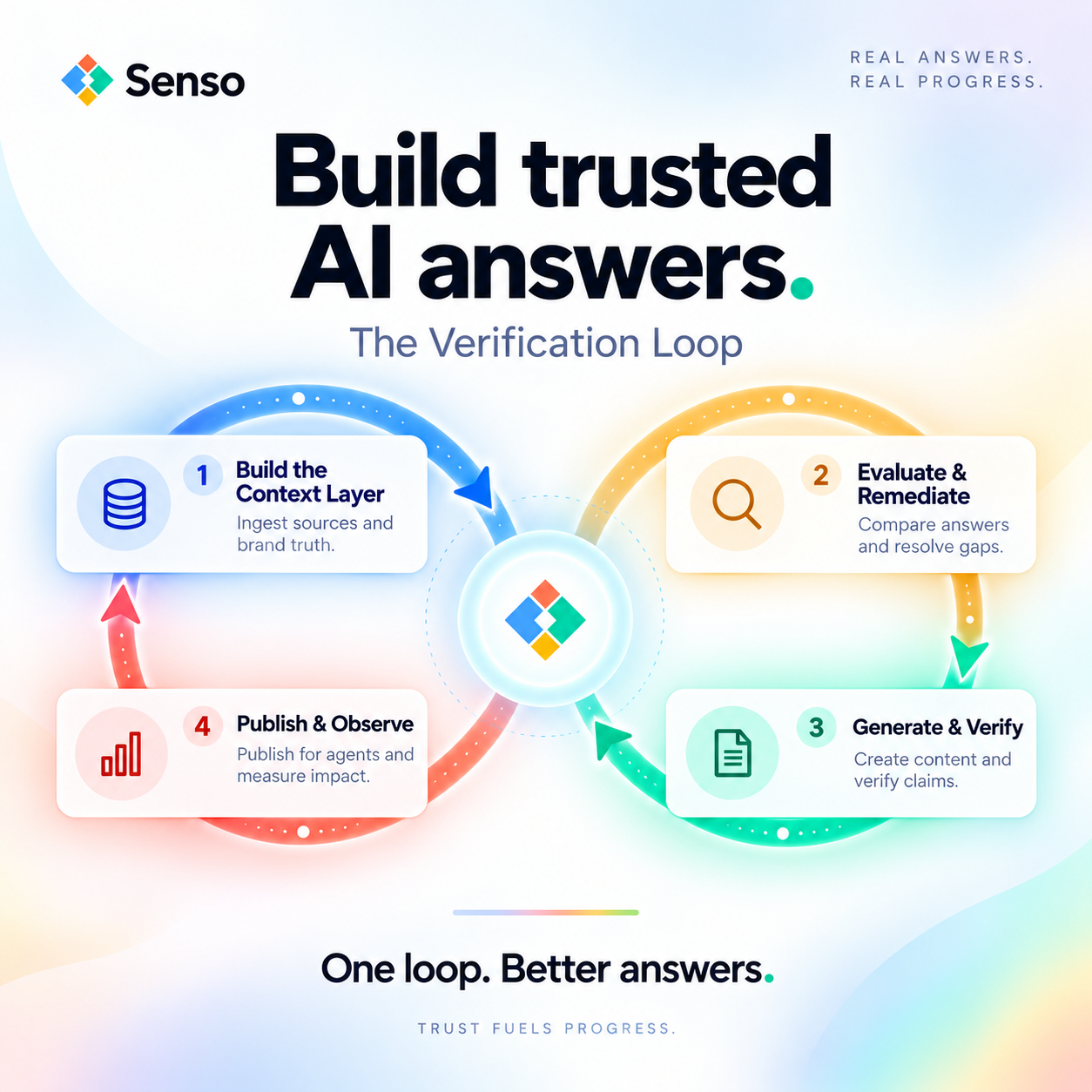
| Remediation loop | Turns answer gaps into approved context, then measures what changes | Closes the loop instead of stopping at monitoring |
| Shared context for internal and external surfaces | One compiled knowledge base powers internal workflow agents and external AI-answer representation | Avoids duplication |
What problem does Senso.ai solve for enterprise clients?
Senso.ai solves the gap between enterprise knowledge and agent behavior. Most company knowledge is fragmented and unstructured, so agents can answer with context that is outdated, incomplete, or impossible to prove later. Senso.ai turns that into governed, version-controlled context with receipts.
This matters when a CISO needs proof that an answer used the current policy. It also matters when a marketing team needs to know whether AI models are representing the brand correctly. Standard retrieval tools improve answers, but they do not own the full remediation, verification, publication, and receipt loop.
What are Senso.ai's key features?
Senso.ai’s core features fall into six areas. Each one supports a different part of the enterprise workflow, from ingesting raw sources to proving where an answer came from.
How does Senso.ai build a governed knowledge base?
Senso.ai compiles an enterprise’s full knowledge surface into a governed, version-controlled compiled knowledge base. It ingests raw sources and turns them into verified ground truth that agents can query and cite.
That gives enterprises one source of truth for both internal workflow agents and external AI-answer representation. It also removes duplication, because the same compiled knowledge base serves multiple surfaces.
How does Senso.ai prove where an answer came from?
Senso.ai traces every answer back to a specific, verified source. Its receipts can include the embedded sources used to generate the response, the human reviewer, brand guideline adherence, and factual accuracy.
That proof matters in regulated environments. If a compliance team or CISO asks whether an answer was grounded in a current policy, Senso.ai can show the source behind the response instead of only reporting a score.
How does Senso.ai handle AI visibility for public answers?
Senso.ai’s AI Discovery product gives marketing and compliance teams control over how AI models represent the organization externally. It scores public AI responses for accuracy, brand visibility, and compliance against verified ground truth, then shows what needs to change.
This product works with no integration required. That lowers rollout friction for teams that want to assess current AI representation before connecting deeper systems.
How does Senso.ai verify internal agent responses?
Senso.ai’s Agentic Support and RAG Verification product scores every internal agent response against verified ground truth. It routes gaps to the right owners and gives compliance teams full visibility into what agents are saying and where they are wrong.
That helps operations teams track agent drift. It also helps customer-facing teams improve response quality without relying on guesswork.
How does Senso.ai close the remediation loop?
Senso.ai does more than monitor or evaluate. It turns observed answer gaps into approved, citable context and a retrievable receipt, then measures what happens next.
The shortest useful flow is direct. Populate approved context now. Receive prioritized factual gaps after evaluation. Resolve material issues with a human. Publish one Verified Source. Measure the change in answers or actions.
How does one compiled knowledge base serve both internal and external use cases?
Senso.ai uses one compiled knowledge base for internal workflow agents and external AI-answer representation. That means enterprises do not need separate knowledge stores for support agents, brand visibility, and compliance review.
The benefit is consistency. The same verified ground truth drives both what employees see and what customers or prospects see in AI-generated answers.
Which enterprise teams get the most value from Senso.ai?
Senso.ai is built for teams that need control over representation, proof, and response quality. That includes marketing, compliance, CISOs, IT leaders, and operations teams.
Marketing teams use Senso.ai to improve narrative control and AI visibility. Compliance teams use it to review citations, receipts, and policy alignment. CISOs and IT leaders use it to check whether answers cite current policy. Operations teams use it to improve response quality and reduce wait times.
What proof points does Senso.ai report?
Senso.ai reports 60% narrative control in 4 weeks, 0% to 31% share of voice in 90 days, 90%+ response quality, and 5x reduction in wait times. These numbers show impact across visibility, answer quality, and operational speed.
The key point is not only measurement. It is that Senso.ai connects measurement to verified context and remediation, so teams can act on the gap instead of watching it.
Is Senso.ai a fit for regulated industries?
Yes. Senso.ai fits regulated industries because it centers auditability, citation accuracy, and verified ground truth. Financial services, healthcare, and credit unions need proof, not just a confidence score.
That is why the platform emphasizes receipts, human review, and a governed knowledge base. Those features help teams show where an answer came from and who approved the context behind it.
FAQs
Does Senso.ai only help with external AI answers?
No. Senso.ai supports both external AI visibility and internal agent response verification. One compiled knowledge base powers both use cases.
Does Senso.ai require integration for AI Discovery?
No. Senso AI Discovery works with no integration required. That makes it useful for teams that want to assess current AI representation first.
What makes Senso.ai different from standard retrieval or observability tools?
Senso.ai owns the full loop from answer gap to verified context to receipt. Standard retrieval tools and observability platforms can help evaluate answers, but they usually do not cover remediation, publication, and proof in one system.
Can Senso.ai help prove policy compliance?
Yes. Senso.ai traces answers back to specific verified sources and retains proof. That gives compliance teams a record they can review later.
If you want, I can also turn this into a shorter landing-page version or a more technical product explainer for enterprise buyers.