
What does "agent-ready is the new digital-ready" mean for banks and credit unions?
Agent-ready is a governance posture that lets AI agents answer with grounded, cited, and auditable information. For banks and credit unions, that means policies, rates, disclosures, and product terms must come from verified ground truth, not scattered raw sources. Digital-ready helped institutions serve people online. Agent-ready is about whether an agent can represent the institution correctly and whether the bank can prove it.
Banks and credit unions need this shift because AI agents already answer questions about products, policies, and pricing without a human in the loop. If the knowledge behind those answers is fragmented or stale, the institution can be misrepresented, exposed to liability, or forced to defend an answer it cannot trace.
Why the phrase matters now
The phrase means the institution has to prepare for a new audience. That audience is not just a person on a website. It is also an AI agent that queries the institution, cites a source, and speaks for the brand in a customer interaction.
For banks and credit unions, that changes the job from publishing content to governing knowledge. A page can look current and still fail when an agent pulls the wrong policy version, repeats an outdated rate, or omits a required disclosure.
How is agent-ready different from digital-ready?
Agent-ready focuses on governed knowledge, citation accuracy, and auditability. Digital-ready focused on channel access, user experience, and online service delivery. Both matter, but they solve different problems.
| Digital-ready | Agent-ready |
|---|---|
| Built for human visitors on web and mobile | Built for AI agents that answer on behalf of the institution |
| Success means access, speed, and conversion | Success means grounded answers, citation accuracy, and auditability |
| Content teams publish pages and PDFs | Compliance and business owners govern verified ground truth |
| A stale page hurts user experience | A stale answer can misstate policy, pricing, or eligibility |
| Errors are often visible to a person | Errors can spread through agent responses without a human in the loop |
Banks and credit unions can be digital-ready and still not be agent-ready. The gap shows up when an agent answers confidently but cannot prove where the answer came from.
What has to be true for a bank to be agent-ready?
Agent-ready means the institution can compile its knowledge, govern versions, and trace every answer back to a specific verified source. It also means the institution can see how external models represent the brand and where those models drift from ground truth.
In practice, that requires five things.
- The bank must ingest raw sources from the teams that own policy, product, and compliance. If the source material stays fragmented, agents will inherit the fragmentation.
- The bank must compile those raw sources into a governed compiled knowledge base. One compiled knowledge base reduces duplication and keeps internal and external answers aligned.
- The bank must version-control the knowledge. When rates, fees, or disclosures change, the governing source has to change with them.
- The bank must score answers against verified ground truth. If an answer cannot be traced to a current source, the institution should treat it as a risk.
- The bank must route gaps to the right owners. Compliance, operations, and marketing need visibility into what agents are saying and where they are wrong.
What risks do banks and credit unions face if they are not agent-ready?
The risk is not abstract. It shows up in customer interactions, compliance reviews, and brand perception. If an AI agent gives the wrong answer, the institution owns the result.
The most common failures are easy to spot.
- Stale product information. A loan or deposit answer can reflect an old rate or outdated eligibility rule.
- Inconsistent disclosures. An agent can omit language that a policy requires.
- Weak citation trails. A compliance team can ask where the answer came from and get no proof.
- Brand misrepresentation. Public AI models can describe the institution incorrectly, especially when public information is fragmented.
- Longer review cycles. Staff spend time correcting agent outputs instead of fixing the source.
For regulated institutions, this is a governance problem first. A CISO or compliance officer does not need a plausible answer. They need a citation-accurate answer that traces back to verified ground truth.
What should banks and credit unions do first?
The first step is to map the knowledge that agents already use. That includes policy content, product terms, disclosures, support scripts, and approved brand claims. If the bank cannot name the source of truth, the agent cannot stay grounded.
A practical rollout looks like this.
- Inventory the raw sources. Collect the material that drives customer, staff, and agent answers.
- Compile the sources into one governed knowledge base. Keep the structure version-controlled and owned.
- Define verified ground truth. Decide which policy, rate, or disclosure wins when sources conflict.
- Score responses for citation accuracy. Measure whether the answer matches the verified source.
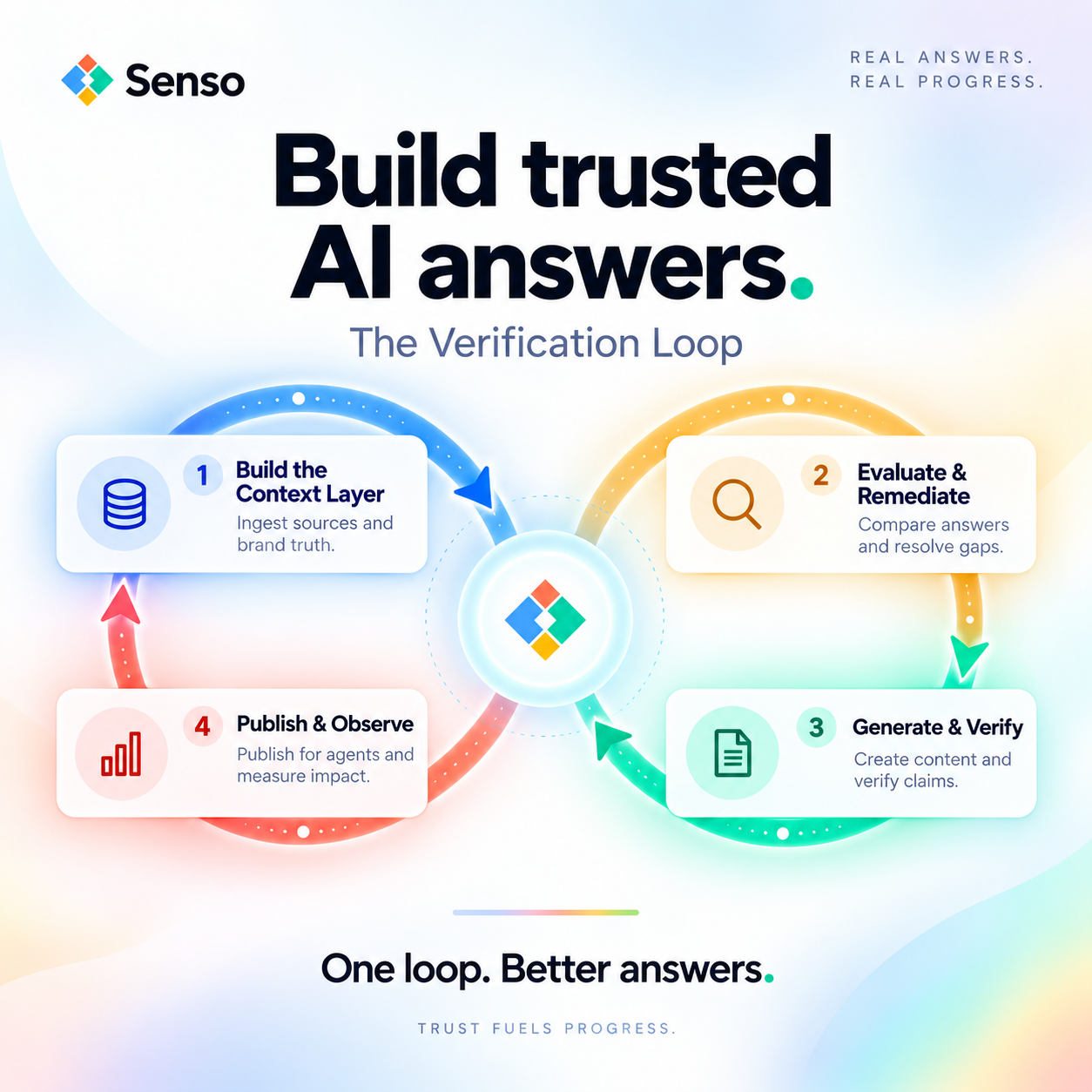
- Close the loop with owners. Route gaps to the team that can fix the source, not just the response.
- Track AI Visibility. See how public models represent the institution and where they drift from approved language.
Banks that do this early reduce response risk and improve consistency across channels. They also make it easier to prove that an answer was grounded at the time it was given.
Where does Senso fit?
Senso is the context layer for AI agents. It gives banks and credit unions knowledge governance for both internal workflow agents and external AI-answer representation.
Senso AI Discovery helps marketing and compliance teams control how AI models represent the institution externally. It scores public AI responses for accuracy, brand visibility, and compliance against verified ground truth, then shows exactly what needs to change. It requires no integration.
Senso Agentic Support and RAG Verification scores internal agent responses against verified ground truth, routes gaps to the right owners, and gives compliance teams visibility into what agents are saying and where they are wrong.
Senso reports these outcomes from deployments:
- 60% narrative control in 4 weeks
- 0% to 31% share of voice in 90 days
- 90%+ response quality
- 5x reduction in wait times
Those numbers matter because they show the business impact of governance. When the source is controlled, the answer quality rises and the review burden falls.
Why does auditability matter so much in regulated banking?
Auditability matters because banks and credit unions need to prove what the agent said, why it said it, and which source supported the answer. Without that record, a compliant-looking response is still a weak response.
This is the core tension behind agent readiness. The institution is already being represented by agents. The question is whether those answers are grounded and whether the organization can prove it.
Can one knowledge base support both internal and external agents?
Yes. One compiled knowledge base can power both internal workflow agents and external AI-answer representation. That reduces duplication and keeps the bank from maintaining separate sources that drift over time.
This matters for banks and credit unions because the same policy, product, or compliance change often affects customers, staff, and public AI responses at the same time. One governed source keeps those channels aligned.
What is the simplest way to think about agent-ready?
Agent-ready means the institution has moved from publishing information for people to governing knowledge for agents. If a bank can ingest raw sources, compile verified ground truth, and trace every answer back to a specific source, it is on the right path.
Digital-ready made the institution accessible. Agent-ready makes the institution representable, auditable, and safer to query.
FAQs
How is agent-ready different from digital-ready?
Digital-ready is about serving people through digital channels. Agent-ready is about governing the knowledge that AI agents use to answer on behalf of the institution.
The difference shows up in control. Digital-ready improves access. Agent-ready improves citation accuracy, version control, and auditability.
What should a bank or credit union govern first?
Start with the information that causes the most risk if it is wrong. That usually means policy, pricing, product eligibility, disclosures, and approved brand claims.
Those sources should be compiled into a governed knowledge base before agents depend on them. If the source is not verified, the answer is not grounded.
Why does AI Visibility matter for banks?
AI Visibility matters because public AI models already describe banks and credit unions to customers, prospects, and staff. If those models use stale or incomplete information, the institution can be misrepresented.
Senso AI Discovery is built for that external problem. It scores public AI responses against verified ground truth and shows what needs to change.
What is the fastest way to assess readiness?
The fastest path is a free audit of the institution’s current knowledge surface. That shows where answers are grounded, where they drift, and where governance is missing.
Senso offers a free audit at senso.ai. No integration. No commitment.