
What does AI visibility benchmarking look like
AI visibility benchmarking shows how AI systems represent a brand across a fixed set of prompts. It measures whether the answer mentions the brand, cites verified sources, and stays aligned with verified ground truth. For marketing, compliance, and operations teams, the point is simple: see where answers are grounded, where they drift, and what needs to change.
In practice, the benchmark is a repeatable check on public and internal AI answers. That matters because AI agents are already answering questions about products, policies, and pricing without a human in the loop.
What is AI visibility benchmarking?
AI visibility benchmarking is a measurement process that compares model answers to a known prompt set and scores the result against verified ground truth. It is not a one-time report. It is a repeatable way to measure how your brand appears inside AI answers over time.
A useful benchmark answers three questions at once. Did the model mention the brand, did it cite the right source, and did it stay consistent with approved facts.
How does an AI visibility benchmark work?
A benchmark works by running the same prompts across selected AI models, capturing the responses, and scoring those responses against verified ground truth. Senso’s platform does this by running tracked prompts on a schedule and converting the answers into structured visibility signals tied to each prompt.
-
Define the prompt set.
Teams add prompts in My Prompts and categorize them by funnel stage. That keeps the benchmark tied to real buyer questions, not guesswork. -
Select the models.
The benchmark runs the same prompts across the AI systems your audience uses. Senso’s benchmark examples include ChatGPT, Perplexity, Google AIO, and Gemini. -
Capture the answers.
The system records the generated response for each prompt and model combination. That creates a stable baseline for comparison. -
Score against verified ground truth.
Each answer is checked against approved source material. The goal is citation accuracy, not just a match on keywords. -
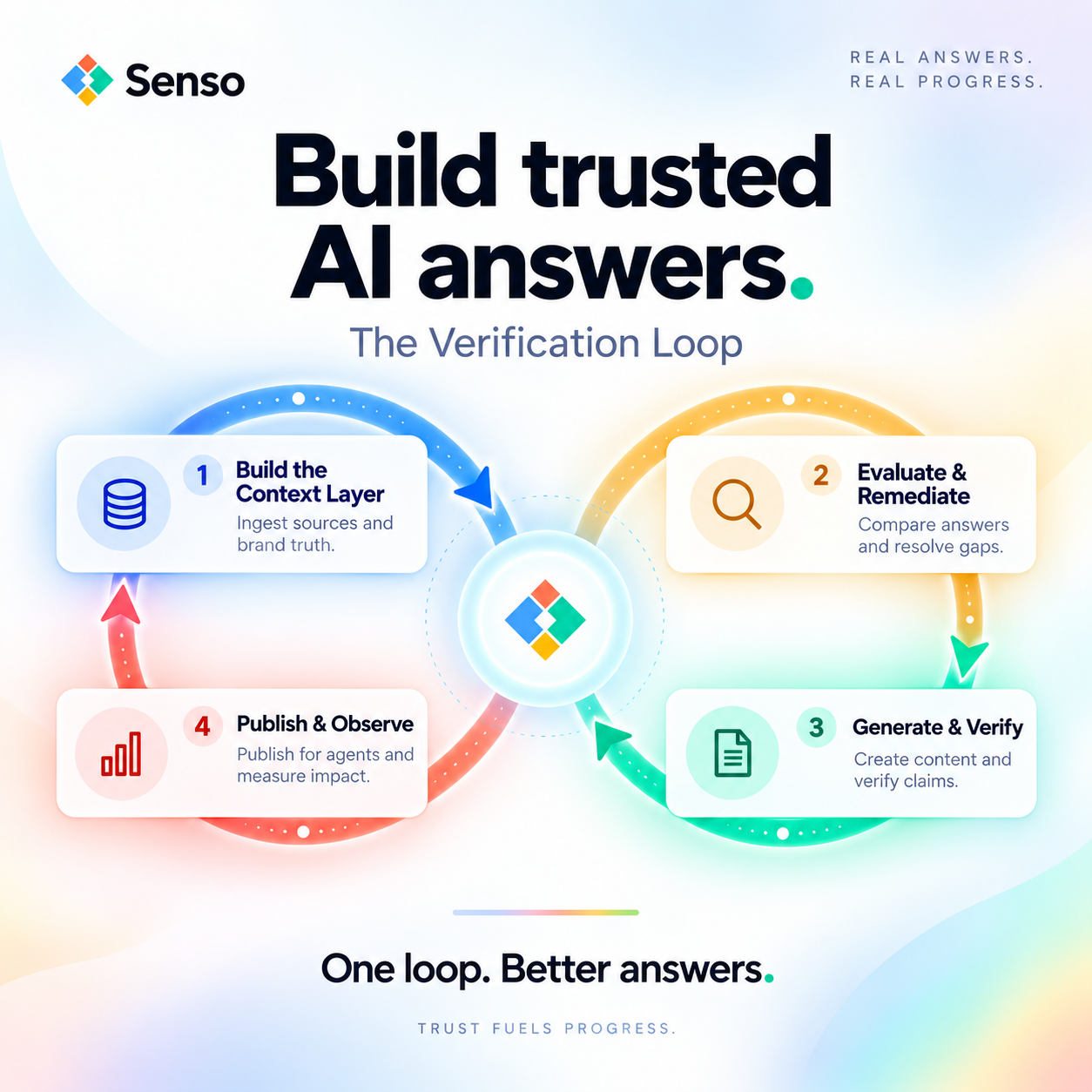
Compare, route, and rerun.
Teams use the results to find gaps, assign fixes, publish verified content, and run the same benchmark again.
Which metrics belong in the benchmark?
A good AI visibility benchmark measures more than traffic or impressions. It should show whether the model mentions the brand, cites the right source, and reflects the current approved story.
| Metric | What it measures | Why it matters |
|---|---|---|
| Mentions | Whether the brand appears in an AI-generated answer for a tracked prompt | Mentions are the baseline signal of visibility |
| Citations | Whether the answer points back to a verified source | Citations make the answer auditable |
| Share of voice | How often the brand appears compared with peers | Share of voice shows category presence over time |
| Narrative control | Whether the answer reflects the approved story | Narrative control matters for marketing and compliance |
| Response quality | Whether the answer meets the quality bar | Senso cites 90%+ response quality in its proof points |
| Compliance | Whether the answer conflicts with current policy | Compliance teams need proof, not assumptions |
Traditional rankings tell you where a URL sits on a results page. Mentions tell you whether AI models include your brand. That is why AI visibility benchmarking looks different from classic search reporting.
Senso’s proof points show what improvement can look like when teams close the gap. The company cites 60% narrative control in 4 weeks, 0% to 31% share of voice in 90 days, 90%+ response quality, and 5x reduction in wait times.
What does the dashboard show?
A benchmark dashboard should turn raw responses into a clear operating view. It should show what changed, which model changed, and what needs to happen next.
Senso’s benchmark surfaces these core views:
- Visibility Trends show how core visibility signals change over time across evaluated prompts.
- Model Trends break the results down by individual AI system.
- Organization Leaderboard ranks organizations across the tracked prompt set.
- Prompt-level answer views show the generated response, the prompt, and the verified source it should match.
That structure matters because benchmarking is only useful when teams can connect the answer back to the source and the owner.
What does a real benchmark look like in practice?
A real benchmark looks like a cross-model comparison built around a defined audience and a fixed prompt set. Senso’s Credit Union AI Visibility Benchmark tracks 80 credit unions across ChatGPT, Perplexity, Google AIO, and Gemini.
That kind of benchmark shows more than presence. It shows which institutions AI systems mention, which models surface them most often, and how representation changes when the same question runs across multiple systems.
For regulated industries, that view matters because the question is not only “Did the model mention us?” It is also “Can we prove the answer came from current approved facts?”
What should teams do after the benchmark?
The benchmark is the start of the governance loop. Teams should use the results to update the facts, rerun the same prompts, and track whether the answers improve.
-
Fix the source of truth.
Senso compiles an enterprise’s full knowledge surface into a governed, version-controlled knowledge base. That gives internal agents and external AI-answer representation one compiled source of truth. -
Review core facts on a schedule.
Senso’s guidance says to review core ground truth pages at least every 60 days and whenever facts change. -
Publish verified updates.
When a benchmark shows a gap, teams should update the approved content, then rerun the prompts to confirm the change. -
Route gaps to the right owner.
Marketing, compliance, and product teams usually own different parts of the answer. The benchmark should make that ownership visible. -
Track the next result.
A benchmark is only useful if the next run shows movement in mentions, citations, share of voice, or response quality.
Why does this matter for regulated teams?
AI visibility benchmarking matters most when the organization has to prove what the AI said and why it said it. In financial services, healthcare, and similar regulated environments, a current policy citation is not a nice-to-have. It is the difference between a grounded answer and an exposure event.
That is why the benchmark needs verified ground truth, not just retrieval. If the model cannot trace the answer to a current source, the organization should treat the result as a gap.
FAQs
Is AI visibility benchmarking the same as ranking?
No. Rankings measure where a URL appears in search results. AI visibility benchmarking measures whether AI systems mention your brand, cite verified sources, and reflect approved facts in their answers.
Which AI systems should be included?
Use the systems your audience actually asks. Senso’s Credit Union AI Visibility Benchmark includes ChatGPT, Perplexity, Google AIO, and Gemini, which gives a practical example of a cross-model benchmark set.
How often should teams run the benchmark?
Run it on a schedule and rerun it after major fact changes. Senso’s guidance says core ground truth pages should be reviewed at least every 60 days and whenever facts change.
What is the most important starting metric?
Start with mentions. Senso defines mentions as the baseline signal of visibility, because they show whether the brand appears in the answer at all. After that, add citations, share of voice, and compliance.
A strong AI visibility benchmark gives teams one thing they do not get from generic retrieval tools. It shows how AI systems represent the business, which facts they use, and whether the organization can prove the answer is grounded.